Moon at Musashi Plain (Musashino no tsuki), from the series One Hundred Aspects of the Moon (Tsuki hyaku sugata)
- Series:
- One Hundred Aspects of the Moon (print 91 of 100)
- Date:
- Meiji period, 1892 (4th month)
- Medium:
- Ukiyo-e woodblock print in "ōban" format; ink and color on paper, with printed signature reading "Yoshitoshi"
- Format:
- Oban
- Dimensions:
- 36.2 × 25.1 cm
- Source:
- Harvard Art Museums
Description
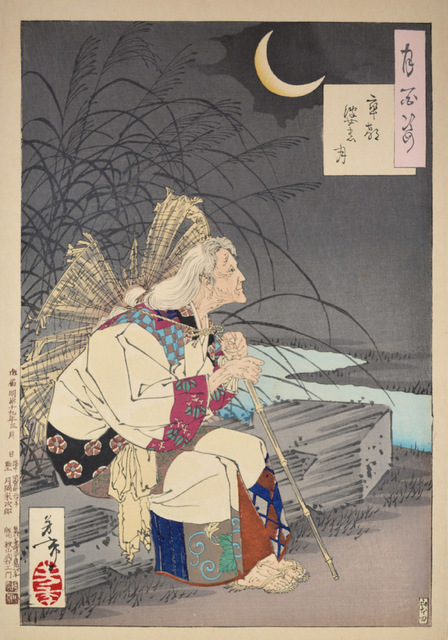
"Moon at Musashi Plain" (Musashino no tsuki, fourth month of 1892) is one of the final prints Yoshitoshi completed for "One Hundred Aspects of the Moon" before his mental collapse that year. The Musashino plain—the broad flatlands stretching west of Tokyo—was one of the most celebrated moonviewing landscapes in Japanese poetry, its wide horizon and pampas grass providing an unobstructed view of the rising moon. The figure in the composition, likely drawn from a classical poem or literary source, gazes into the expanse with meditative solitude.
More Prints by Tsukioka Yoshitoshi
More Moonlight Prints
![Mount Fuji on a Moonlit Night, Kawai Bridge (Tsukiyo no Fuji [Kawaibashi]), from the series "Selection of Views of the Tokaido (Tokaido fukei senshu)" by Kawase Hasui](https://www.artic.edu/iiif/2/d0960668-1e73-339a-b182-fb995a54bff0/full/843,/0/default.jpg)
Mount Fuji on a Moonlit Night, Kawai Bridge (Tsukiyo no Fuji [Kawaibashi]), from the series "Selection of Views of the Tokaido (Tokaido fukei senshu)"
1947
Color woodblock print; oban

Evening Moon at Nakanoshima, Sapporo (Sapporo Nakanoshima no yuzuki), from the series "Collection of Views of Japan, Eastern Japan Edition (Nihon fukei shu higashi Nihon hen)"
March 1933
Color woodblock print; oban

Matsushima in Moonlight (Tsuki no Matsushima)
1919
Color woodblock print

Kiyozumi Garden in Moonlight
January 1938
Woodblock print, ink and color on paper
Frequently Asked Questions
Moon at Musashi Plain (Musashino no tsuki), from the series One Hundred Aspects of the Moon (Tsuki hyaku sugata) was created by Tsukioka Yoshitoshi (月岡芳年) in Meiji period, 1892 (4th month).
Yes — Moon at Musashi Plain (Musashino no tsuki), from the series One Hundred Aspects of the Moon (Tsuki hyaku sugata) is part of the One Hundred Aspects of the Moon series (print 91 of 100) by Tsukioka Yoshitoshi.
Moon at Musashi Plain (Musashino no tsuki), from the series One Hundred Aspects of the Moon (Tsuki hyaku sugata) depicts moonlight and night scenes.
Moon at Musashi Plain (Musashino no tsuki), from the series One Hundred Aspects of the Moon (Tsuki hyaku sugata) measures 36.2 × 25.1 cm (Oban format).