
Story Of the priest Nittô
- Medium:
- Mokuhanga (Japanese woodblock)
- Image courtesy of
- Saru Gallery
Description
This print depicts the Buddhist priest Nittō, drawn from a hagiographic episode of his religious life. The image belongs to Yoshitoshi's didactic late-Meiji production, in which moral exemplars — Buddhist masters, loyal retainers, virtuous figures from Japanese and world history — provided edifying subject matter for an audience navigating rapid Westernization. Compositionally, prints of this type isolate the central figure against a sparingly described setting, focusing attention on gesture, expression, and religious attribute. Yoshitoshi's late religious figures show his interest in psychological introspection: the inwardness of meditation rendered through controlled posture and downcast gaze. The mokuhanga technique allowed delicate gradations of sumi ink to model robe folds, while restrained colour blocks — often pale browns and indigos — preserve the contemplative tone. Compared with the supernatural drama of his ghost series, these religious subjects reveal a quieter Yoshitoshi attentive to moral seriousness. The print stands within his broader effort, in the final decade of his career, to anchor the ukiyo-e narrative tradition to subjects that would carry weight as the woodblock market declined under competition from photography and lithography.
More Prints by Tsukioka Yoshitoshi
More Religious Prints

The Great Buddha, Kamakura (Kamakura Daibutsu)
Kamakura Daibutsu
1930
Color woodblock print

Hall of the Great Buddha (Nara Daibutsuden)
1950
Color woodblock print
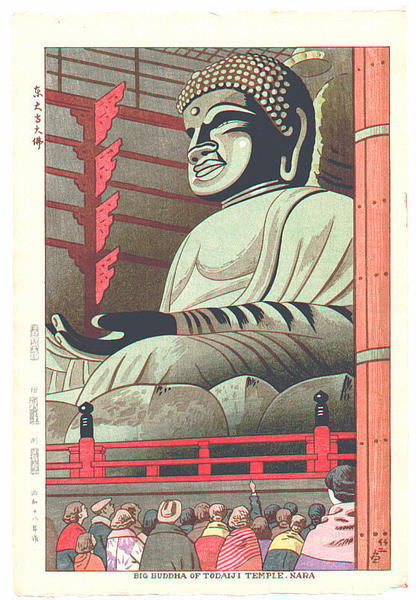
Great Buddha
大仏
Woodblock print

Clearing after a Snowfall at the Kannon Temple in Asakusa (Asakusa Kannon no yukibare), from the series "Twenty Views of Tokyo (Tokyo nijukkei)"
1926
Color woodblock print; oban
Frequently Asked Questions
Story Of the priest Nittô was created by Tsukioka Yoshitoshi (月岡芳年).
Story Of the priest Nittô depicts religious.