
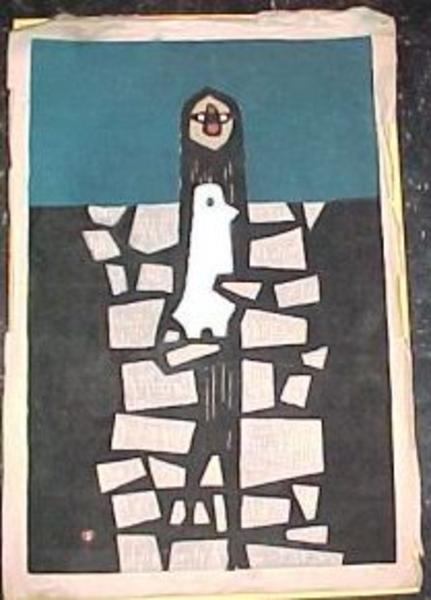
Mud House (Doro no ie), from the series "Manchuria (Manshu)"
- Series:
- Manchuria (Manshu)
- Date:
- 1944 (printed c. 1950 from recut block?)
- Medium:
- Color woodblock print; oban
- Format:
- Oban
- Edition:
- Self-printed
- Source:
- Art Institute of Chicago
Description
The 1945 Mud House from the Manchuria series depicts the vernacular building type of the occupied territories—the packed-earth construction that characterized rural architecture across Manchuria, its thick walls and flat roof adapted to the continental climate's extreme winters and dry summers. Azechi's Manchurian prints documented a radically different built environment from the wooden mountain architecture of Japan, his bold simplified style finding in the earthen walls' massive geometry a different but equally compelling formal subject.
More Prints by Umetaro Azechi

![Untitled [portrait of a boy] by Umetaro Azechi](https://1.api.artsmia.org/800/136025.jpg)
More Landscapes Prints

Lake Kugushi in Wakasa Province (Wakasa Kugushiko), from the series Souvenirs of Travel I (Tabi miyage dai isshu)"
Wakasa Kugushiko
1920
Color woodblock print; oban
Autumn Maple Leaves at Takao, from the album Eight Views of Kyoto (Kyôto hakkei)
Woodblock print

The Beach at Kaiganji in Sanuki Province (Sanuki Kaiganji no hama), from the series "Collection of Views of Japan II, Kansai Edition (Nihon fukei shu II Kansai hen)"
1934
Color woodblock print; oban

Tea Kettle, section of a sheet from the series "Mirror of Stone Rubbings of Views of the Provinces" (Kohon meihitsu ishizuri kagami)
n.d.
Woodblock print; ishizuri-e, section of harimaze sheet
Featured in Collections
Curated cross-cuts that include this print.
Frequently Asked Questions
Mud House (Doro no ie), from the series "Manchuria (Manshu)" was created by Umetaro Azechi (畦地梅太郎) in 1944 (printed c. 1950 from recut block?).
Yes — Mud House (Doro no ie), from the series "Manchuria (Manshu)" is part of the Manchuria (Manshu) series by Umetaro Azechi.
Mud House (Doro no ie), from the series "Manchuria (Manshu)" depicts landscapes, architecture, and village scenes.