
Three-tiered pagoda
- Medium:
- Mokuhanga (Japanese woodblock)
- Image courtesy of
- Saru Gallery
Description
Three-tiered pagoda addresses one of Hiratsuka's recurring subjects: the wooden architecture of Japanese Buddhist temples. The sanjū-no-tō, or three-storied pagoda, is found at numerous temple complexes across Japan, with notable examples at Kōfuku-ji, Yakushi-ji, and Hokki-ji. Hiratsuka's approach to such structures emphasizes their tectonic logic—the bracketing systems, tiled eaves, and tapering proportions translated into a hierarchy of black planes and white intervals. The vertical orientation typical of pagoda subjects suits the planar carving style he developed, where structural members read as crisp lines against the pale washi. Hiratsuka treated temple architecture not as scenic backdrop but as autonomous form, a position he held across hundreds of related prints documenting pagodas, halls, and gates throughout his career. The monochrome approach carries an argument: by stripping color from a subject conventionally rendered in nishiki-e polychrome, he forces attention onto the carpentry itself, the relationship of post to beam, eave to story. This pictorial argument runs throughout the temple work that anchors his contribution to sōsaku-hanga.
More Prints by Hiratsuka Un'ichi


More Temples & Shrines Prints
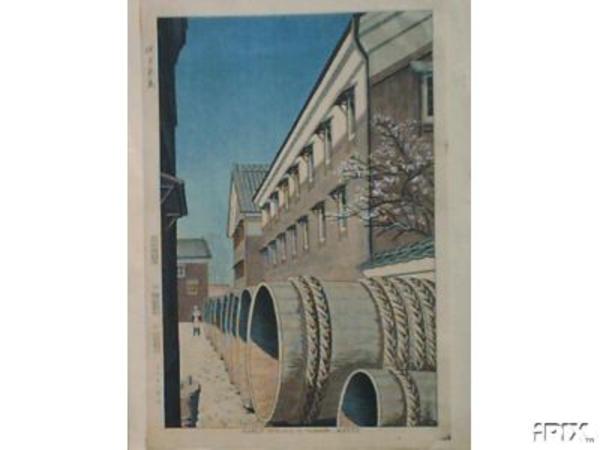
Fushimi Inari Temple
伏見稲荷
Woodblock print

The Compound of the Tenman Shrine at Kameido in the Snow (Kameido Tenmangu keidai no yuki), from the series "Famous Places in the Eastern Capital (Toto meisho)"
c. 1832/38
Color woodblock print; oban
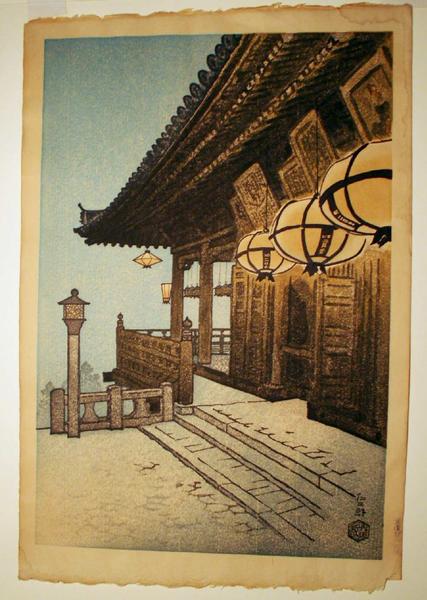
Temple with lanterns
Woodblock print

A Section of the Byodo Temple at Uji (Uji Byodoin no ichibu), from the series "Souvenirs of Travel, Second Series (Tabi miyage dai nishu)"
Uji Byodoin no ichibu
1921
Color woodblock print; oban
Featured in Collections
Curated cross-cuts that include this print.
Frequently Asked Questions
Three-tiered pagoda was created by Hiratsuka Un'ichi (平塚運一).
Three-tiered pagoda depicts temples & shrines and pagodas.