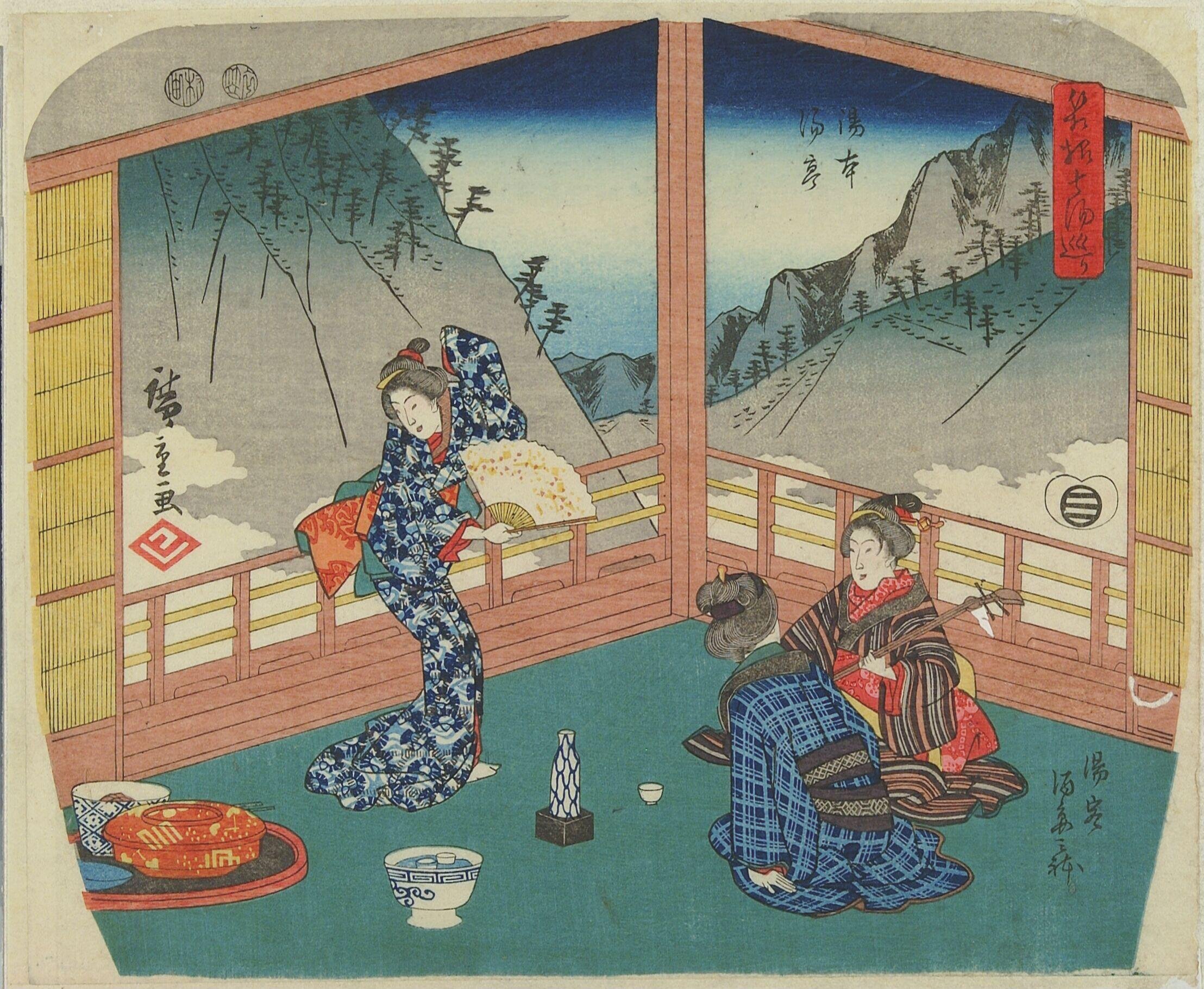
A Hot Spring Inn at Yumoto
- Date:
- 1851
- Medium:
- Source:
- Victoria and Albert Museum
Description
A Hot Spring Inn at Yumoto, dated 1851 and preserved in the Victoria and Albert Museum, is a genre-tinged Edo ukiyo-e landscape print by Utagawa Hiroshige set in one of the most famous hot-spring villages on the Tōkaidō. Yumoto, at the foot of the Hakone pass in present-day Kanagawa Prefecture, had long been a destination for both road-weary travelers and pleasure-seeking Edoites, and its setting in a wooded valley along the Hayakawa River made it a natural subject for landscape designers. The print presents a multi-storey inn nestled against a steep slope, its open verandahs filled with bathers, attendants, and guests in casual yukata; the river flows past the foreground over rocks, and forested hills close in behind, narrowing the composition into a deep, sheltered pocket of greenery. As elsewhere in his work, Hiroshige integrates topographic specificity with the conventions of fūzoku (manners) illustration, so the design records both a recognizable place and a way of life. The colorist's choices—saturated greens for foliage, blue-grey for moving water, and warmer browns for the timbered inn—give the scene a fresh, slightly damp atmosphere appropriate to the mountain valley. As a landscape print of the early 1850s, the work shows Hiroshige continuing to refine his treatment of the Hakone region that had figured so prominently in his earlier Tōkaidō series, here at a more intimate scale.
More Prints by Utagawa Hiroshige


More Landscapes Prints

Lake Kugushi in Wakasa Province (Wakasa Kugushiko), from the series Souvenirs of Travel I (Tabi miyage dai isshu)"
Wakasa Kugushiko
1920
Color woodblock print; oban
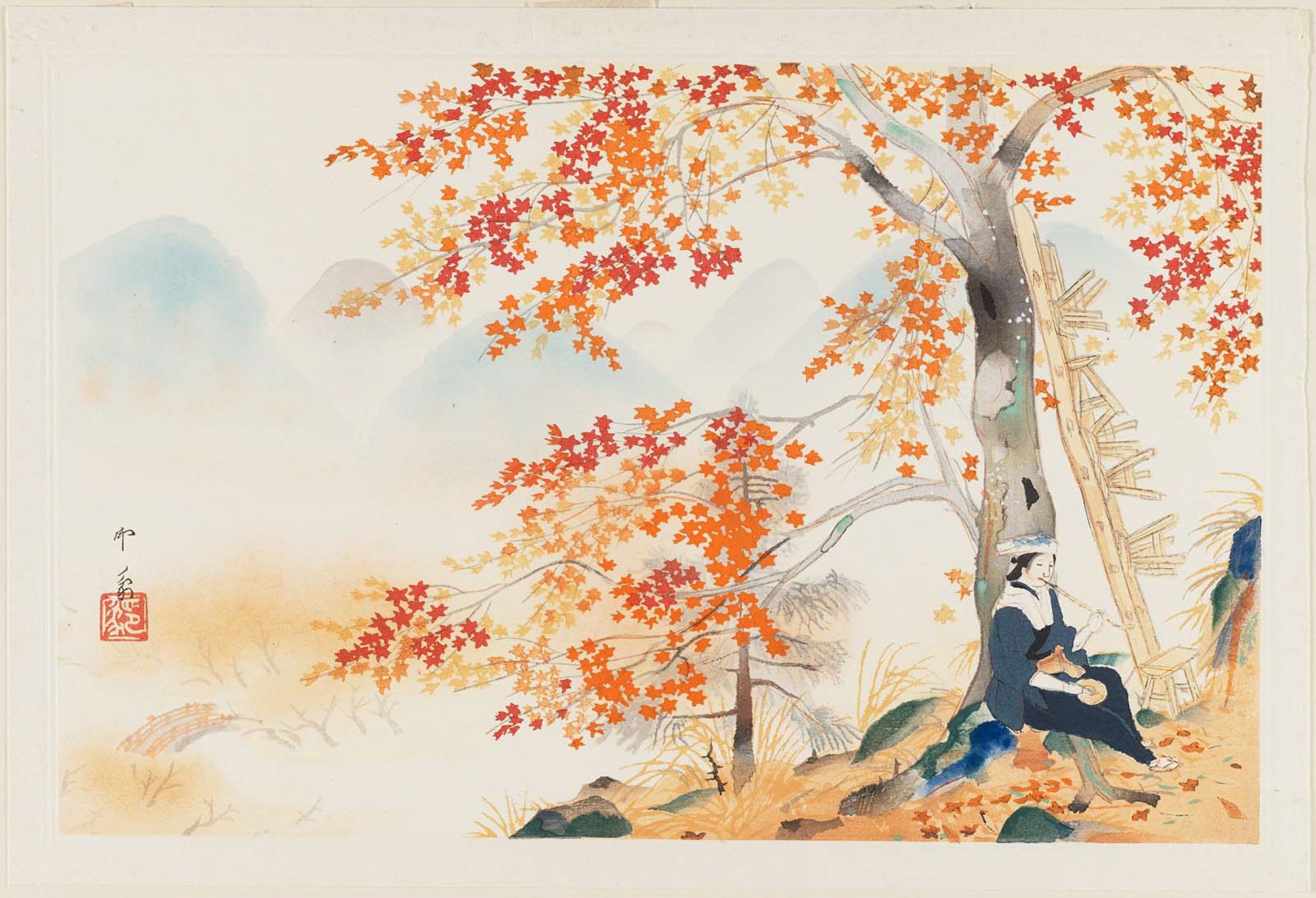
Autumn Maple Leaves at Takao, from the album Eight Views of Kyoto (Kyôto hakkei)
Woodblock print

The Beach at Kaiganji in Sanuki Province (Sanuki Kaiganji no hama), from the series "Collection of Views of Japan II, Kansai Edition (Nihon fukei shu II Kansai hen)"
1934
Color woodblock print; oban

Tea Kettle, section of a sheet from the series "Mirror of Stone Rubbings of Views of the Provinces" (Kohon meihitsu ishizuri kagami)
n.d.
Woodblock print; ishizuri-e, section of harimaze sheet
Featured in Collections
Curated cross-cuts that include this print.
Frequently Asked Questions
A Hot Spring Inn at Yumoto was created by Utagawa Hiroshige (歌川広重) in 1851.
A Hot Spring Inn at Yumoto depicts landscapes and spring.