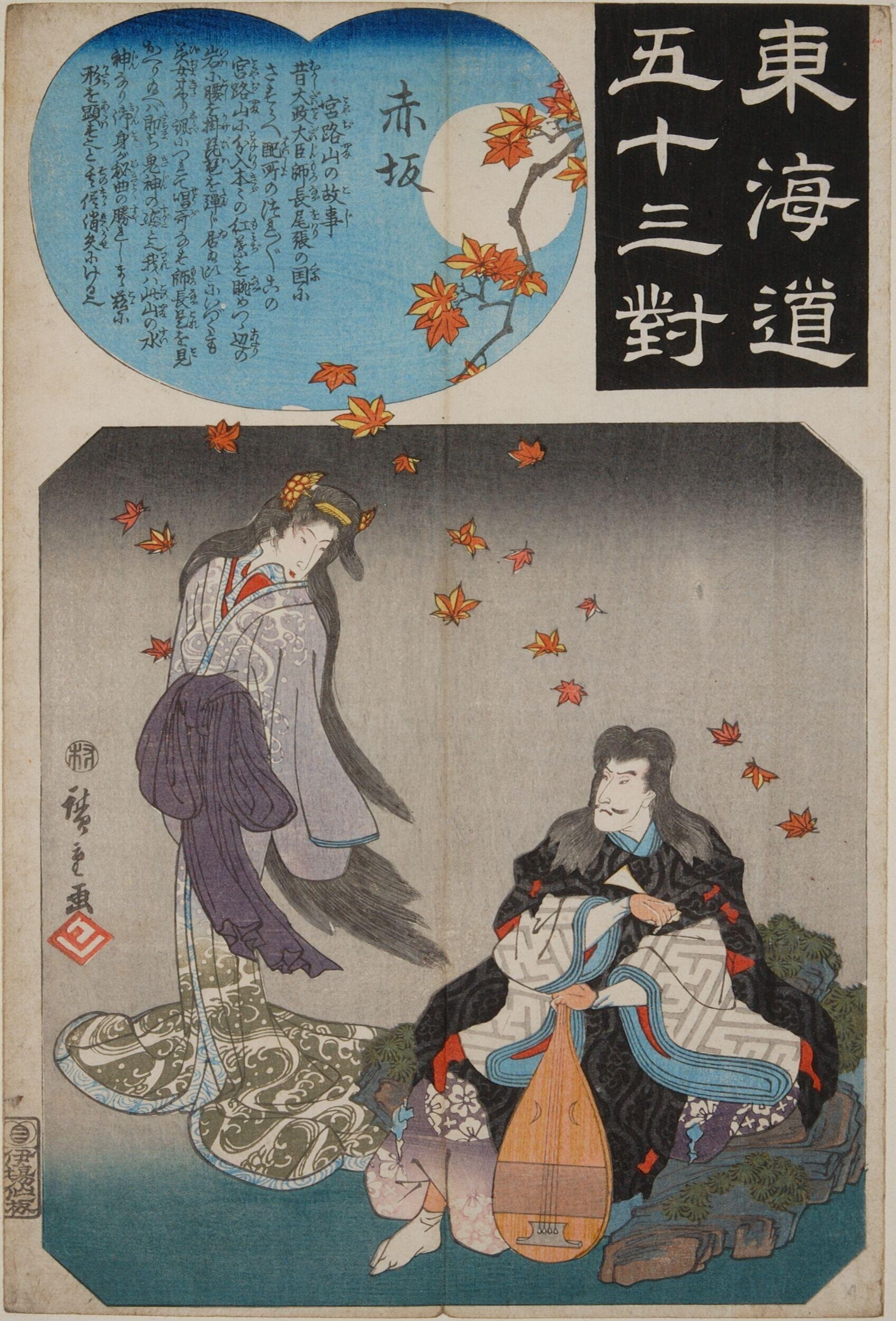
Akasaka: The Story of Miyajiyama (Miyajiyama no koji)
- Medium:
- Source:
- Victoria and Albert Museum
Description
A ghostly woman with long, flowing black hair and elaborate hair ornaments hovers on the left, her pale lavender and gray robes trailing off into wisps rather than resting on the ground; her figure is faintly transparent against the gray night sky. Below her, a seated man in a black outer robe with a maze-patterned white under-robe grips a biwa (lute) propped against the rocks, his head turned back to look at her with a startled expression. Red maple leaves drift through the air between them, and above the scene a fan-shaped inset on blue ground shows a full moon behind a maple branch alongside columns of Japanese text; the artist's signature and seal appear at left. Utagawa Hiroshige, "Akasaka: The Story of Miyajiyama (Miyajiyama no koji)," print, year unknown.
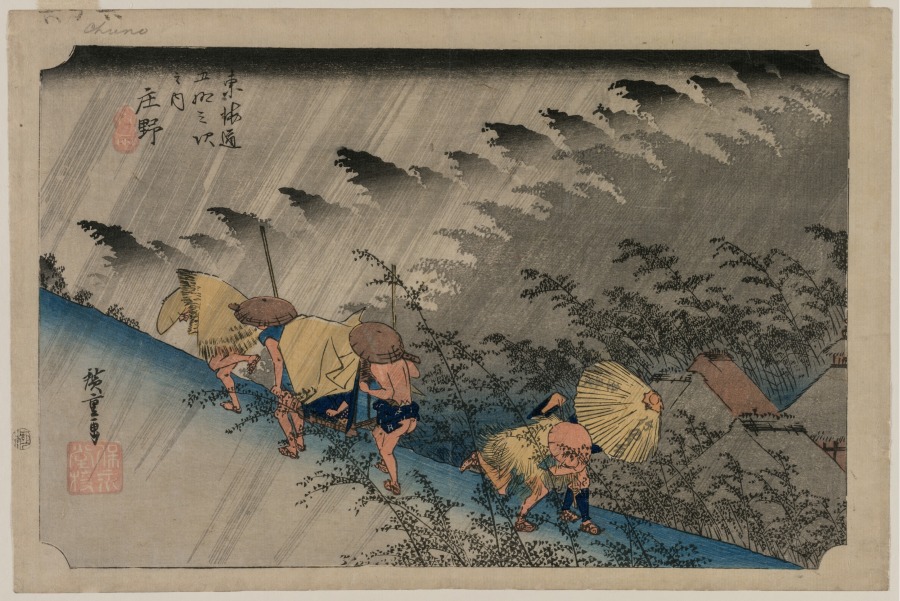
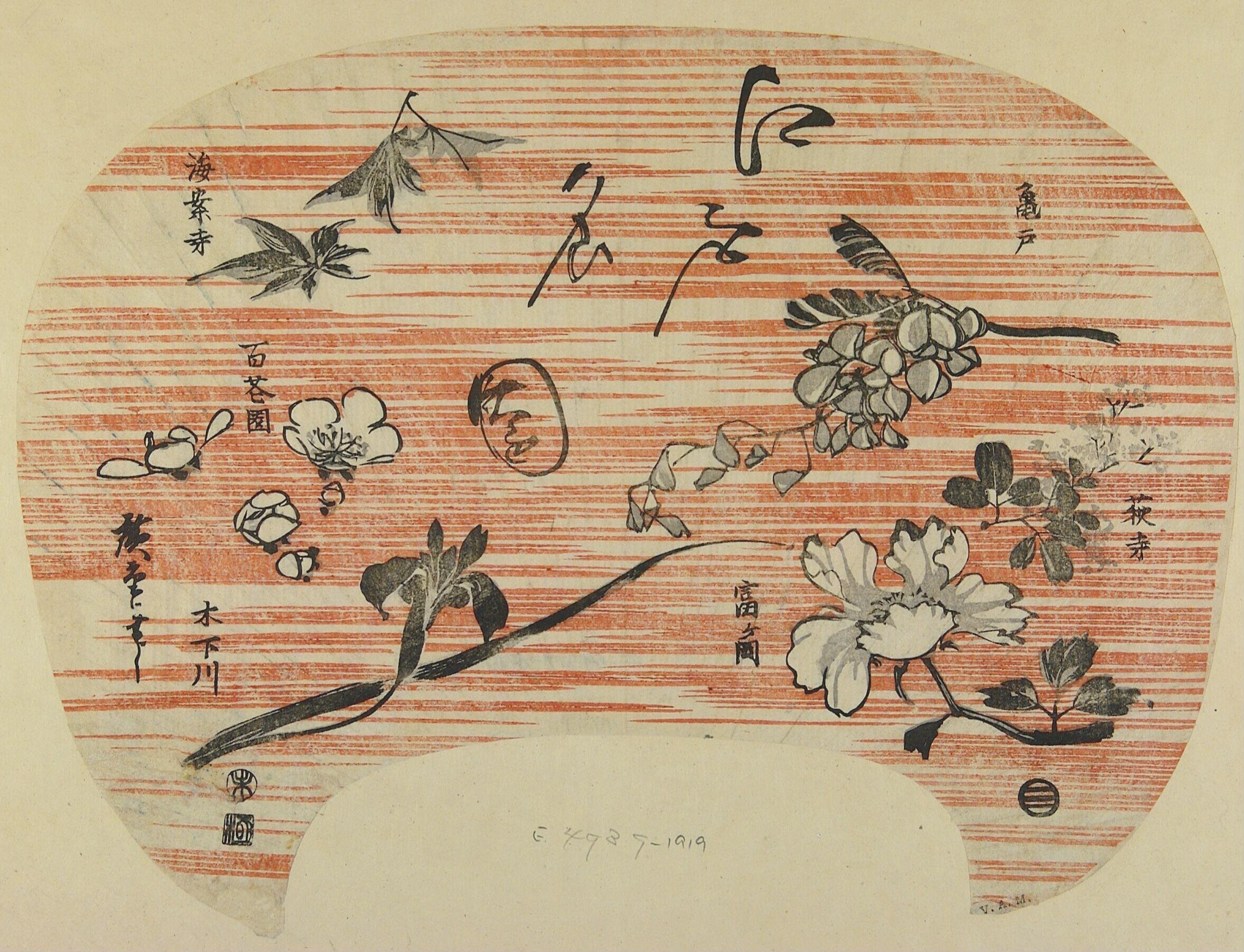
More Prints by Utagawa Hiroshige


More Landscapes Prints

Lake Kugushi in Wakasa Province (Wakasa Kugushiko), from the series Souvenirs of Travel I (Tabi miyage dai isshu)"
Wakasa Kugushiko
1920
Color woodblock print; oban
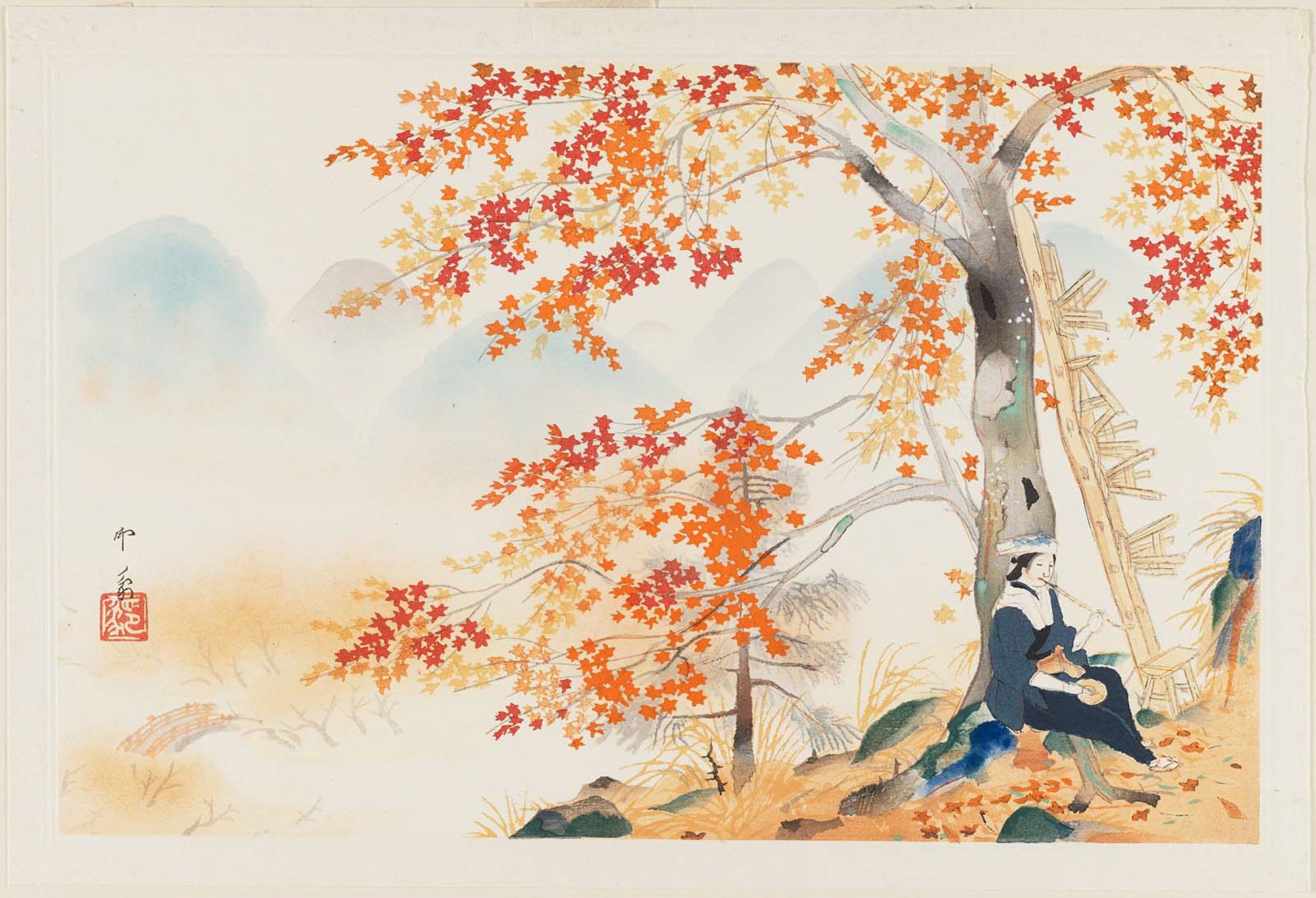
Autumn Maple Leaves at Takao, from the album Eight Views of Kyoto (Kyôto hakkei)
Woodblock print

The Beach at Kaiganji in Sanuki Province (Sanuki Kaiganji no hama), from the series "Collection of Views of Japan II, Kansai Edition (Nihon fukei shu II Kansai hen)"
1934
Color woodblock print; oban

Tea Kettle, section of a sheet from the series "Mirror of Stone Rubbings of Views of the Provinces" (Kohon meihitsu ishizuri kagami)
n.d.
Woodblock print; ishizuri-e, section of harimaze sheet
Featured in Collections
Curated cross-cuts that include this print.
Frequently Asked Questions
Akasaka: The Story of Miyajiyama (Miyajiyama no koji) was created by Utagawa Hiroshige (歌川広重).
Akasaka: The Story of Miyajiyama (Miyajiyama no koji) depicts landscapes.