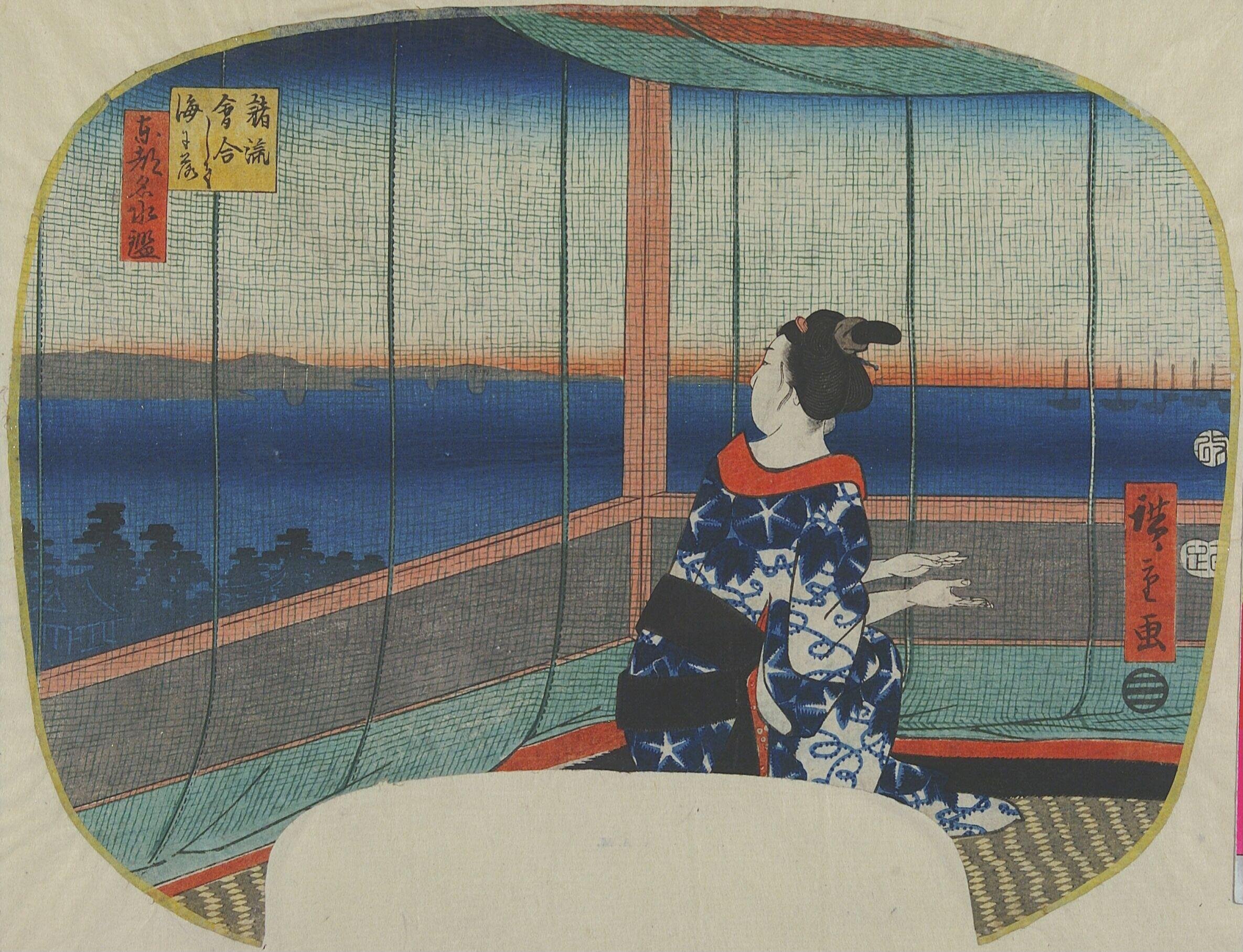
All Rivers Converge and Flow into the Sea
- Date:
- 1857
- Medium:
- Source:
- Victoria and Albert Museum
Description
All Rivers Converge and Flow into the Sea is a landscape print by Utagawa Hiroshige made around 1857, with this impression held in the Victoria and Albert Museum. The composition gathers the visual idea of many rivers meeting the ocean into a single image, with broad bands of water, distant shipping, and a low strip of land at the horizon. Hiroshige's mature manner depends on tonal mastery rather than incident: variations of blue, layered through bokashi gradient printing, render both the rivers and the sea beyond. As a piece of Edo ukiyo-e, the design responds to the long-standing interest in symbolic geography that runs through Japanese painting and printmaking, where named places stand in for larger ideas about flow, exchange, and the unity of a land segmented by mountains. The composition also draws on Hiroshige's deep familiarity with Edo Bay and the mouths of the Sumida and Tama rivers, which he had depicted from many vantage points throughout his career. By emphasizing the convergence of waters rather than a specific celebrated location, the print quietly broadens the landscape print beyond meisho-e into something closer to allegory. The Victoria and Albert Museum impression preserves the controlled palette and clean registration of distant sails that good early states retain. Within Hiroshige's late output it is a reminder that, alongside his record of fifty-three Tokaido stations and one hundred famous views of Edo, he continued to explore more contemplative subjects in which the landscape itself, rather than its travelers, takes the leading role. The print remains a quietly impressive example of late Edo period landscape ukiyo-e at its most distilled.
More Prints by Utagawa Hiroshige


More Landscapes Prints

Lake Kugushi in Wakasa Province (Wakasa Kugushiko), from the series Souvenirs of Travel I (Tabi miyage dai isshu)"
Wakasa Kugushiko
1920
Color woodblock print; oban
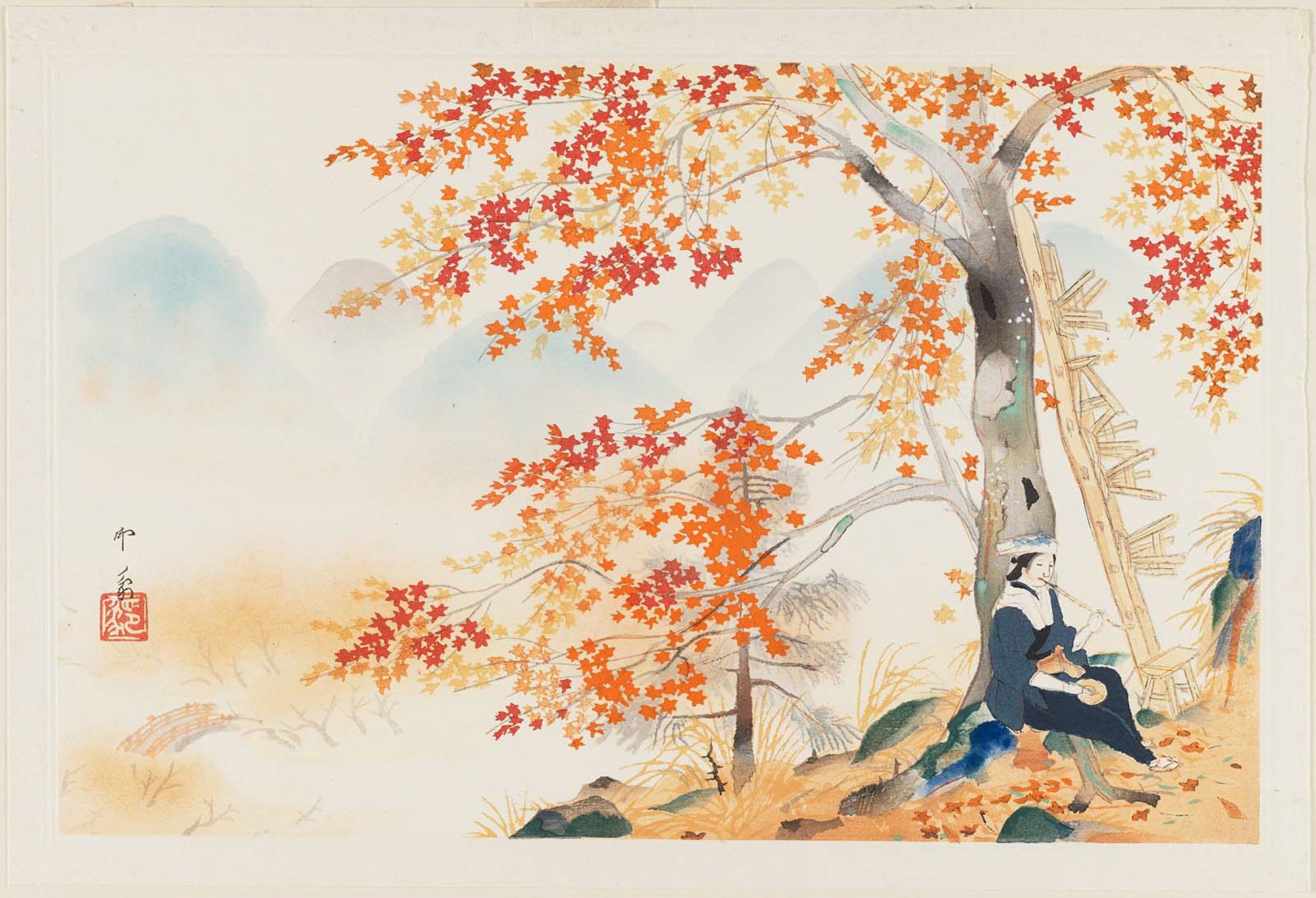
Autumn Maple Leaves at Takao, from the album Eight Views of Kyoto (Kyôto hakkei)
Woodblock print

The Beach at Kaiganji in Sanuki Province (Sanuki Kaiganji no hama), from the series "Collection of Views of Japan II, Kansai Edition (Nihon fukei shu II Kansai hen)"
1934
Color woodblock print; oban

Tea Kettle, section of a sheet from the series "Mirror of Stone Rubbings of Views of the Provinces" (Kohon meihitsu ishizuri kagami)
n.d.
Woodblock print; ishizuri-e, section of harimaze sheet
Featured in Collections
Curated cross-cuts that include this print.
Frequently Asked Questions
All Rivers Converge and Flow into the Sea was created by Utagawa Hiroshige (歌川広重) in 1857.
All Rivers Converge and Flow into the Sea depicts landscapes.