
Amanohashidate, from the series "Famous Places of Japan (Honcho meisho)"
- Date:
- c. 1837/39
- Medium:
- Color woodblock print; oban
- Source:
- Art Institute of Chicago
Description
Amanohashidate, from the series "Famous Places of Japan (Honcho meisho)," is an early-1830s woodblock print by Utagawa Hiroshige treating one of the three classical scenic views of Japan: the long pine-clad sandbar that stretches across the bay at Miyazu in Tango Province (modern Kyoto Prefecture). Amanohashidate, whose name translates as "bridge of heaven," had been celebrated in poetry, painting, and pilgrimage literature for centuries, and its inclusion in any survey of Japan's meisho was effectively required. Hiroshige's design uses the natural geometry of the place: a thin spine of pines runs across the composition, the bay opens out on either side, and distant mountains close the horizon. The artist subtly suggests the famous viewing convention, in which visitors bend over and look at the sandbar between their legs so that it appears to hang in the sky, by simplifying the foreground into a graceful curve and treating the water with the soft, almost ethereal bokashi gradations that define his most lyrical landscape print work. This impression is held in the collection of the Art Institute of Chicago. As part of Famous Places of Japan, the print situates Hiroshige's Edo ukiyo-e practice within a national imagination: not just the road from Edo to Kyoto, not just the city itself, but a wider archipelago of canonical views that woodblock prints helped to consolidate and disseminate to a broad nineteenth-century public.
More Prints by Utagawa Hiroshige


More Landscapes Prints

Lake Kugushi in Wakasa Province (Wakasa Kugushiko), from the series Souvenirs of Travel I (Tabi miyage dai isshu)"
Wakasa Kugushiko
1920
Color woodblock print; oban
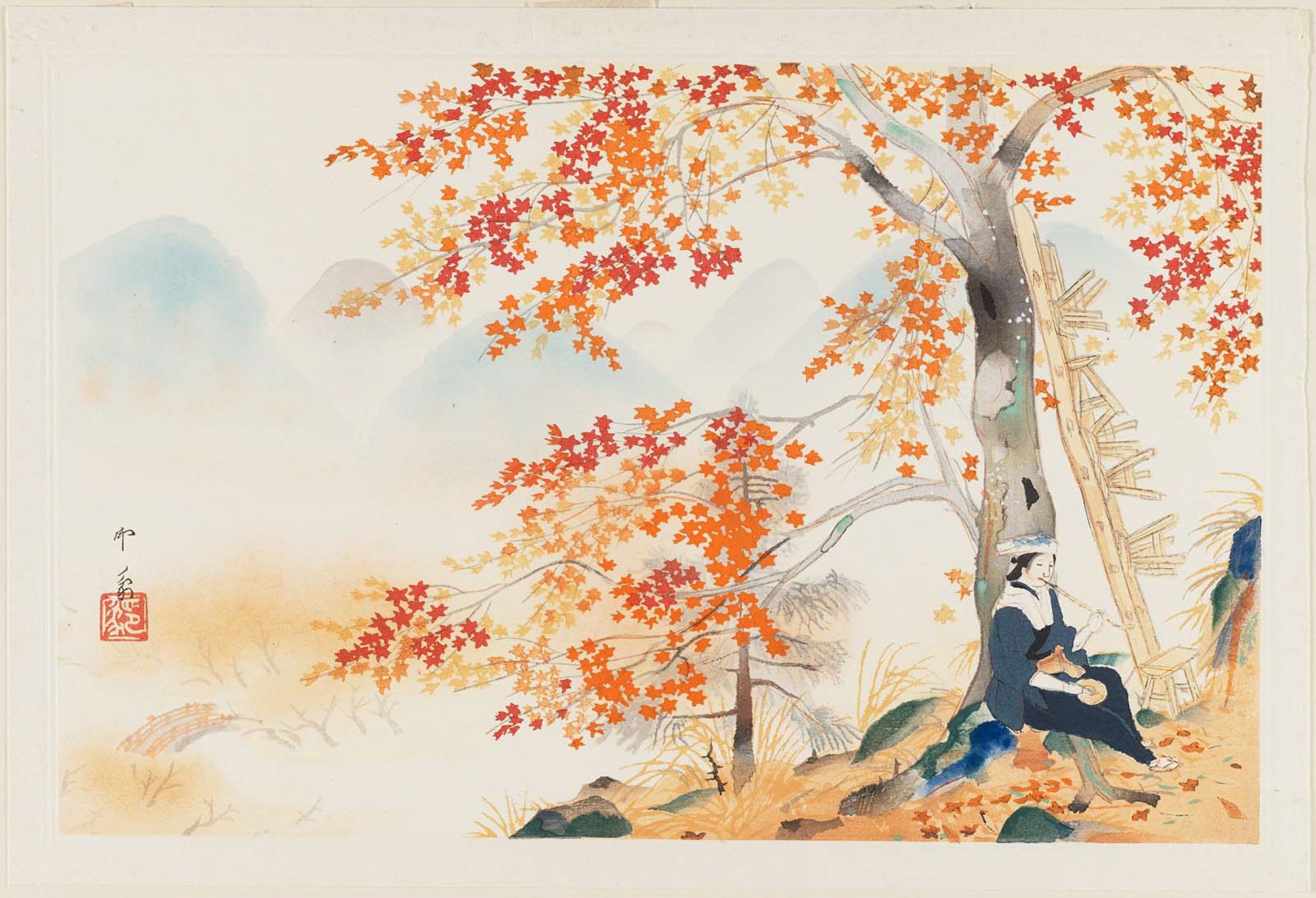
Autumn Maple Leaves at Takao, from the album Eight Views of Kyoto (Kyôto hakkei)
Woodblock print

The Beach at Kaiganji in Sanuki Province (Sanuki Kaiganji no hama), from the series "Collection of Views of Japan II, Kansai Edition (Nihon fukei shu II Kansai hen)"
1934
Color woodblock print; oban

Tea Kettle, section of a sheet from the series "Mirror of Stone Rubbings of Views of the Provinces" (Kohon meihitsu ishizuri kagami)
n.d.
Woodblock print; ishizuri-e, section of harimaze sheet
Featured in Collections
Curated cross-cuts that include this print.
Frequently Asked Questions
Amanohashidate, from the series "Famous Places of Japan (Honcho meisho)" was created by Utagawa Hiroshige (歌川広重) in c. 1837/39.
Amanohashidate, from the series "Famous Places of Japan (Honcho meisho)" depicts landscapes.