
America (Amerika)
- Date:
- 1860
- Medium:
- Color woodblock print; oban
- Source:
- Art Institute of Chicago
Description
America (Amerika), issued in 1860, is one of the so-called Yokohama-e prints that flourished briefly after the opening of Yokohama to foreign trade in 1859. Although traditionally attributed to Utagawa Hiroshige, the design likely emerged from the studio of his successor Hiroshige II, who carried the master's signature for some years after the artist's death in 1858; works in this corner of the Edo ukiyo-e tradition are often cataloged under the Hiroshige name. The composition presents an imagined American scene drawn from secondhand prints and reports: westerners in formal coats and bonnets, a steamship and rigged sailing vessels in the harbor, gabled buildings rendered in a half-understood foreign architectural vocabulary, and a horizontal sky written across in a manner unlike any Japanese landscape print convention. Far from a documentary record, the sheet is a fascinating index of how late Edo Japan visualized the foreign world it was being forced to admit, mixing curiosity and caricature in equal measure. The work belongs to the museum's holdings of mid-nineteenth-century Japanese prints at the Art Institute of Chicago, where it documents the moment that the closed Edo system began to give way to the new international order of the Meiji era.
More Prints by Utagawa Hiroshige


More Landscapes Prints

Lake Kugushi in Wakasa Province (Wakasa Kugushiko), from the series Souvenirs of Travel I (Tabi miyage dai isshu)"
Wakasa Kugushiko
1920
Color woodblock print; oban
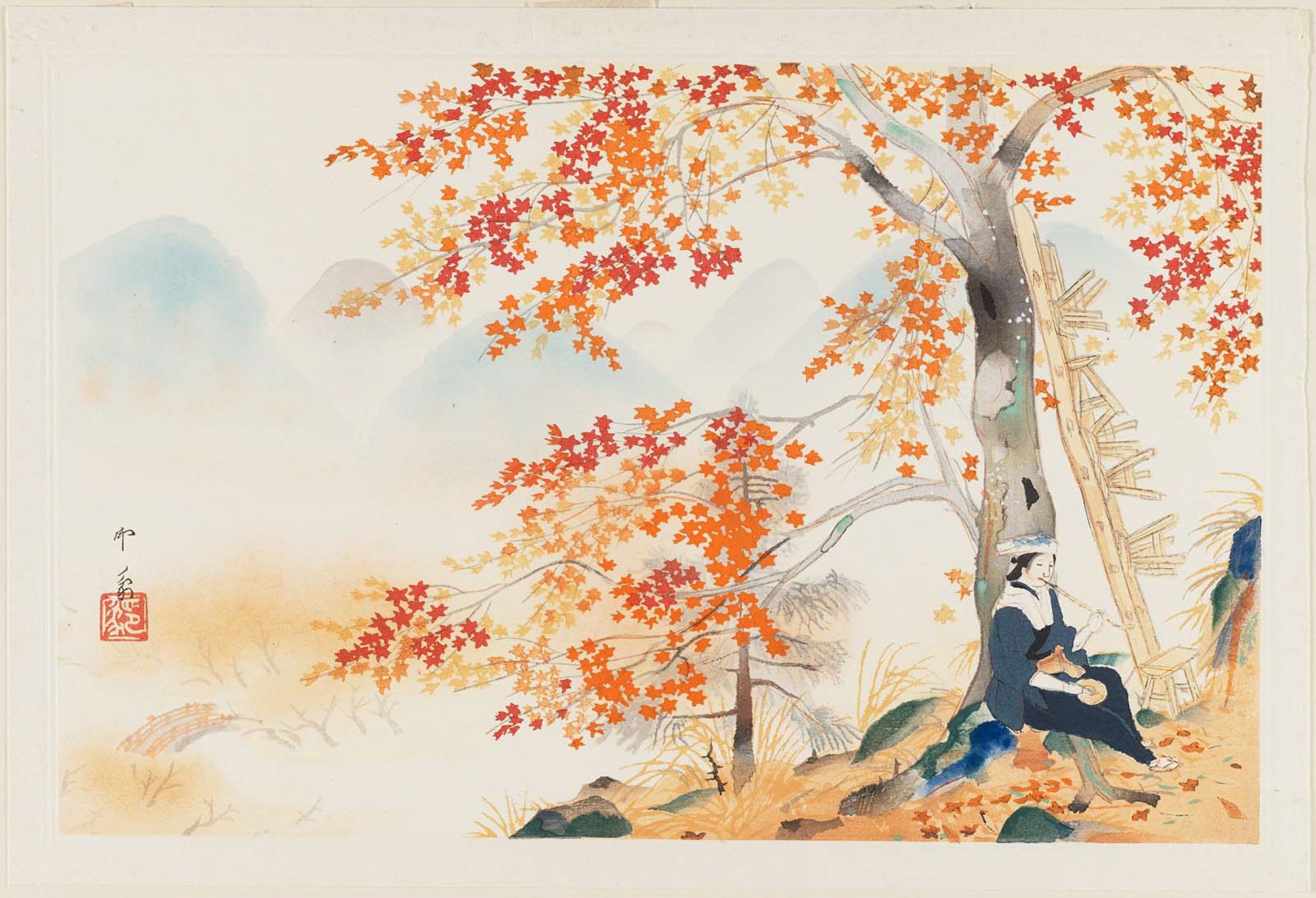
Autumn Maple Leaves at Takao, from the album Eight Views of Kyoto (Kyôto hakkei)
Woodblock print

The Beach at Kaiganji in Sanuki Province (Sanuki Kaiganji no hama), from the series "Collection of Views of Japan II, Kansai Edition (Nihon fukei shu II Kansai hen)"
1934
Color woodblock print; oban

Tea Kettle, section of a sheet from the series "Mirror of Stone Rubbings of Views of the Provinces" (Kohon meihitsu ishizuri kagami)
n.d.
Woodblock print; ishizuri-e, section of harimaze sheet
Featured in Collections
Curated cross-cuts that include this print.
Frequently Asked Questions
America (Amerika) was created by Utagawa Hiroshige (歌川広重) in 1860.
America (Amerika) depicts landscapes.