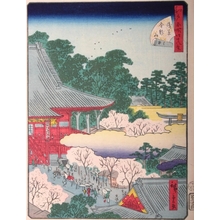
Asakusa
- Medium:
- Woodblock print
- Source:
- Art Gallery of Greater Victoria
- Image courtesy of
- Art Gallery of Greater Victoria
Description
Asakusa was the most visited temple district in Edo, centered on Senso-ji and its attendant commercial streets, and Hiroshige returned to it across multiple series. This print likely frames the approach to Senso-ji through the Kaminarimon gate, the Nakamise shopping street, or the festival grounds during a seasonal celebration. The composition may employ the gate's architecture as a monumental framing device in the foreground, with the pagoda or main hall visible in the middleground beyond a dense crowd. Hiroshige's Asakusa prints typically populate the scene with figures that reflect the district's democratic character—merchants, pilgrims, children, entertainers—rendered in flat color with minimal facial detail. The sky above the precinct would receive a horizontal bokashi wash, while the architectural elements are articulated through crisp keyblock lines. As a meisho-e subject, Asakusa carried both topographical and devotional associations that Hiroshige's treatment honors without sentimentality.
More Prints by Utagawa Hiroshige


More Urban Scenes Prints
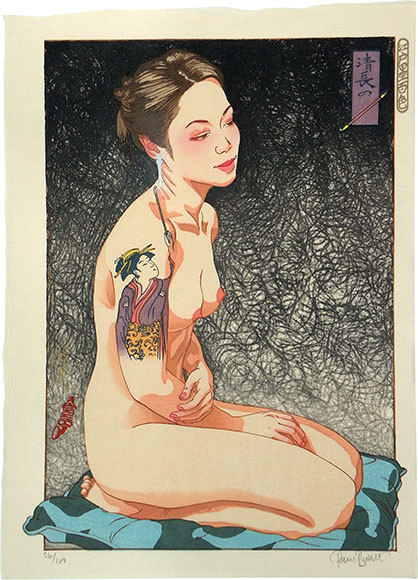
A Hundred Shades of Ink of Edo: Kiyonaga's Pipe (Edo zumi hyaku shoku: Kiyonaga no kiseru)
Woodblock print

View of Kabuki Theater from Matsuya (Ginza Matsuya yori Kabukiza), no. 3 from the series "Pictures of Ginza, First Series (Gashu Ginza dai isshu)"
1928
Color lithograph

Distant View of Mitsukoshi Movie Theater in Shinjuku from the Sixth Floor of Hoteiya (Hoteiya rokkai kara Shinjuku Mitsukoshi Musashi no kan enbo zu), no. 1 from the series "Scenery of Shinjuku (Gashu Shinjuku fukei)"
1930
Color lithograph
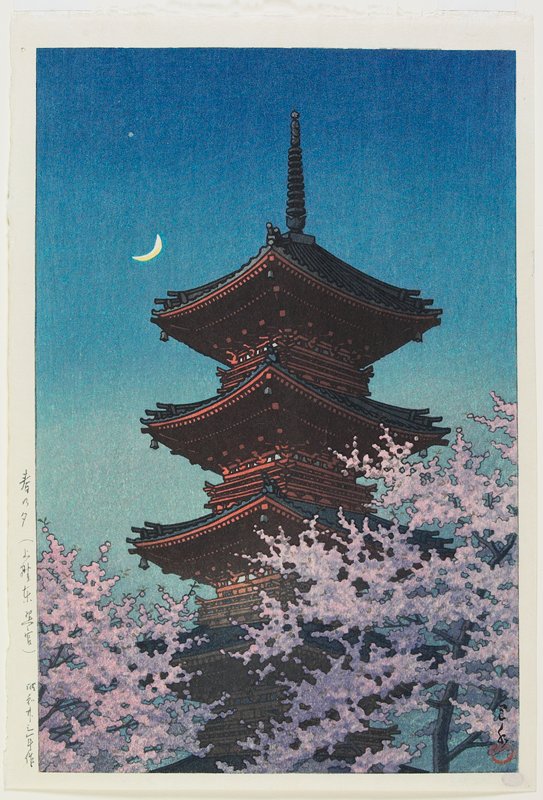
Spring Dusk at the Tōshō Shrine in Ueno
1948
Woodblock print, ink and color on paper
Featured in Collections
Curated cross-cuts that include this print.
Frequently Asked Questions
Asakusa was created by Utagawa Hiroshige (歌川広重).
Asakusa depicts urban scenes and temples & shrines.