
Awa Province: Naruto Whirlpools (Awa, Naruto no fuha), from the series "Famous Places in the Sixty-odd Provinces (Rokujuyoshu meisho zue)"
- Date:
- 1855
- Medium:
- Color woodblock print; oban
- Source:
- Art Institute of Chicago
Description
Awa Province: Naruto Whirlpools is one of the most reproduced sheets of Utagawa Hiroshige's series Famous Places in the Sixty-odd Provinces (Rokujuyoshu meisho zue), published in 1855. The Naruto Strait, between Awaji Island and the province of Awa on the eastern coast of Shikoku, is famous for the violent tidal whirlpools that form there twice a day. Hiroshige builds the composition almost entirely from water, with great curls of foam and deep blue concentric eddies filling the lower two thirds of the sheet and dwarfing the rocky outcrops and tiny boats along the shore. The design is widely understood to acknowledge Katsushika Hokusai's earlier Great Wave, while reorienting the motif from oceanic threat to natural marvel: the whirlpools are not described as dangerous but as a wonder of the province. Hiroshige uses bokashi gradation across the spirals to give them volume, the printers laying ink with care so that lighter and darker blues circle around the empty white centers. As a vertical Edo ukiyo-e landscape print of the most ambitious kind, Naruto stands at the head of the visual repertoire by which provincial Japan was made legible to Edo readers. The Art Institute of Chicago preserves an impression of the design, and the sheet is among the most collected of the entire series.
More Prints by Utagawa Hiroshige


More Landscapes Prints

Lake Kugushi in Wakasa Province (Wakasa Kugushiko), from the series Souvenirs of Travel I (Tabi miyage dai isshu)"
Wakasa Kugushiko
1920
Color woodblock print; oban
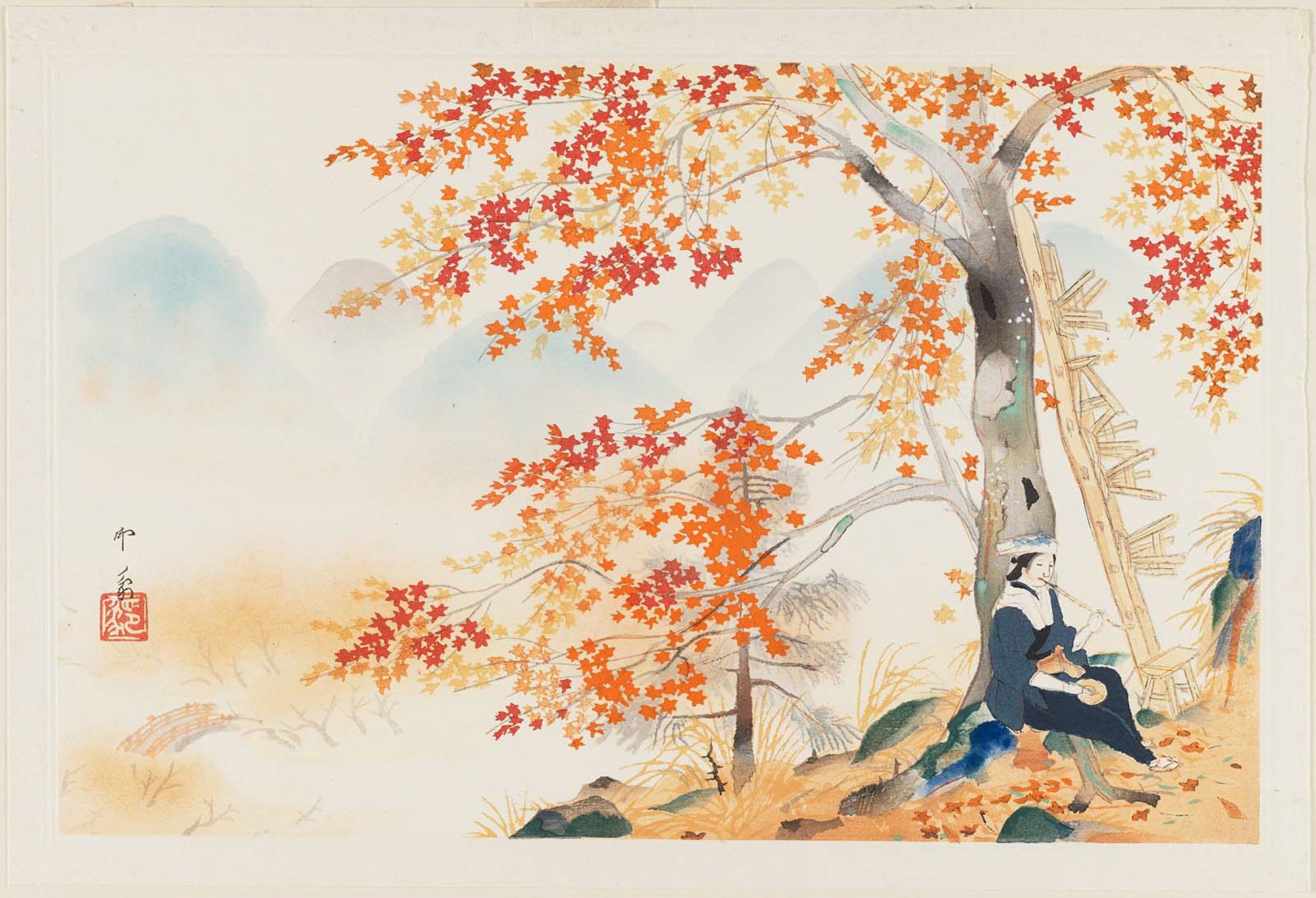
Autumn Maple Leaves at Takao, from the album Eight Views of Kyoto (Kyôto hakkei)
Woodblock print

The Beach at Kaiganji in Sanuki Province (Sanuki Kaiganji no hama), from the series "Collection of Views of Japan II, Kansai Edition (Nihon fukei shu II Kansai hen)"
1934
Color woodblock print; oban

Tea Kettle, section of a sheet from the series "Mirror of Stone Rubbings of Views of the Provinces" (Kohon meihitsu ishizuri kagami)
n.d.
Woodblock print; ishizuri-e, section of harimaze sheet
Featured in Collections
Curated cross-cuts that include this print.
Frequently Asked Questions
Awa Province: Naruto Whirlpools (Awa, Naruto no fuha), from the series "Famous Places in the Sixty-odd Provinces (Rokujuyoshu meisho zue)" was created by Utagawa Hiroshige (歌川広重) in 1855.
Awa Province: Naruto Whirlpools (Awa, Naruto no fuha), from the series "Famous Places in the Sixty-odd Provinces (Rokujuyoshu meisho zue)" depicts landscapes.