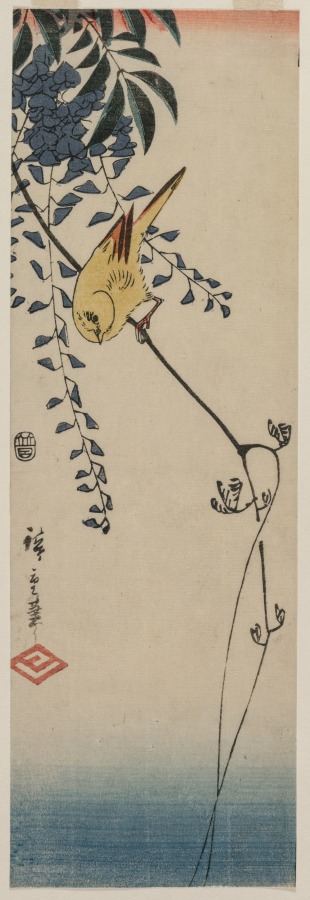
Canary and Wisteria
- Date:
- mid-1840s
- Medium:
- color woodblock print
- Source:
- Cleveland Museum of Art
Description
Canary and Wisteria, dated about 1844 and held by the Cleveland Museum of Art, is a delicate Edo ukiyo-e kacho-e by Utagawa Hiroshige. The print pairs a brilliant yellow canary with a hanging spray of pale purple wisteria, two motifs that together evoke late spring and convey the freshness and softness of the season. Wisteria, with its long pendulous racemes and slender vines, was a favorite plant of poets and garden designers, while the small caged or freely depicted canary was a relatively new and prized songbird in Edo, often associated with refined leisure. Hiroshige uses a vertical chu-tanzaku format to let the wisteria cascade from the upper edge of the sheet down past the bird, which perches on a slender tendril and turns its head as if listening or about to sing. The colors are typical of the artist's bird and flower work in the early 1840s: a sunlit yellow on the canary, gradated lavender and indigo on the blossoms, soft greens for the leaves, and a faint pink atmospheric wash behind the design. Calligraphic inscriptions, often kyoka verses by amateur poets, complete the upper portion of the sheet. Although Hiroshige is justly celebrated for his landscape print series, this kacho-e shows him drawing on the long Chinese and Japanese tradition of paired bird and flower images and adapting it for a fashionable Edo print audience.
More Prints by Utagawa Hiroshige


More Landscapes Prints

Lake Kugushi in Wakasa Province (Wakasa Kugushiko), from the series Souvenirs of Travel I (Tabi miyage dai isshu)"
Wakasa Kugushiko
1920
Color woodblock print; oban
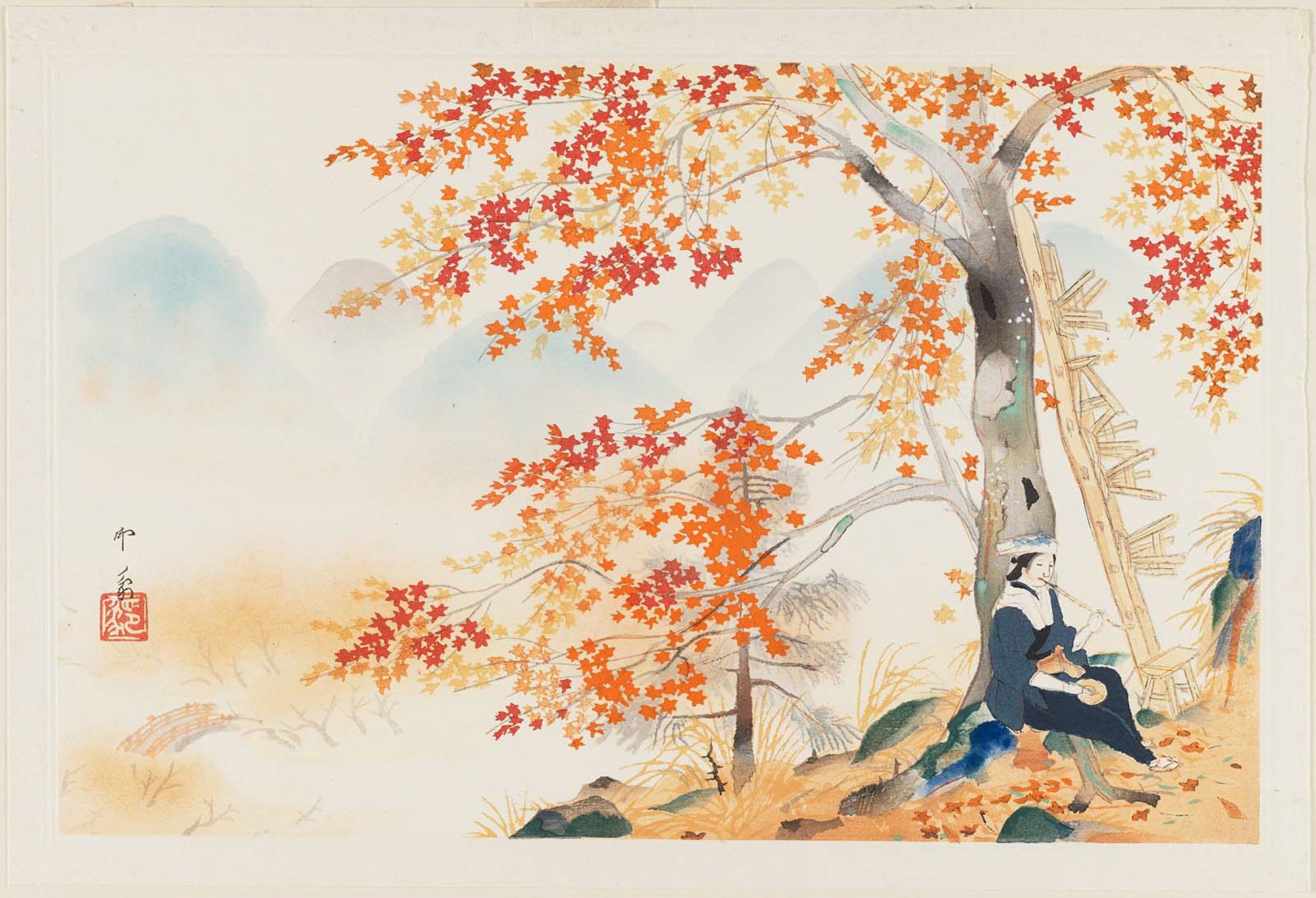
Autumn Maple Leaves at Takao, from the album Eight Views of Kyoto (Kyôto hakkei)
Woodblock print

The Beach at Kaiganji in Sanuki Province (Sanuki Kaiganji no hama), from the series "Collection of Views of Japan II, Kansai Edition (Nihon fukei shu II Kansai hen)"
1934
Color woodblock print; oban

Tea Kettle, section of a sheet from the series "Mirror of Stone Rubbings of Views of the Provinces" (Kohon meihitsu ishizuri kagami)
n.d.
Woodblock print; ishizuri-e, section of harimaze sheet
Featured in Collections
Curated cross-cuts that include this print.
Frequently Asked Questions
Canary and Wisteria was created by Utagawa Hiroshige (歌川広重) in mid-1840s.
Canary and Wisteria depicts landscapes.