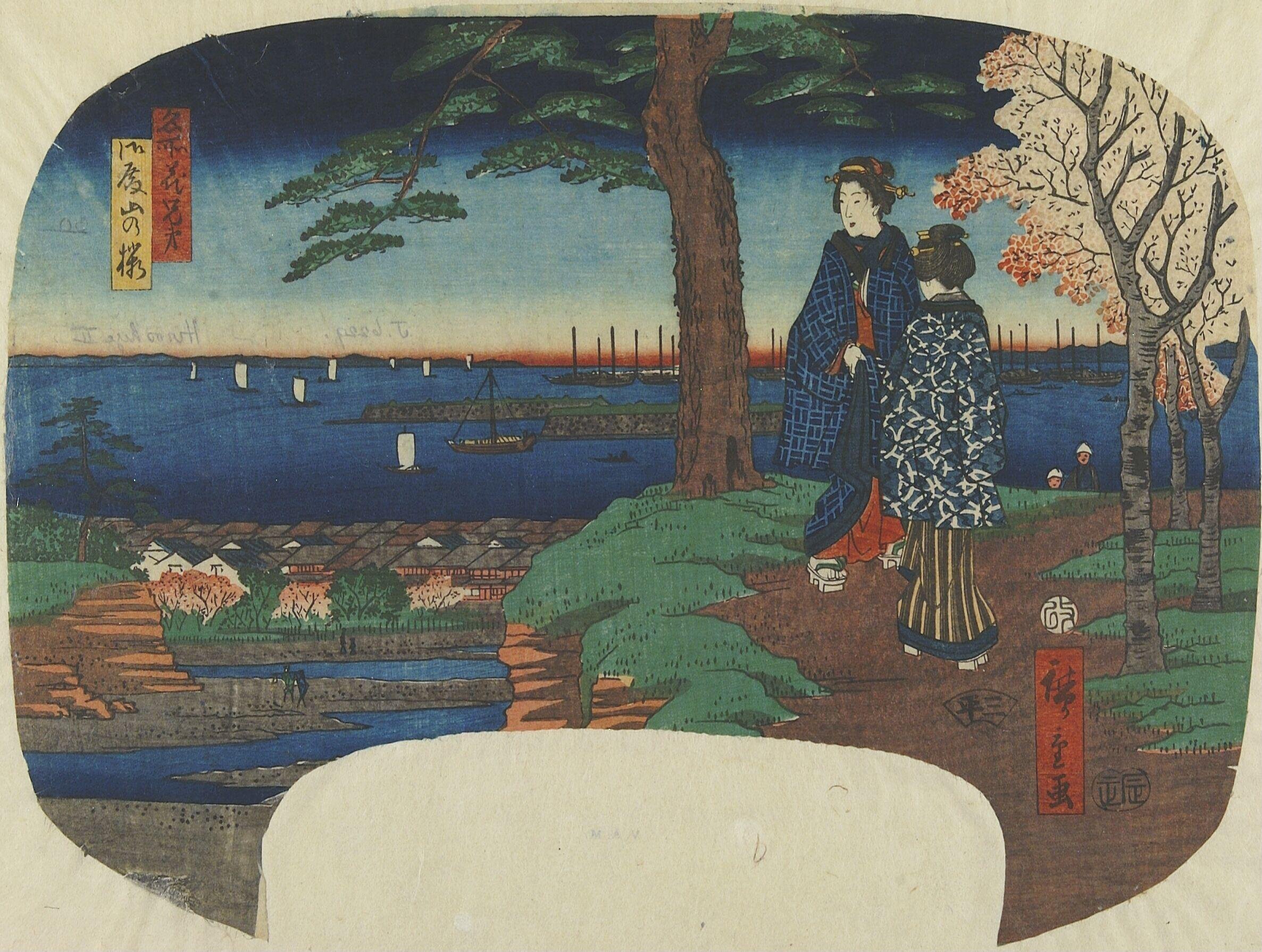
Cherry Trees on Mount Goten
- Date:
- 1856
- Medium:
- Source:
- Victoria and Albert Museum
Description
Cherry Trees on Mount Goten, dated 1856 and preserved in the Victoria and Albert Museum, places Utagawa Hiroshige's late Edo ukiyo-e production in dialogue with the city's most enduring seasonal subject: cherry-viewing (hanami). Mount Goten (Gotenyama) lay on a low bluff at Shinagawa, overlooking the southern approaches to Edo Bay, and had been planted with cherry trees by order of the eighth shogun, Tokugawa Yoshimune, as part of his program to make hanami available to the broad population. By the mid-nineteenth century the site was one of the most popular cherry-blossom destinations in the city. In this design Hiroshige uses a high vantage that opens out toward the bay: foreground and middle ground are filled with the bright pink-white canopy of cherry trees, beneath which small groups of visitors picnic, drink, and stroll along the path. Beyond the bluff the eye is led down across slope and shore to a strip of water, with the suggestion of distant mountains and Bōsō headlands closing the horizon. The palette—pale pink for blossom, soft green for new foliage, blue for the bay—is gentle and seasonal, and the printer's bokashi at sea and sky deepens the sense of recession. As a landscape print, the work both records a beloved Edo site and contributes to a long visual tradition in which Hiroshige had become a central figure, anticipating the closely related Gotenyama designs in One Hundred Famous Views of Edo.
More Prints by Utagawa Hiroshige


More Landscapes Prints

Lake Kugushi in Wakasa Province (Wakasa Kugushiko), from the series Souvenirs of Travel I (Tabi miyage dai isshu)"
Wakasa Kugushiko
1920
Color woodblock print; oban
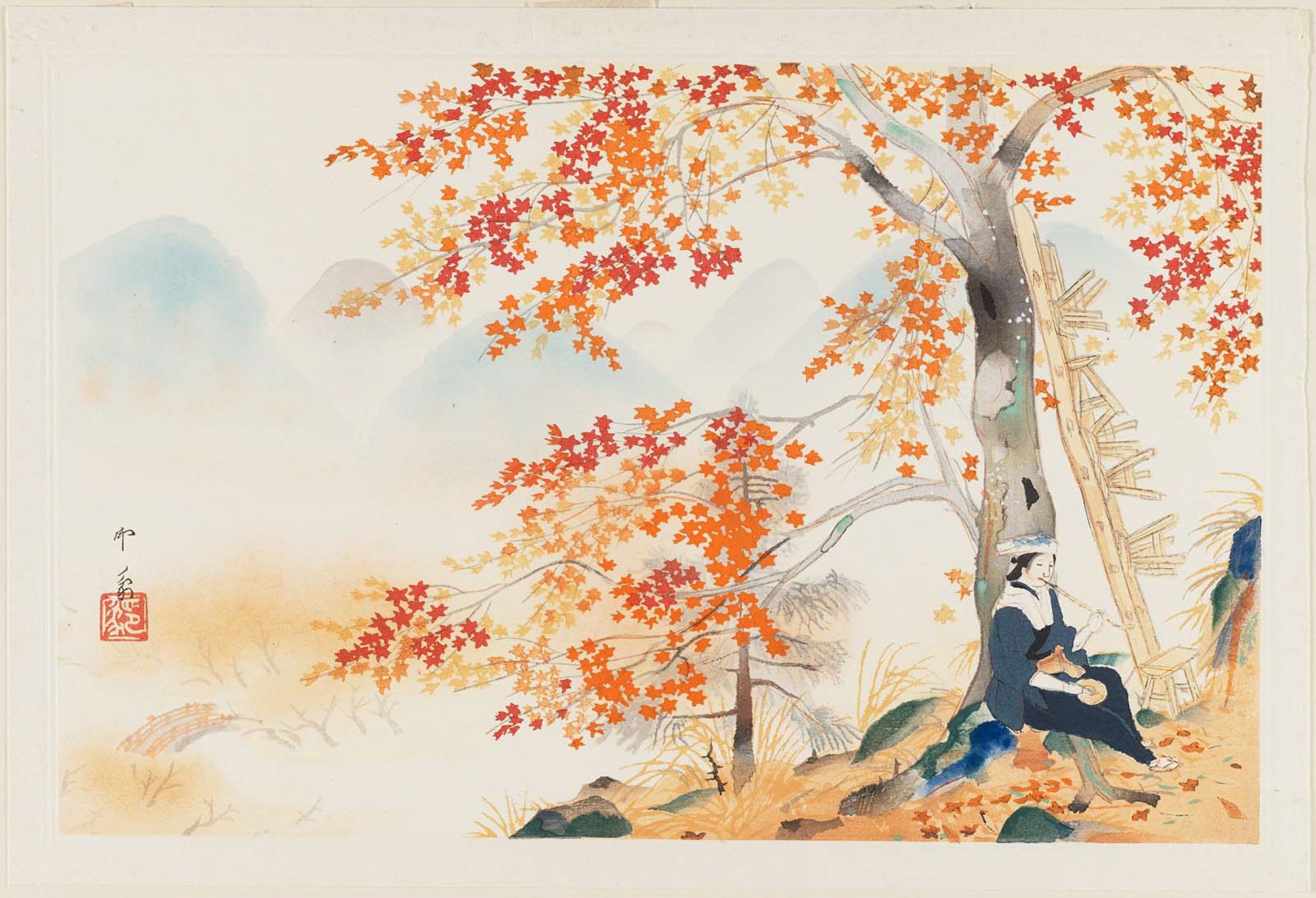
Autumn Maple Leaves at Takao, from the album Eight Views of Kyoto (Kyôto hakkei)
Woodblock print

The Beach at Kaiganji in Sanuki Province (Sanuki Kaiganji no hama), from the series "Collection of Views of Japan II, Kansai Edition (Nihon fukei shu II Kansai hen)"
1934
Color woodblock print; oban

Tea Kettle, section of a sheet from the series "Mirror of Stone Rubbings of Views of the Provinces" (Kohon meihitsu ishizuri kagami)
n.d.
Woodblock print; ishizuri-e, section of harimaze sheet
Featured in Collections
Curated cross-cuts that include this print.
Frequently Asked Questions
Cherry Trees on Mount Goten was created by Utagawa Hiroshige (歌川広重) in 1856.
Cherry Trees on Mount Goten depicts landscapes.