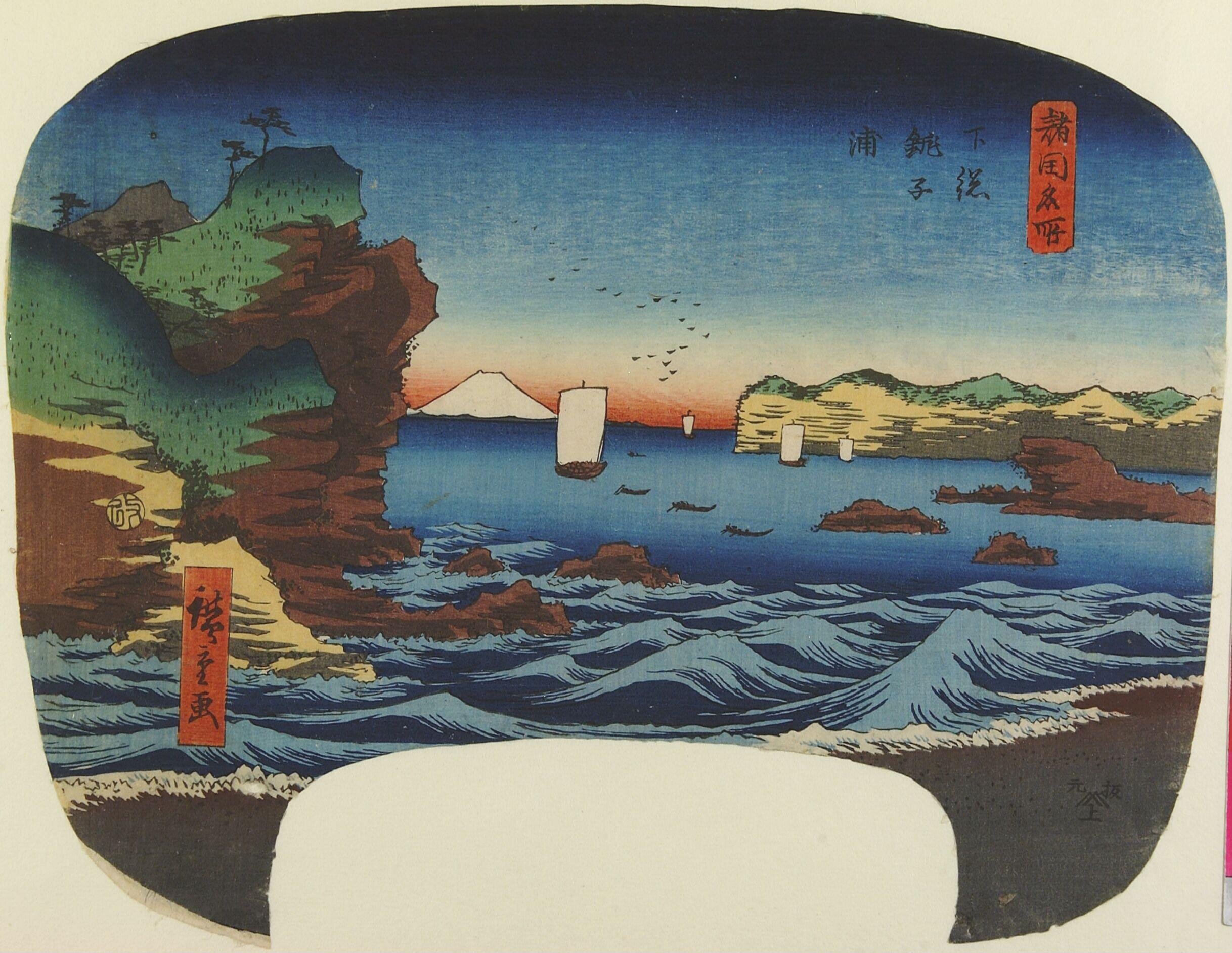
Choshi Bay in Shimosa Province
- Date:
- 1854-1858
- Medium:
- Source:
- Victoria and Albert Museum
Description
Chōshi Bay in Shimōsa Province, dated 1854 and held by the Victoria and Albert Museum, is an Edo ukiyo-e landscape print by Utagawa Hiroshige depicting the dramatic coastline at the eastern tip of the Bōsō Peninsula. Chōshi, where the Tone River meets the Pacific, was famous for its fishing fleets, its soy sauce industry, and its open sea views, which contrasted sharply with the sheltered bays around Edo. In this Utagawa Hiroshige landscape print the artist captures the breadth and exposure of the location, with cliffs, breaking waves and distant headlands organised across the composition. The Edo ukiyo-e treatment of the sea in such designs typically combined careful patterning of wave forms with controlled bokashi gradations from a deeper indigo at the horizon to lighter tones inshore. Hiroshige's design positions small fishing boats and figures along the shoreline, giving scale to the geography and reminding viewers that Chōshi's identity was rooted in maritime labour. The Victoria and Albert Museum impression preserves the clarity of the key block lines and the subtlety of the colour overlays. As a late landscape print, the work shows Hiroshige's continuing engagement with regions east and north of Edo, extending the geographical scope of meisho-e beyond the Tokaido. It stands as a confident Utagawa Hiroshige treatment of an Eastern Province whose dramatic coastline made it ideally suited to the Edo ukiyo-e idiom.
More Prints by Utagawa Hiroshige


More Landscapes Prints

Lake Kugushi in Wakasa Province (Wakasa Kugushiko), from the series Souvenirs of Travel I (Tabi miyage dai isshu)"
Wakasa Kugushiko
1920
Color woodblock print; oban
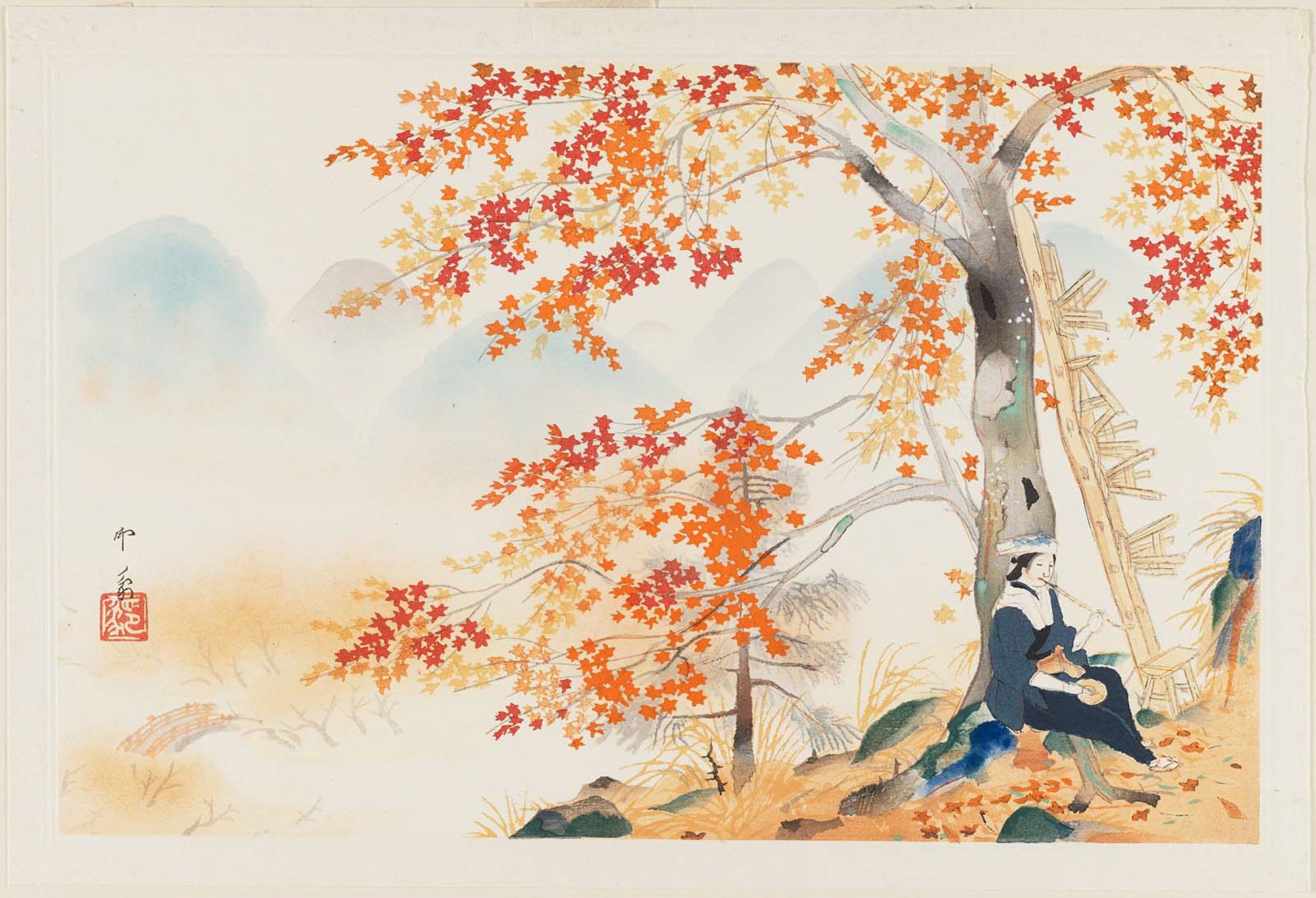
Autumn Maple Leaves at Takao, from the album Eight Views of Kyoto (Kyôto hakkei)
Woodblock print

The Beach at Kaiganji in Sanuki Province (Sanuki Kaiganji no hama), from the series "Collection of Views of Japan II, Kansai Edition (Nihon fukei shu II Kansai hen)"
1934
Color woodblock print; oban

Tea Kettle, section of a sheet from the series "Mirror of Stone Rubbings of Views of the Provinces" (Kohon meihitsu ishizuri kagami)
n.d.
Woodblock print; ishizuri-e, section of harimaze sheet
Featured in Collections
Curated cross-cuts that include this print.
Frequently Asked Questions
Choshi Bay in Shimosa Province was created by Utagawa Hiroshige (歌川広重) in 1854-1858.
Choshi Bay in Shimosa Province depicts landscapes.