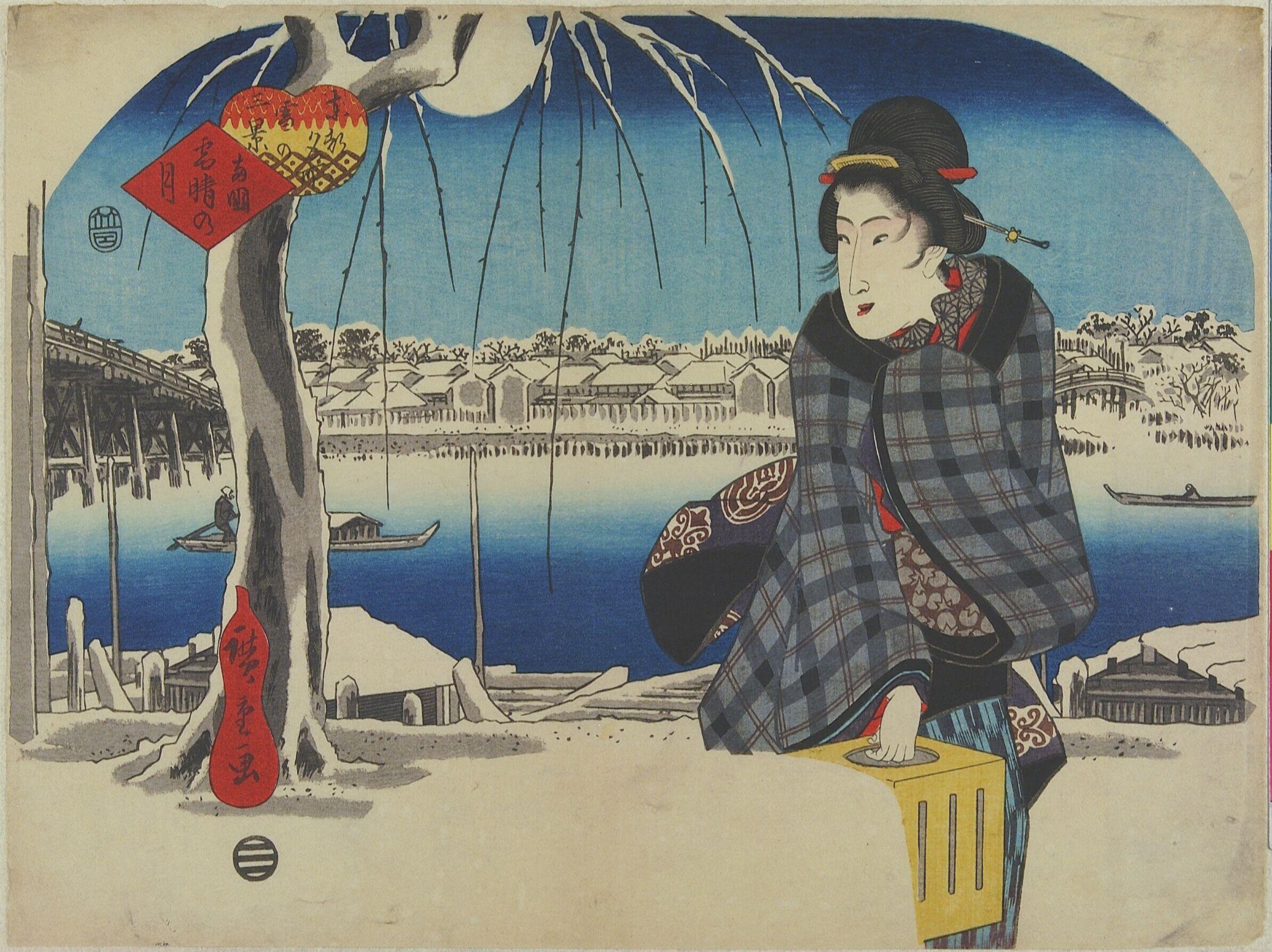
Clear Skies after Snow--Ryogoku in Moonlight
- Date:
- 1843-1847
- Medium:
- Source:
- Victoria and Albert Museum
Description
Clear Skies after Snow--Ryogoku in Moonlight, dated 1843, is an Edo ukiyo-e landscape print by Utagawa Hiroshige in the Victoria and Albert Museum. The scene returns to one of Hiroshige's favourite urban subjects, the Ryogoku bridge spanning the Sumida River, but recasts it under the wintry conditions of a freshly cleared snow night. The bridge stretches across the middle of the composition, white with accumulated snow, while moonlight glints off the river and on the surrounding rooftops. Boats and travellers are reduced to small dark accents that establish scale within the silvered scene. Hiroshige's design illustrates a long pictorial tradition that prized seki, the lingering quality of a landscape after weather has passed: skies clear, air cold, light unusually pure. By choosing this moment he transforms a crowded popular site into a near-silent meditation on cold beauty. Bokashi gradation across the sky implies the recent storm, while delicate keyblock lines render bare branches and railings. Within the broader trajectory of Hiroshige's career, snow prints recur as one of his most celebrated specialities, and Ryogoku itself appears across many series and one-off sheets. This work belongs in the company of his other snow scenes such as those at Asuka-yama or the famous Kanbara of the Tokaido, all united by an austere, contemplative mood. As a record of Edo's bridge culture and as a quietly powerful composition, the print continues to reward close attention from collectors and scholars alike.
More Prints by Utagawa Hiroshige


More Landscapes Prints

Lake Kugushi in Wakasa Province (Wakasa Kugushiko), from the series Souvenirs of Travel I (Tabi miyage dai isshu)"
Wakasa Kugushiko
1920
Color woodblock print; oban
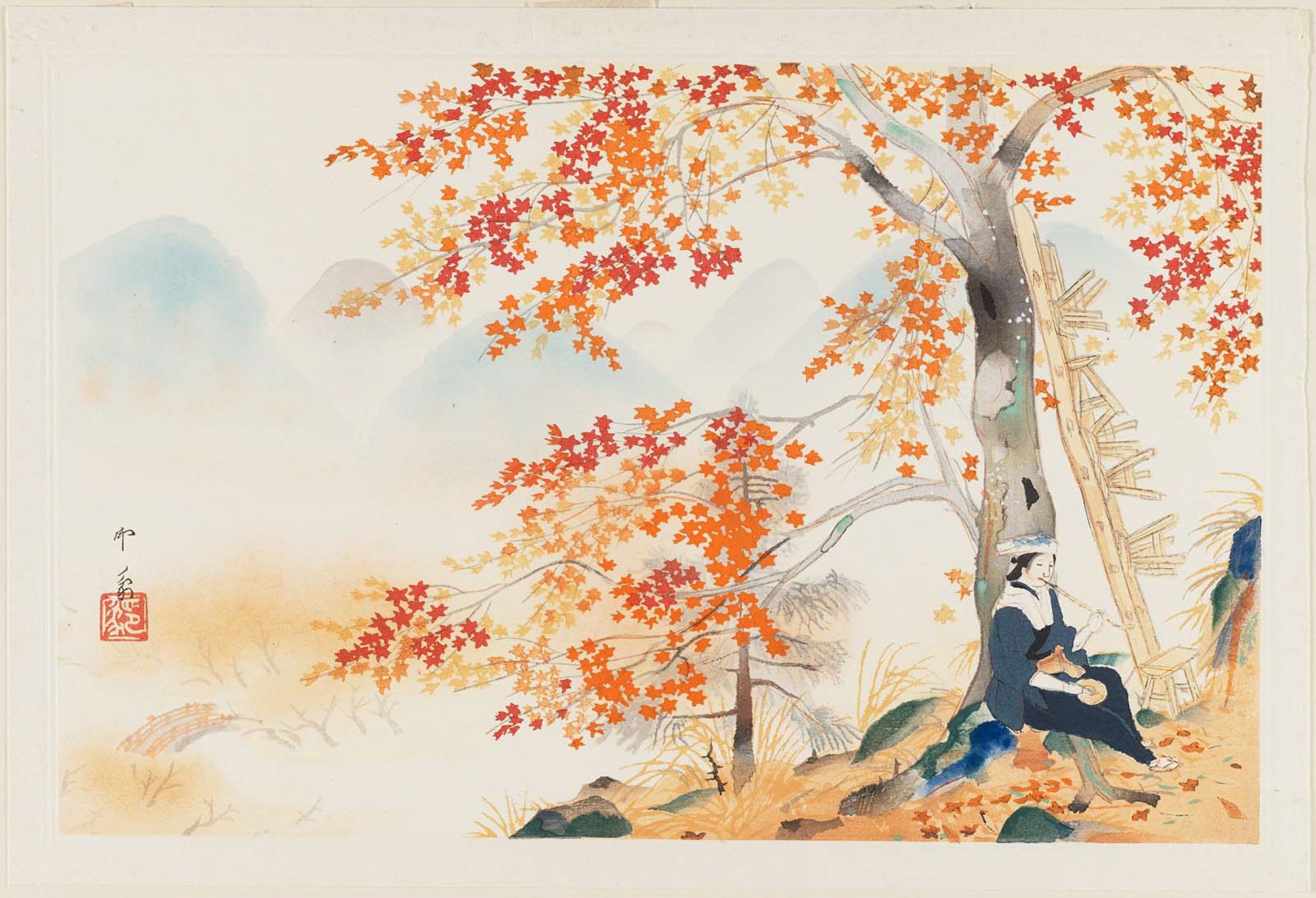
Autumn Maple Leaves at Takao, from the album Eight Views of Kyoto (Kyôto hakkei)
Woodblock print

The Beach at Kaiganji in Sanuki Province (Sanuki Kaiganji no hama), from the series "Collection of Views of Japan II, Kansai Edition (Nihon fukei shu II Kansai hen)"
1934
Color woodblock print; oban

Tea Kettle, section of a sheet from the series "Mirror of Stone Rubbings of Views of the Provinces" (Kohon meihitsu ishizuri kagami)
n.d.
Woodblock print; ishizuri-e, section of harimaze sheet
Featured in Collections
Curated cross-cuts that include this print.
Frequently Asked Questions
Clear Skies after Snow--Ryogoku in Moonlight was created by Utagawa Hiroshige (歌川広重) in 1843-1847.
Clear Skies after Snow--Ryogoku in Moonlight depicts landscapes, moonlight, and winter.