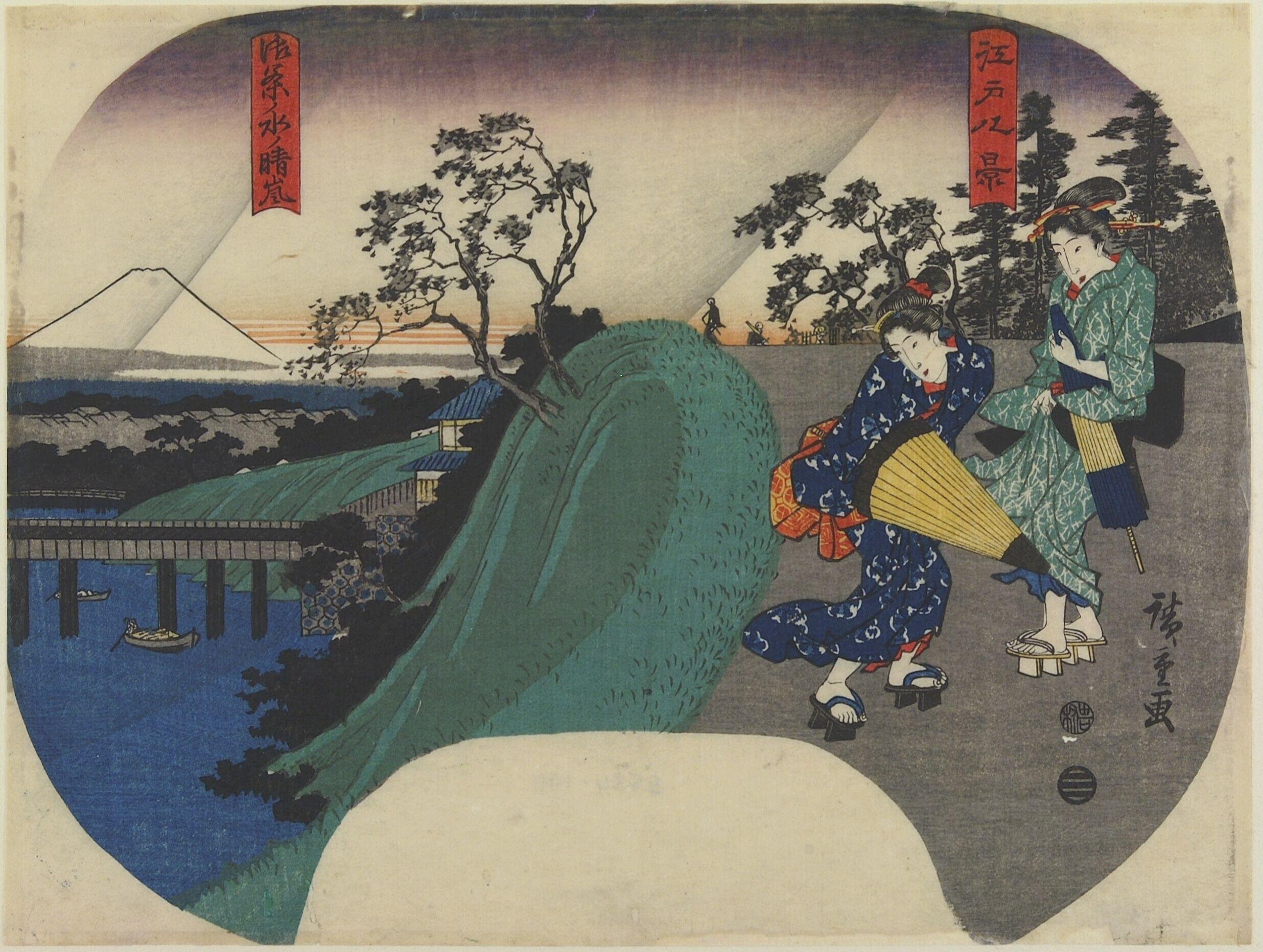
Clearing Skies at Ochanomizu
- Date:
- 1843-1847
- Medium:
- Source:
- Victoria and Albert Museum
Description
Clearing Skies at Ochanomizu, dated 1843 and held by the Victoria and Albert Museum, is an Edo ukiyo-e landscape print by Utagawa Hiroshige depicting one of the more dramatic landscape features within the Edo city walls. Ochanomizu, literally tea water, was a deep ravine cut by the Kanda River in the seventeenth century to serve as a defensive moat for the shogunal castle and to provide cool, prized water for the shogun's tea. By the early nineteenth century its steep wooded banks, stone embankments, and arching bridges had become a favored subject for landscape print designers. Hiroshige depicts the gorge from above and to one side, with the river curving below stone retaining walls and the slopes rising in lush green into a clearing sky after rain. Bokashi gradations carry the sky from soft gray clouds into pale blue, suggesting the dispersal of a passing shower, while small figures cross a wooden bridge or follow paths along the embankment. The composition demonstrates the artist's interest in transitional weather effects, an interest that culminated in many of the most celebrated atmospheric scenes of his late Edo series. As a mid-career Edo ukiyo-e print, this sheet links specific urban infrastructure to the poetic motif of weather clearing, a combination that became one of Hiroshige's signature landscape print strategies.
More Prints by Utagawa Hiroshige


More Landscapes Prints

Lake Kugushi in Wakasa Province (Wakasa Kugushiko), from the series Souvenirs of Travel I (Tabi miyage dai isshu)"
Wakasa Kugushiko
1920
Color woodblock print; oban
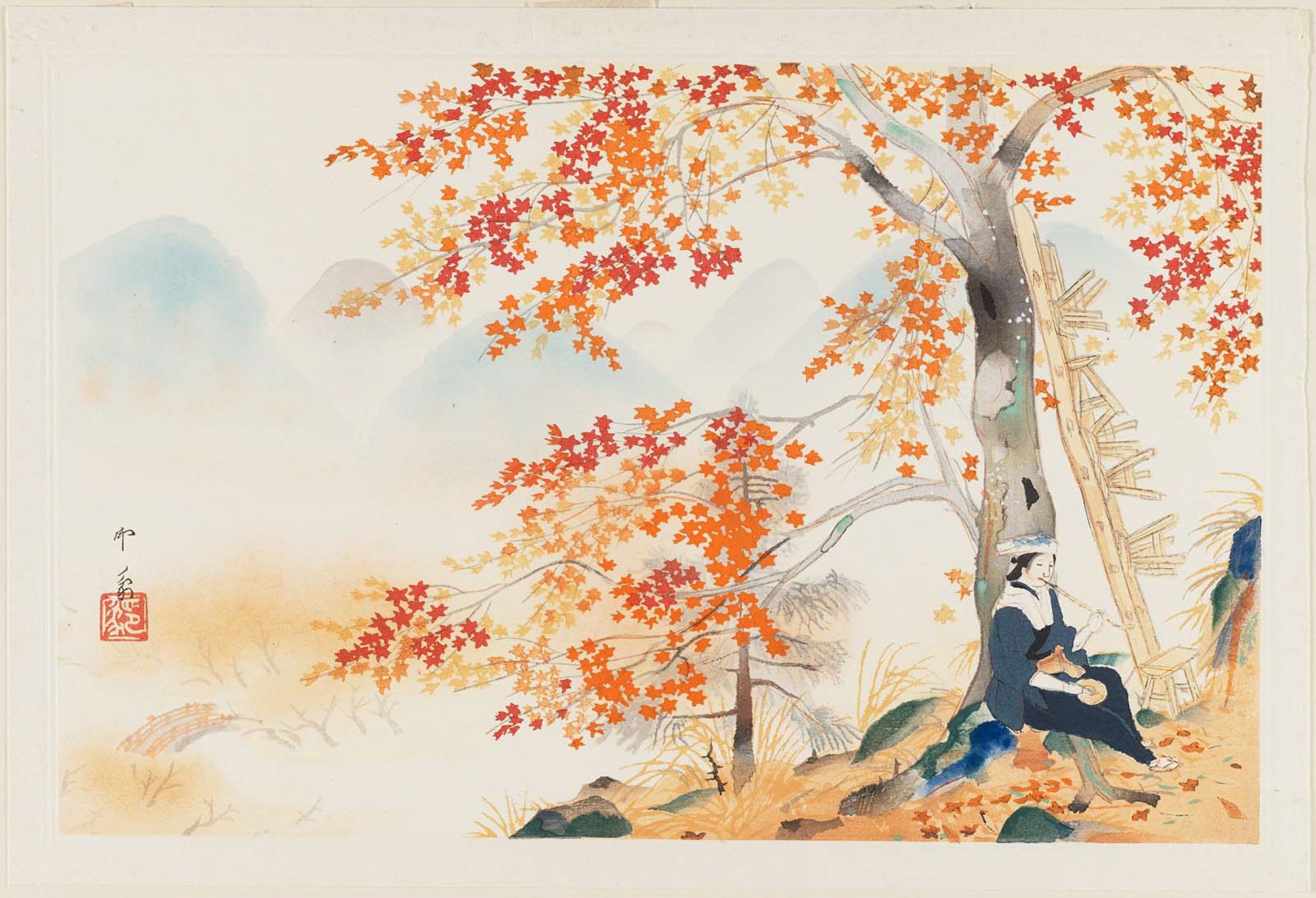
Autumn Maple Leaves at Takao, from the album Eight Views of Kyoto (Kyôto hakkei)
Woodblock print

The Beach at Kaiganji in Sanuki Province (Sanuki Kaiganji no hama), from the series "Collection of Views of Japan II, Kansai Edition (Nihon fukei shu II Kansai hen)"
1934
Color woodblock print; oban

Tea Kettle, section of a sheet from the series "Mirror of Stone Rubbings of Views of the Provinces" (Kohon meihitsu ishizuri kagami)
n.d.
Woodblock print; ishizuri-e, section of harimaze sheet
Featured in Collections
Curated cross-cuts that include this print.
Frequently Asked Questions
Clearing Skies at Ochanomizu was created by Utagawa Hiroshige (歌川広重) in 1843-1847.
Clearing Skies at Ochanomizu depicts landscapes.