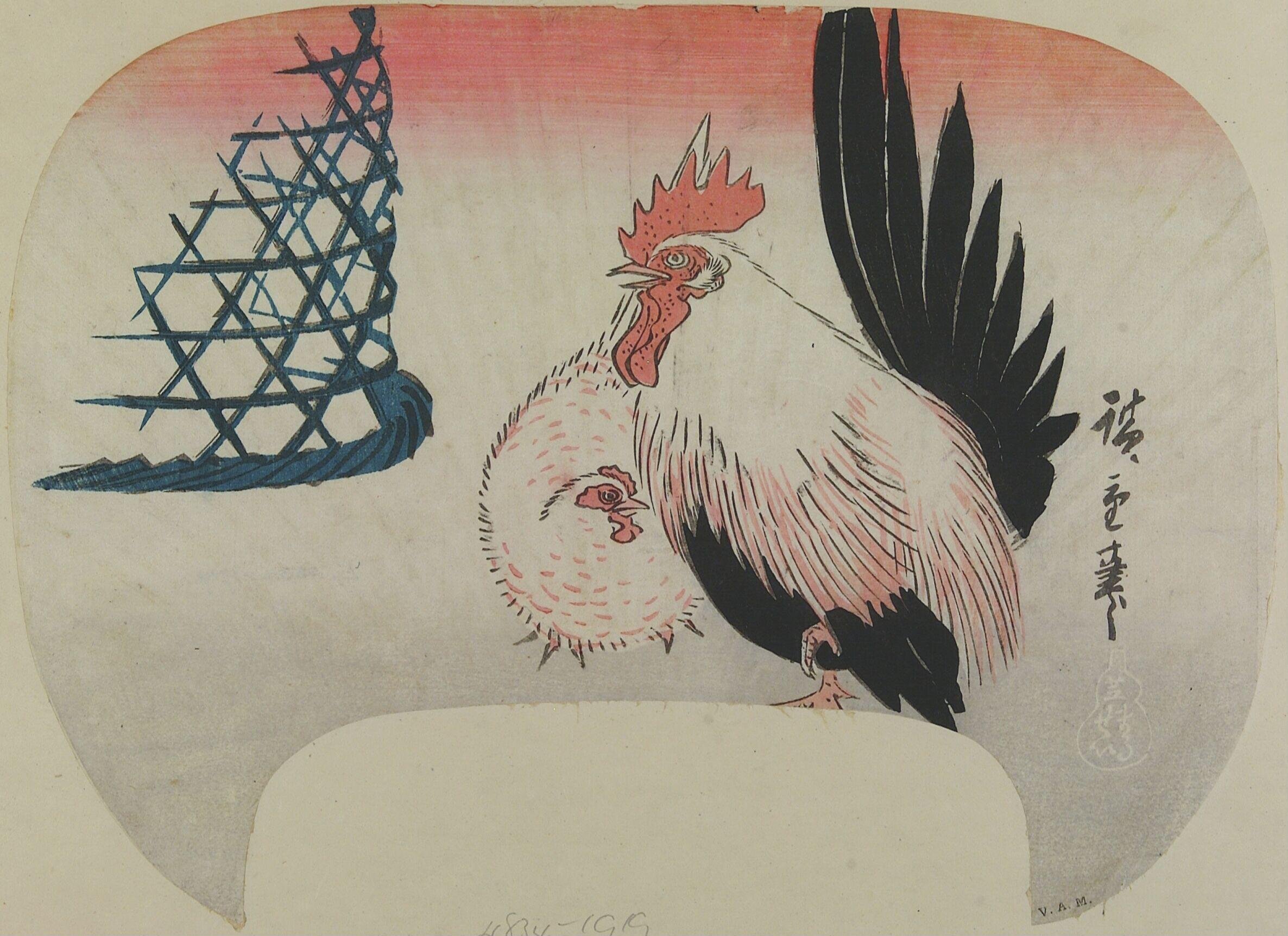
Cockerel, Hen and Basket
- Date:
- ca. 1840-1842
- Medium:
- Source:
- Victoria and Albert Museum
Description
Cockerel, Hen and Basket is an 1840 bird and flower print by Utagawa Hiroshige (1797 to 1858), the leading designer of his generation in the Edo ukiyo-e tradition. While Hiroshige is best known for the landscape print and especially for his views of the Tokaido road and of Edo itself, he produced a substantial body of kacho-e, or bird and flower compositions, throughout his career. Cockerel, Hen and Basket belongs to this parallel practice. The composition centers on a rooster and hen arranged with a woven basket, a domestic subject that draws on East Asian pictorial conventions linking poultry to ideas of rural virtue, productivity, and the daily rhythms of farm life. The cockerel in particular carries a long iconographic association with watchfulness and the announcement of dawn, drawn from Chinese painting and absorbed into Japanese decorative arts. Hiroshige treats the birds with the firm outline and confident color massing characteristic of ukiyo-e print design, allowing the cockerel's red comb and tail feathers to anchor the composition against the more subdued tones of the hen and basket. The 1840 date places this work in the productive middle phase of his career, when his reputation as a landscape designer was firmly established and he was working across multiple genres for the Edo print market. Kacho-e of this kind were valued both as decorative images for the home and as carriers of auspicious meaning, the cockerel and hen together suggesting domestic harmony. The impression is held in the collection of the Victoria and Albert Museum, London, alongside a substantial group of other Hiroshige bird and flower prints.
More Prints by Utagawa Hiroshige


More Landscapes Prints

Lake Kugushi in Wakasa Province (Wakasa Kugushiko), from the series Souvenirs of Travel I (Tabi miyage dai isshu)"
Wakasa Kugushiko
1920
Color woodblock print; oban
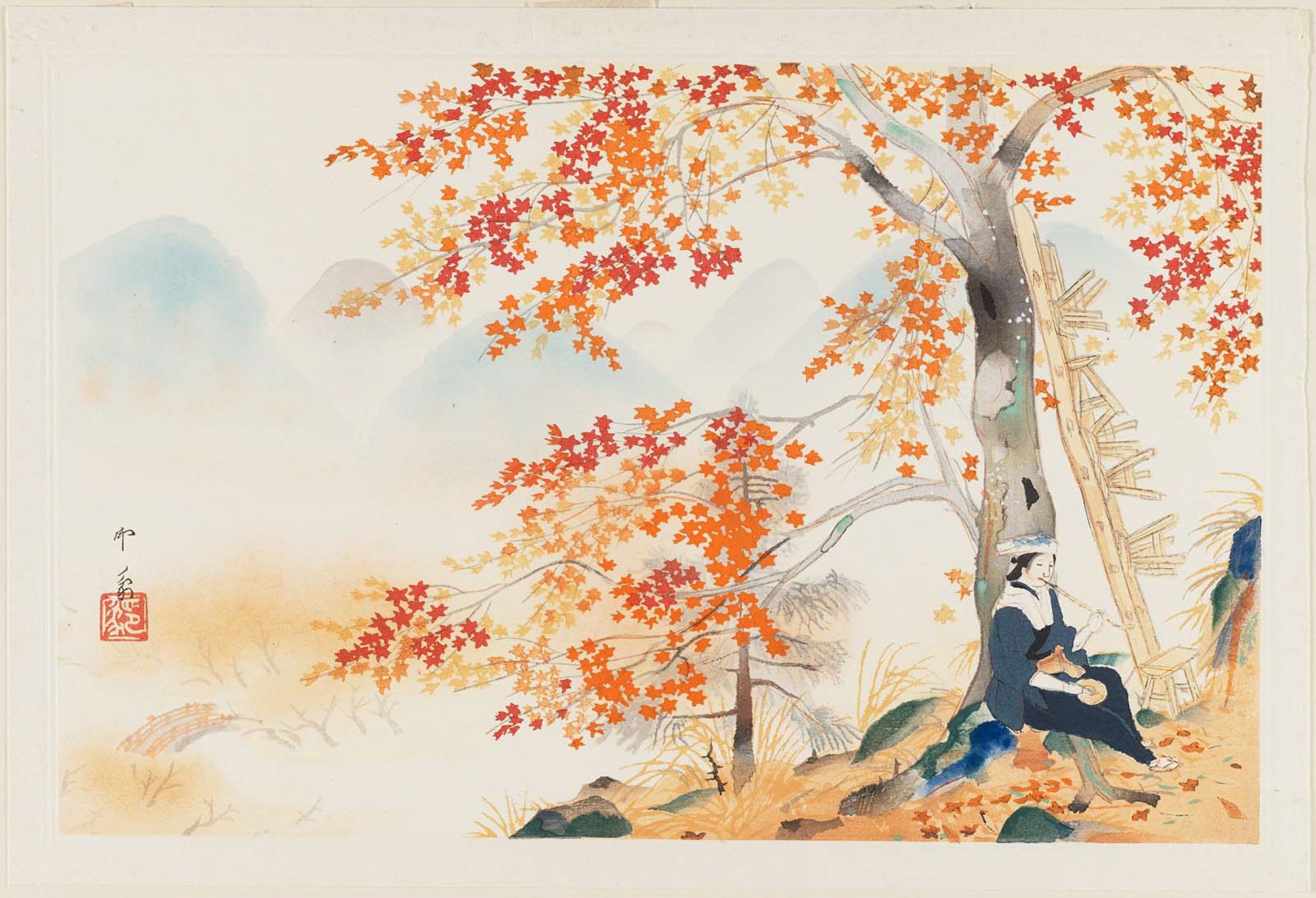
Autumn Maple Leaves at Takao, from the album Eight Views of Kyoto (Kyôto hakkei)
Woodblock print

The Beach at Kaiganji in Sanuki Province (Sanuki Kaiganji no hama), from the series "Collection of Views of Japan II, Kansai Edition (Nihon fukei shu II Kansai hen)"
1934
Color woodblock print; oban

Tea Kettle, section of a sheet from the series "Mirror of Stone Rubbings of Views of the Provinces" (Kohon meihitsu ishizuri kagami)
n.d.
Woodblock print; ishizuri-e, section of harimaze sheet
Featured in Collections
Curated cross-cuts that include this print.
Frequently Asked Questions
Cockerel, Hen and Basket was created by Utagawa Hiroshige (歌川広重) in ca. 1840-1842.
Cockerel, Hen and Basket depicts landscapes.