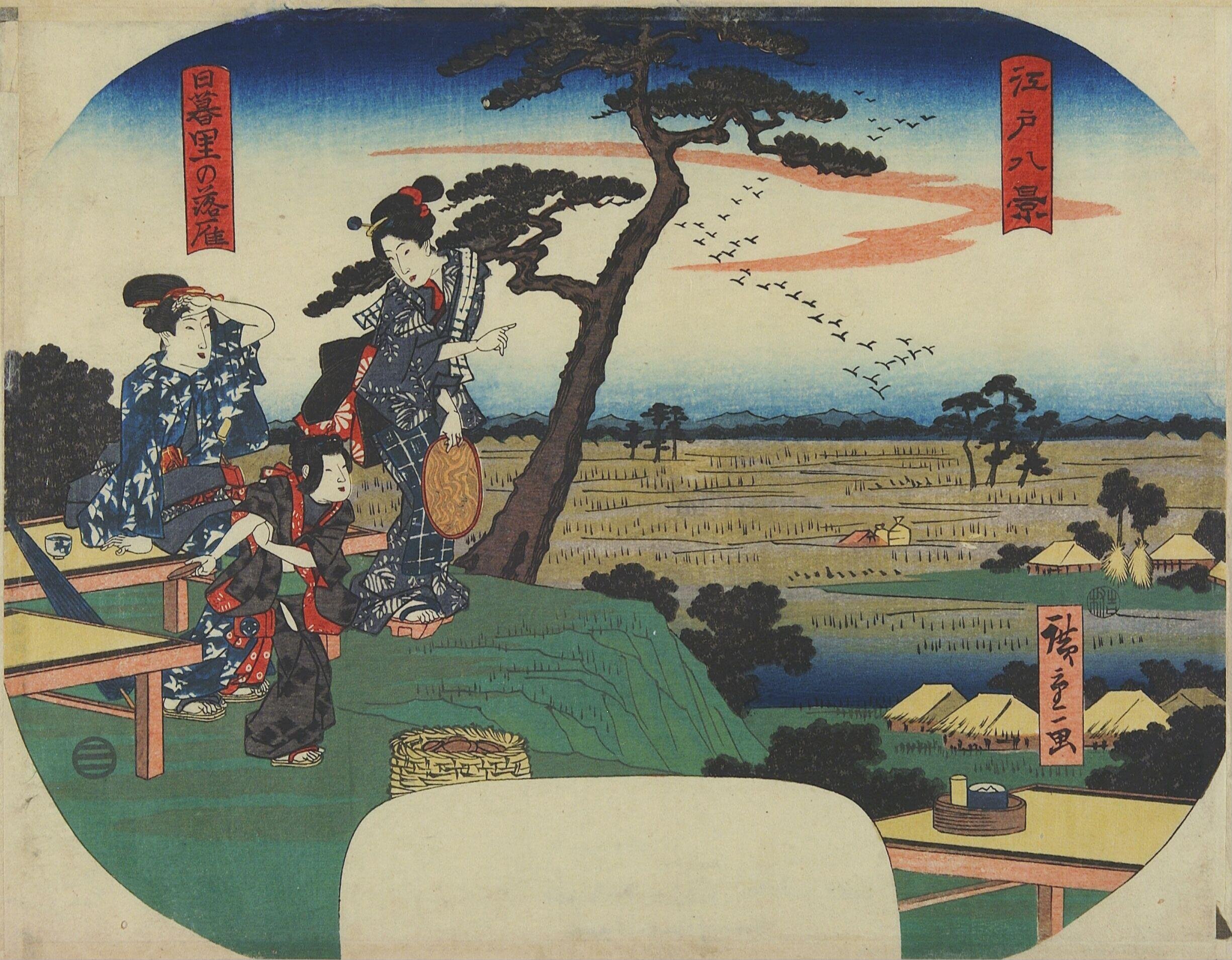
Descending Geese at Nippori
- Date:
- 1843-1847
- Medium:
- Source:
- Victoria and Albert Museum
Description
Descending Geese at Nippori, dated 1843 and held by the Victoria and Albert Museum, is an Edo ukiyo-e landscape print by Utagawa Hiroshige that adapts a classic Chinese 'eight views' motif to the topography of northern Edo. Nippori, a district of temples and gentle hills overlooking the city's outskirts, was a favourite destination for excursions and for viewing wildlife. The motif of descending geese, drawn ultimately from the Eight Views of the Xiao and Xiang Rivers, conventionally signalled autumn and a kind of melancholic beauty. In this Utagawa Hiroshige landscape print the artist sets a flock of geese sweeping down across the sky toward a low foreground of fields and houses, with the elevated temple grounds of Nippori providing a contemplative vantage. Hiroshige's design is restrained: the dominant note is the soft grey of an overcast or twilight sky and the dark wedge of geese in flight, while colour is reserved for foliage and architecture. The Edo ukiyo-e tradition of localising classical themes is fully apparent here, with the meisho of Nippori serving as the modern Japanese answer to a Chinese poetic landscape. The Victoria and Albert Museum impression preserves the subtle bokashi gradations and the carefully judged spacing of the birds in flight. As a landscape print, the work shows how thoroughly Hiroshige absorbed and renewed classical conventions for his Edo audience.
More Prints by Utagawa Hiroshige


More Landscapes Prints

Lake Kugushi in Wakasa Province (Wakasa Kugushiko), from the series Souvenirs of Travel I (Tabi miyage dai isshu)"
Wakasa Kugushiko
1920
Color woodblock print; oban
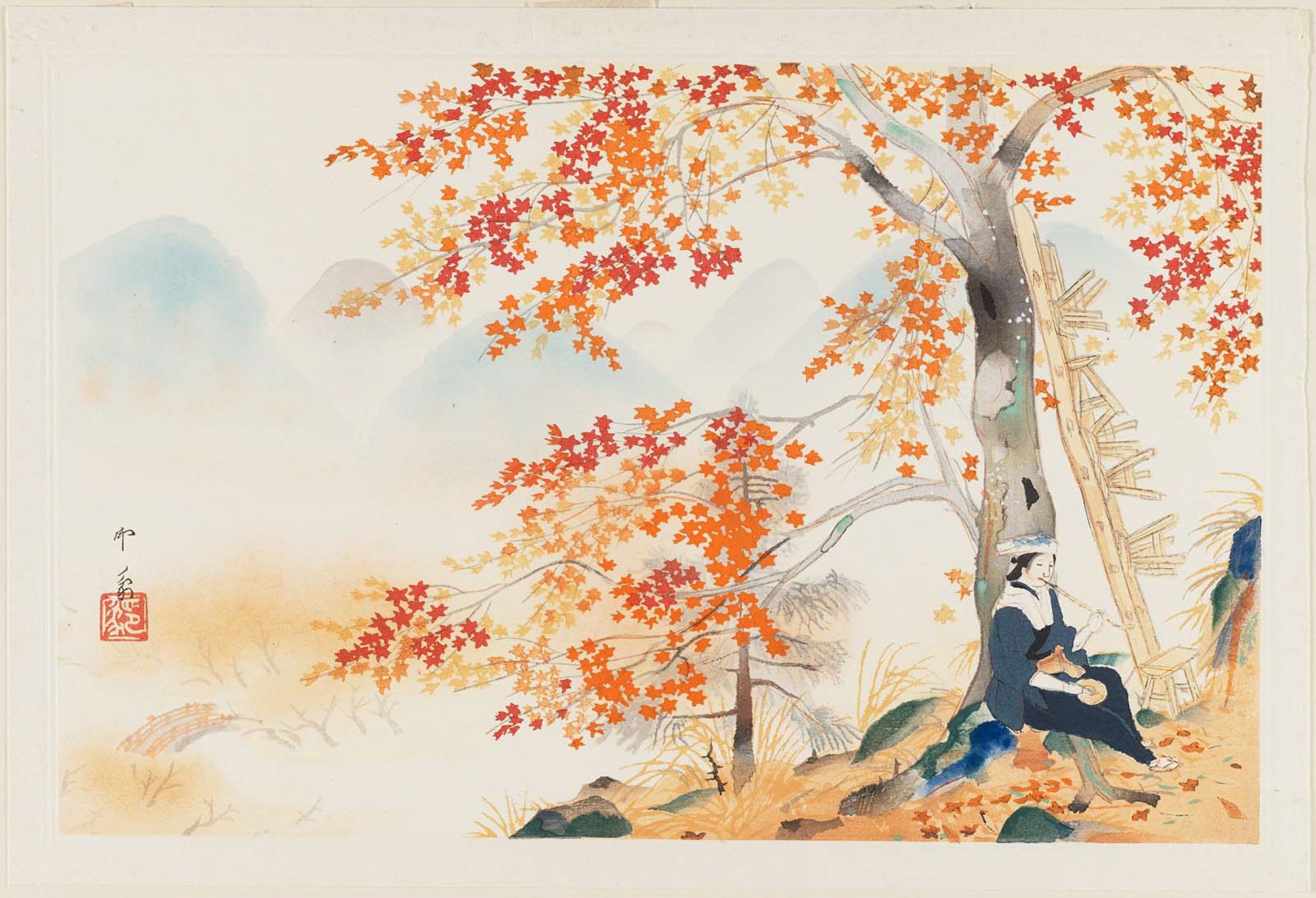
Autumn Maple Leaves at Takao, from the album Eight Views of Kyoto (Kyôto hakkei)
Woodblock print

The Beach at Kaiganji in Sanuki Province (Sanuki Kaiganji no hama), from the series "Collection of Views of Japan II, Kansai Edition (Nihon fukei shu II Kansai hen)"
1934
Color woodblock print; oban

Tea Kettle, section of a sheet from the series "Mirror of Stone Rubbings of Views of the Provinces" (Kohon meihitsu ishizuri kagami)
n.d.
Woodblock print; ishizuri-e, section of harimaze sheet
Featured in Collections
Curated cross-cuts that include this print.
Frequently Asked Questions
Descending Geese at Nippori was created by Utagawa Hiroshige (歌川広重) in 1843-1847.
Descending Geese at Nippori depicts landscapes.