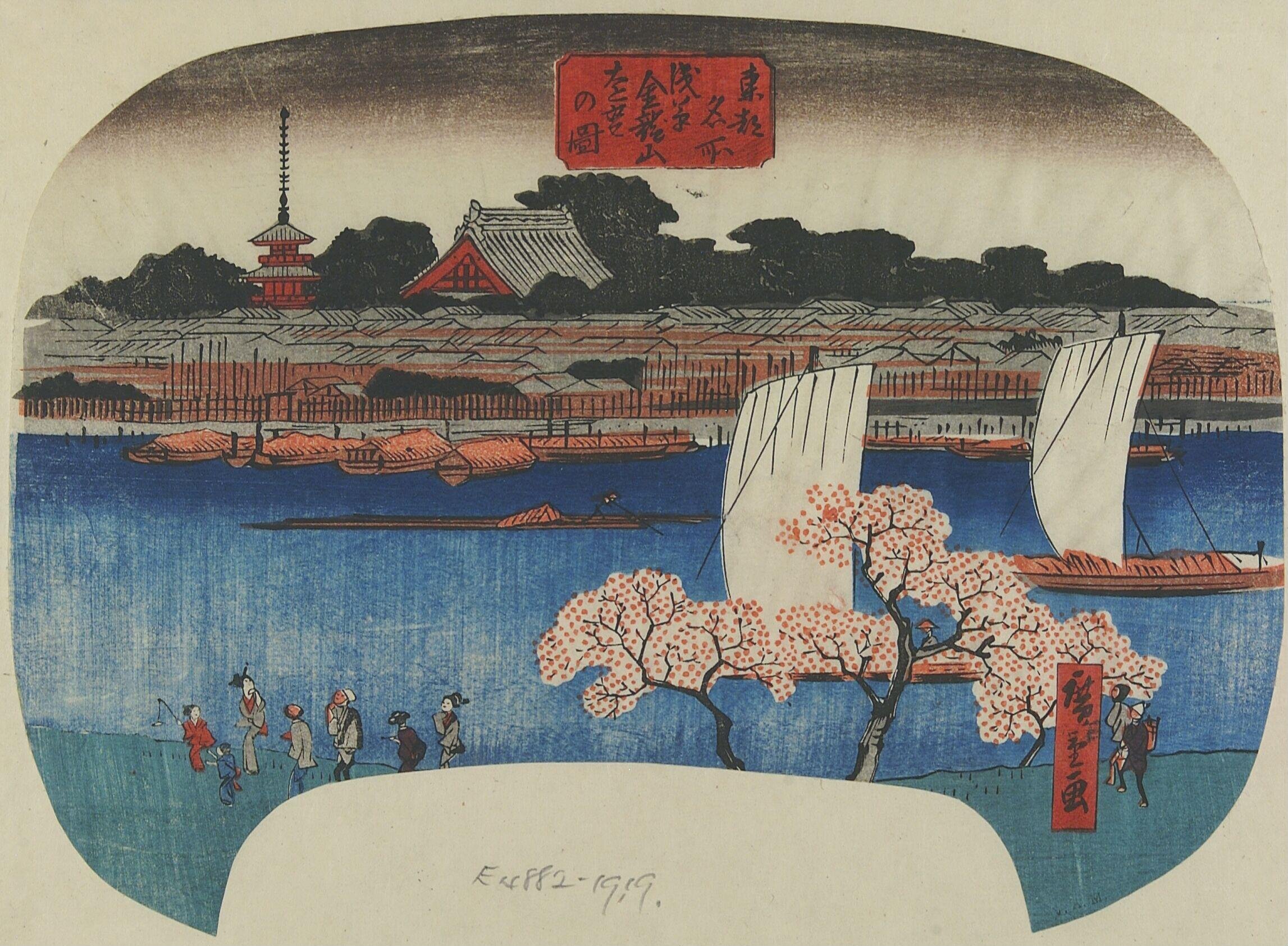
Distant View of the Kinryuzan Temple at Asakusa
- Date:
- ca. 1844-1848
- Medium:
- Source:
- Victoria and Albert Museum
Description
Distant View of the Kinryuzan Temple at Asakusa, dated 1844 and now in the Victoria and Albert Museum, is a landscape print in which Utagawa Hiroshige treats one of the most popular destinations in Edo. Kinryūzan, the formal name of the Sensō-ji complex at Asakusa, was a major Tendai-affiliated temple devoted to Kannon and the focus of intense pilgrim and tourist traffic from the surrounding city. Rather than placing the viewer directly inside the temple precinct, Hiroshige adopts the "distant view" (enkei) convention common in Edo ukiyo-e townscapes, situating the visitor at a vantage from which the great pagoda, the main hall's roof, and the Nakamise approach are visible across an expanse of river, fields, or rooftops. This choice allows him to integrate Sensō-ji into a wider sense of Edo geography, with the Sumida River and lowland marshes contributing to the foreground while pine and willow trees mark the picture's middle ground. The palette favors clear blues, soft greens, and the characteristic vermilion accents of temple architecture, and the printer's use of graded blocks lends the sky and water a quiet luminosity. Within Hiroshige's broader output of Edo views, this design fits into the long sequence of treatments of Asakusa that culminate in his celebrated One Hundred Famous Views of Edo, and it shows how the artist consistently reframed a familiar pilgrimage site as a landscape print suitable for both visiting devotee and armchair traveler.
More Prints by Utagawa Hiroshige


More Landscapes Prints

Lake Kugushi in Wakasa Province (Wakasa Kugushiko), from the series Souvenirs of Travel I (Tabi miyage dai isshu)"
Wakasa Kugushiko
1920
Color woodblock print; oban
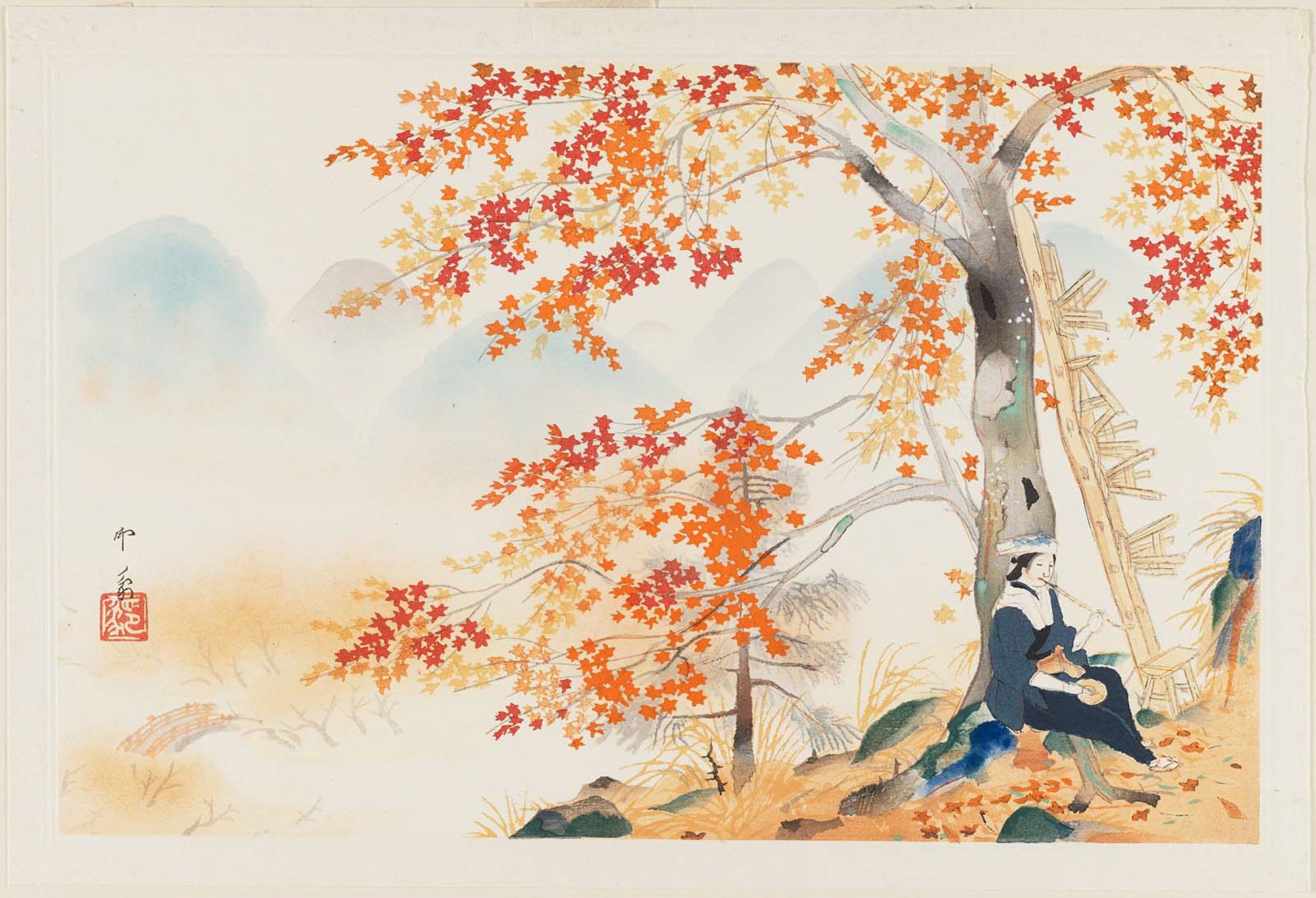
Autumn Maple Leaves at Takao, from the album Eight Views of Kyoto (Kyôto hakkei)
Woodblock print

The Beach at Kaiganji in Sanuki Province (Sanuki Kaiganji no hama), from the series "Collection of Views of Japan II, Kansai Edition (Nihon fukei shu II Kansai hen)"
1934
Color woodblock print; oban

Tea Kettle, section of a sheet from the series "Mirror of Stone Rubbings of Views of the Provinces" (Kohon meihitsu ishizuri kagami)
n.d.
Woodblock print; ishizuri-e, section of harimaze sheet
Featured in Collections
Curated cross-cuts that include this print.
Frequently Asked Questions
Distant View of the Kinryuzan Temple at Asakusa was created by Utagawa Hiroshige (歌川広重) in ca. 1844-1848.
Distant View of the Kinryuzan Temple at Asakusa depicts landscapes.