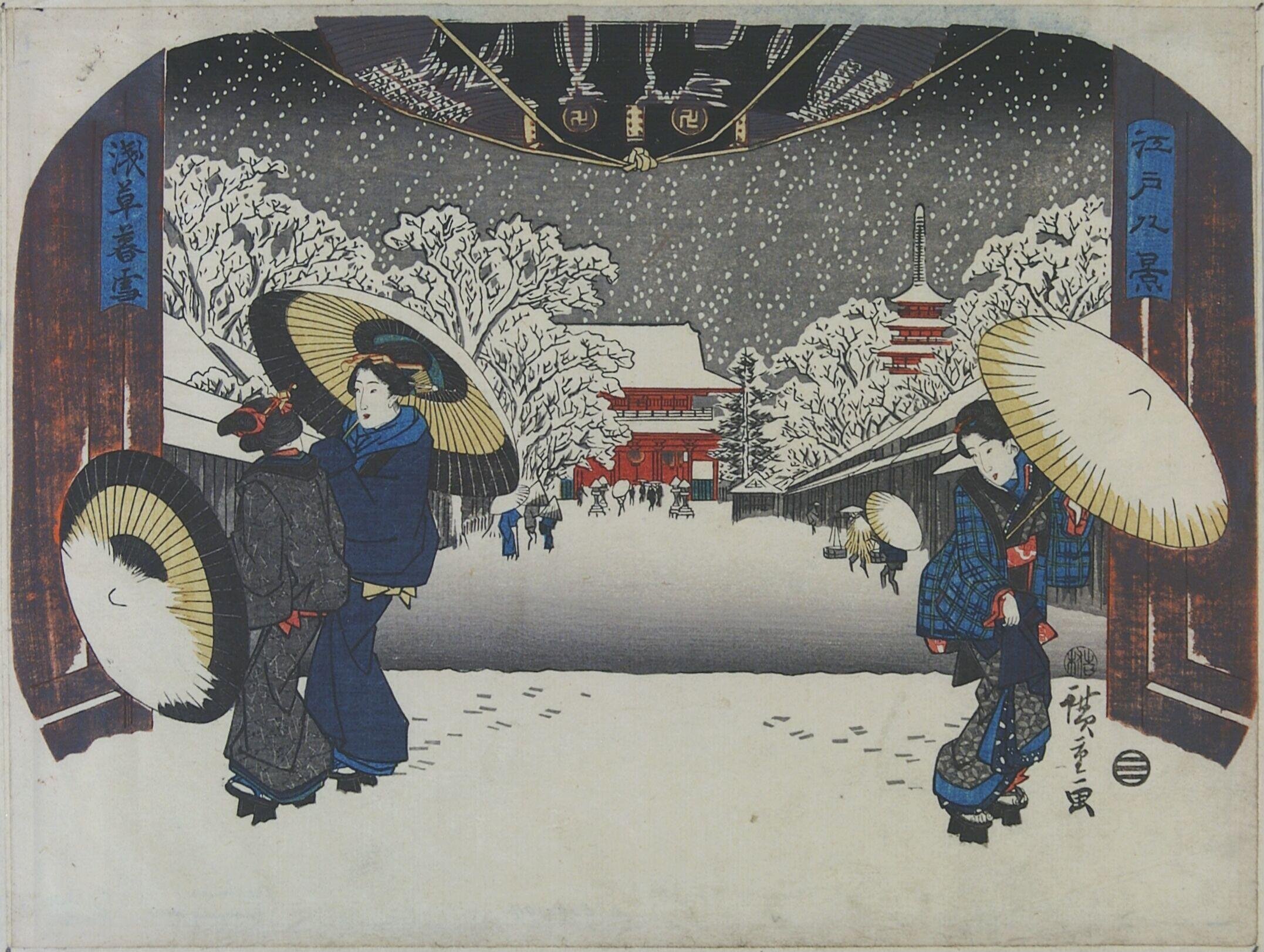
Evening Snow at Asakusa
- Date:
- 1843-1847
- Medium:
- Source:
- Victoria and Albert Museum
Description
Evening Snow at Asakusa, dated 1843 and held by the Victoria and Albert Museum, is an Edo ukiyo-e landscape print by Utagawa Hiroshige that brings the celebrated Sensō-ji temple precincts under a quiet covering of fresh snowfall. Asakusa, in the northeastern part of Edo, was one of the city's great religious and entertainment centres, anchored by the temple to Kannon and surrounded by markets, theatres and teahouses. The 'evening snow' element situates the design within the lineage of the hakkei, or eight views, formula adapted from Chinese landscape traditions, in which specific weather conditions become poetic motifs. In this Utagawa Hiroshige landscape print the great gates and pagoda of Sensō-ji can be glimpsed through a softly grey sky, while pedestrians muffled against the cold cross a foreground of snow-covered ground. Hiroshige uses an Edo ukiyo-e palette of pale blues, greys and a touch of vermilion at the temple to suggest the way snowfall mutes colour and absorbs sound. His handling of the snow itself, achieved through controlled gauffrage and the deliberate reservation of white paper, is one of the marks of his mastery of the landscape print. The Victoria and Albert Museum impression preserves the quietness and atmospheric weight of the design, demonstrating Hiroshige's ability to convert a familiar pilgrimage site into a meditation on seasonal stillness and the temporary beauty of winter in the capital.
More Prints by Utagawa Hiroshige


More Landscapes Prints

Lake Kugushi in Wakasa Province (Wakasa Kugushiko), from the series Souvenirs of Travel I (Tabi miyage dai isshu)"
Wakasa Kugushiko
1920
Color woodblock print; oban
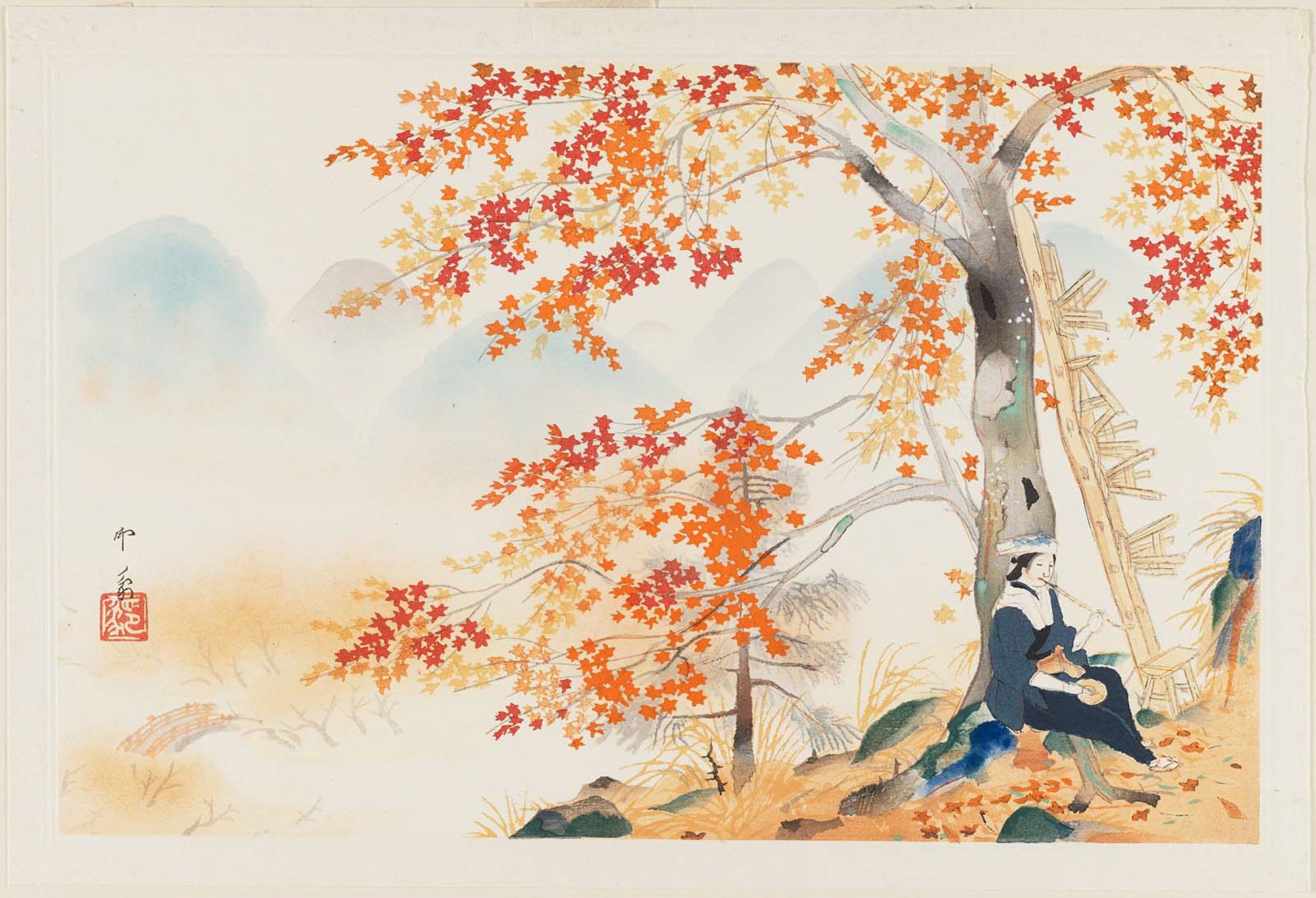
Autumn Maple Leaves at Takao, from the album Eight Views of Kyoto (Kyôto hakkei)
Woodblock print

The Beach at Kaiganji in Sanuki Province (Sanuki Kaiganji no hama), from the series "Collection of Views of Japan II, Kansai Edition (Nihon fukei shu II Kansai hen)"
1934
Color woodblock print; oban

Tea Kettle, section of a sheet from the series "Mirror of Stone Rubbings of Views of the Provinces" (Kohon meihitsu ishizuri kagami)
n.d.
Woodblock print; ishizuri-e, section of harimaze sheet
Featured in Collections
Curated cross-cuts that include this print.
Frequently Asked Questions
Evening Snow at Asakusa was created by Utagawa Hiroshige (歌川広重) in 1843-1847.
Evening Snow at Asakusa depicts landscapes and winter.