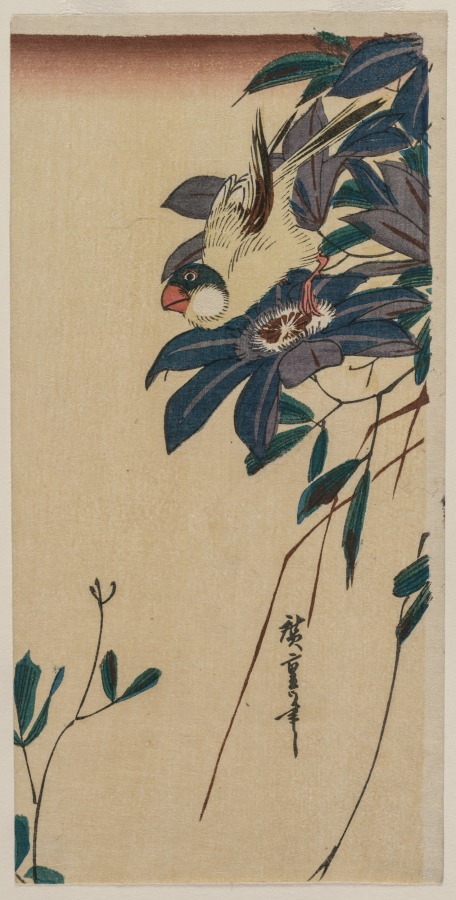
Grosbeak and Clematis
- Date:
- mid-1830s
- Medium:
- color woodblock print
- Source:
- Cleveland Museum of Art
Description
Grosbeak and Clematis is a bird-and-flower print by Utagawa Hiroshige, dated to about 1834 and held today by the Cleveland Museum of Art. The composition pairs a single grosbeak, perched along an arched stem, with a flowering clematis vine. Pale violet-blue petals open across the sheet in deliberate intervals, and a poem inscribed in fine calligraphy occupies the upper portion of the design. The format is the tall narrow chuban tanzaku, a shape Hiroshige favoured for kacho-e because it accommodated both a continuous botanical motif and a band of inscribed verse. While Hiroshige is best known for the Edo ukiyo-e landscape print, his bird-and-flower work was equally accomplished and often more technically demanding, with the publisher and engraver working in close concert to translate his original brush drawing into a few subtly modulated blocks. Bokashi gradations along the bird's breast and the gentle wash beneath the flowers indicate the level of attention given to a single sheet of this kind. Grosbeak and Clematis sits within the dense ecosystem of Edo-period printed seasonal imagery, in which urban viewers consumed birds, flowers, and verses as portable evocations of garden and field. The Cleveland Museum of Art's impression is part of one of the most comprehensive American holdings of nineteenth-century Japanese prints, and the design is sought by specialist collectors as an exemplar of Hiroshige's quieter, more lyrical mode.
More Prints by Utagawa Hiroshige


More Landscapes Prints

Lake Kugushi in Wakasa Province (Wakasa Kugushiko), from the series Souvenirs of Travel I (Tabi miyage dai isshu)"
Wakasa Kugushiko
1920
Color woodblock print; oban
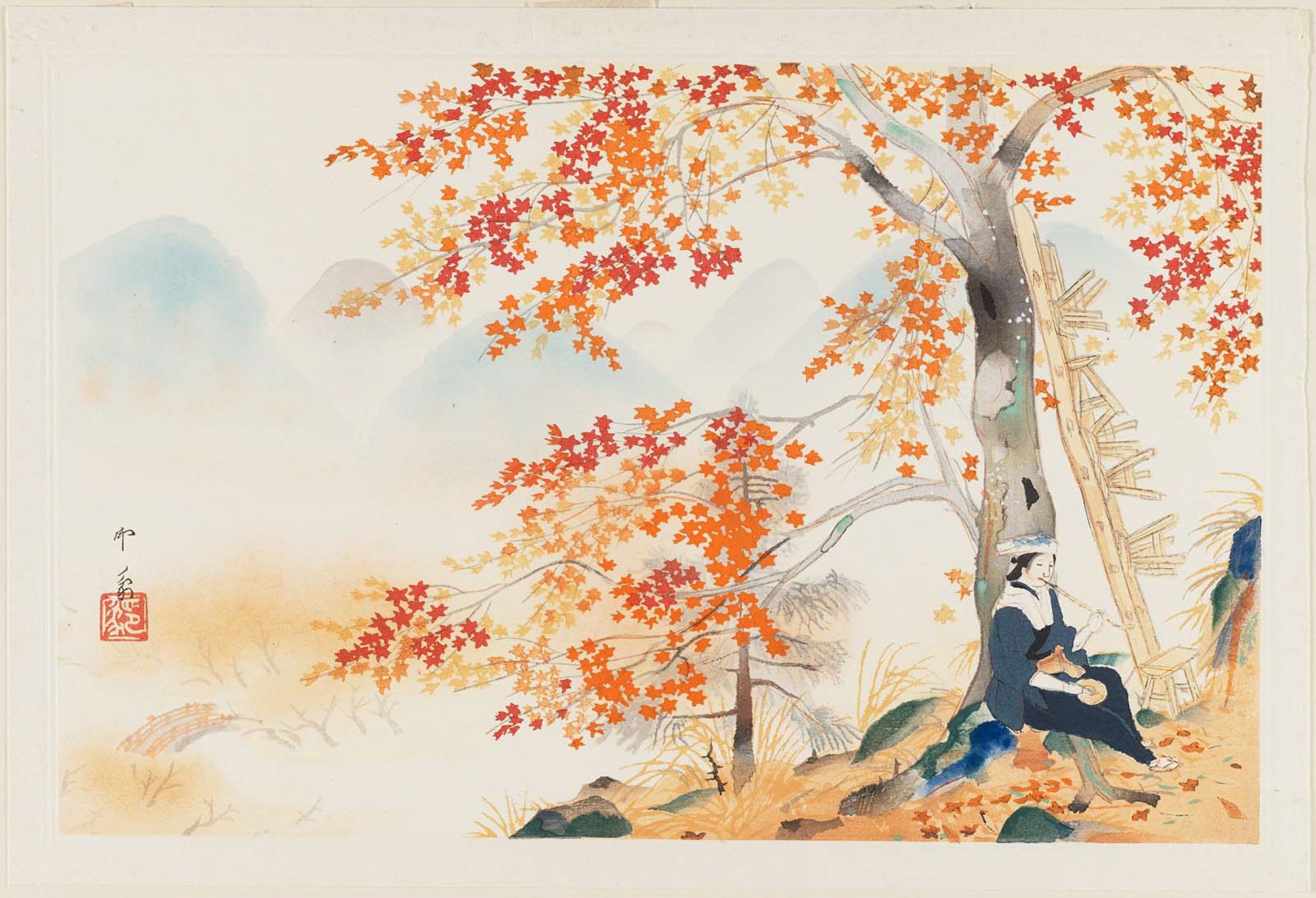
Autumn Maple Leaves at Takao, from the album Eight Views of Kyoto (Kyôto hakkei)
Woodblock print

The Beach at Kaiganji in Sanuki Province (Sanuki Kaiganji no hama), from the series "Collection of Views of Japan II, Kansai Edition (Nihon fukei shu II Kansai hen)"
1934
Color woodblock print; oban

Tea Kettle, section of a sheet from the series "Mirror of Stone Rubbings of Views of the Provinces" (Kohon meihitsu ishizuri kagami)
n.d.
Woodblock print; ishizuri-e, section of harimaze sheet
Featured in Collections
Curated cross-cuts that include this print.
Frequently Asked Questions
Grosbeak and Clematis was created by Utagawa Hiroshige (歌川広重) in mid-1830s.
Grosbeak and Clematis depicts landscapes.