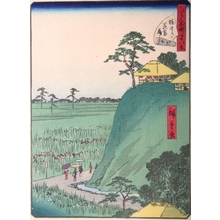
Horikiri
- Medium:
- Woodblock print
- Source:
- Art Gallery of Greater Victoria
- Image courtesy of
- Art Gallery of Greater Victoria
Description
Horikiri, a marshy area in the eastern outskirts of Edo along the Ayase River, was celebrated for its iris gardens, where densely planted kakitsubata irises flowered in late spring. The iris gardens of Horikiri became a specific meisho-e subject in the Edo period, and Hiroshige's treatment would emphasize the thick plantings of violet and purple irises emerging from the water, viewed from narrow earthen paths between the beds. The composition likely employs a low vantage point that places the viewer among the flowers, with the iris stalks and blooms filling the foreground and lower registers while a simple sky and distant tree line complete the background. The technical challenge of printing the iris's distinctive purple—a color prone to fading in fugitive vegetable dyes—required careful pigment selection; later prints in some series show the violet shifted toward grey as the ink aged. Horikiri's gardens attracted urban visitors escaping the dense city for a brief encounter with managed nature, and the site's seasonal specificity gave Hiroshige's composition a precise temporal identity.
More Prints by Utagawa Hiroshige


More Urban Scenes Prints
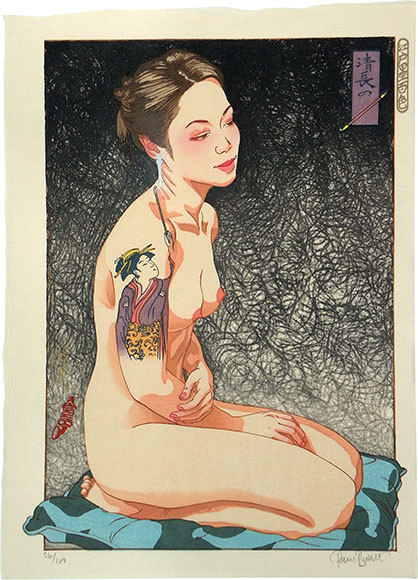
A Hundred Shades of Ink of Edo: Kiyonaga's Pipe (Edo zumi hyaku shoku: Kiyonaga no kiseru)
Woodblock print

View of Kabuki Theater from Matsuya (Ginza Matsuya yori Kabukiza), no. 3 from the series "Pictures of Ginza, First Series (Gashu Ginza dai isshu)"
1928
Color lithograph

Distant View of Mitsukoshi Movie Theater in Shinjuku from the Sixth Floor of Hoteiya (Hoteiya rokkai kara Shinjuku Mitsukoshi Musashi no kan enbo zu), no. 1 from the series "Scenery of Shinjuku (Gashu Shinjuku fukei)"
1930
Color lithograph
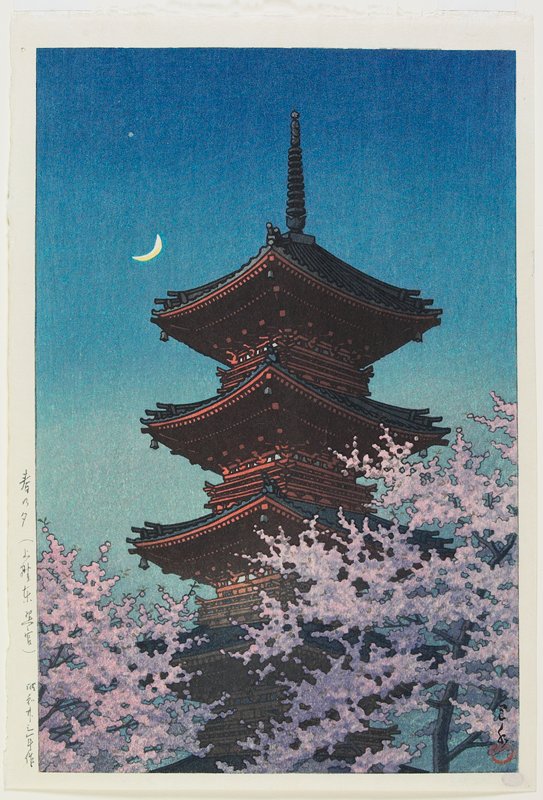
Spring Dusk at the Tōshō Shrine in Ueno
1948
Woodblock print, ink and color on paper
Featured in Collections
Curated cross-cuts that include this print.
Frequently Asked Questions
Horikiri was created by Utagawa Hiroshige (歌川広重).
Horikiri depicts urban scenes and landscapes.