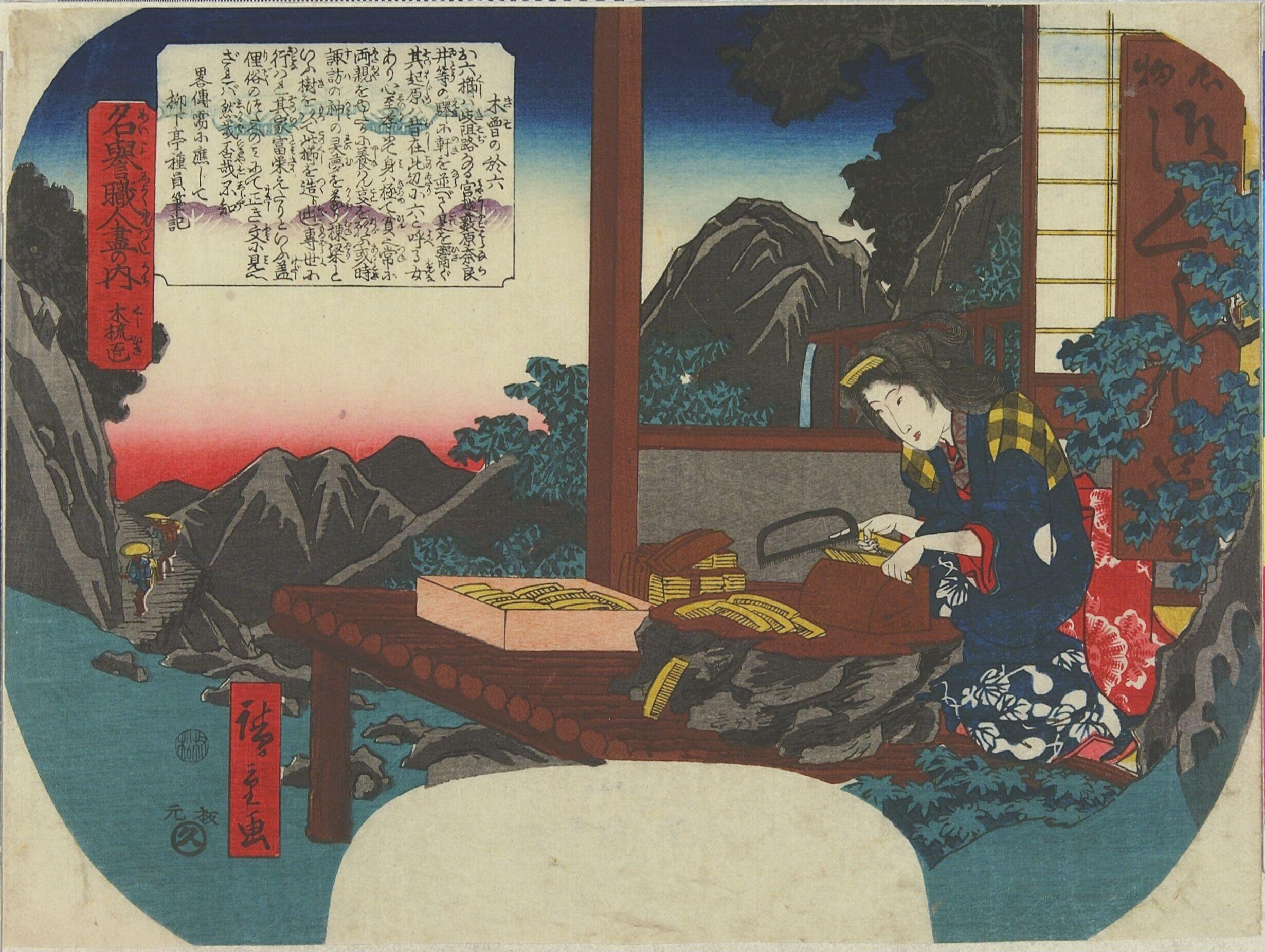
Kiso no Oroku Combs
- Date:
- 1843-47
- Medium:
- Source:
- Victoria and Albert Museum
Description
Created by Utagawa Hiroshige in 1843, Kiso no Oroku Combs is an Edo ukiyo-e woodblock print held in the collection of the Victoria and Albert Museum in London. The image draws on a popular regional legend associated with the post-station town of Yabuhara along the Nakasendo highway in the mountainous Kiso valley. Oroku, the daughter of a local craftsman, was said to have devised the elegant hair combs made from the dense, fine-grained wood of the minebari tree that became one of the most sought-after souvenirs of the Kiso road. Travelers carried them home as proof of having braved the long inland route between Edo and Kyoto. Hiroshige treats the subject with the gentle storytelling instinct that distinguishes his figure work from his more famous landscape print series. The young woman is shown attending to her hair or arranging combs in a tatami-floored interior, framed by sliding doors and the modest furnishings of a provincial workshop. While Hiroshige is best remembered for landscape print compositions such as the Tokaido and Kisokaido station series, this design demonstrates his ability to fold local craft traditions, regional history, and the romance of travel into a single intimate scene. The V and A impression preserves the soft early Tenpo-era palette of muted blues, ochres, and warm pinks that gives the print its quiet domestic atmosphere. As an example of mid-career Hiroshige, the sheet shows how Edo publishers used famous-place subjects to market not only scenery but the human stories attached to roadside towns.
More Prints by Utagawa Hiroshige


More Landscapes Prints

Lake Kugushi in Wakasa Province (Wakasa Kugushiko), from the series Souvenirs of Travel I (Tabi miyage dai isshu)"
Wakasa Kugushiko
1920
Color woodblock print; oban
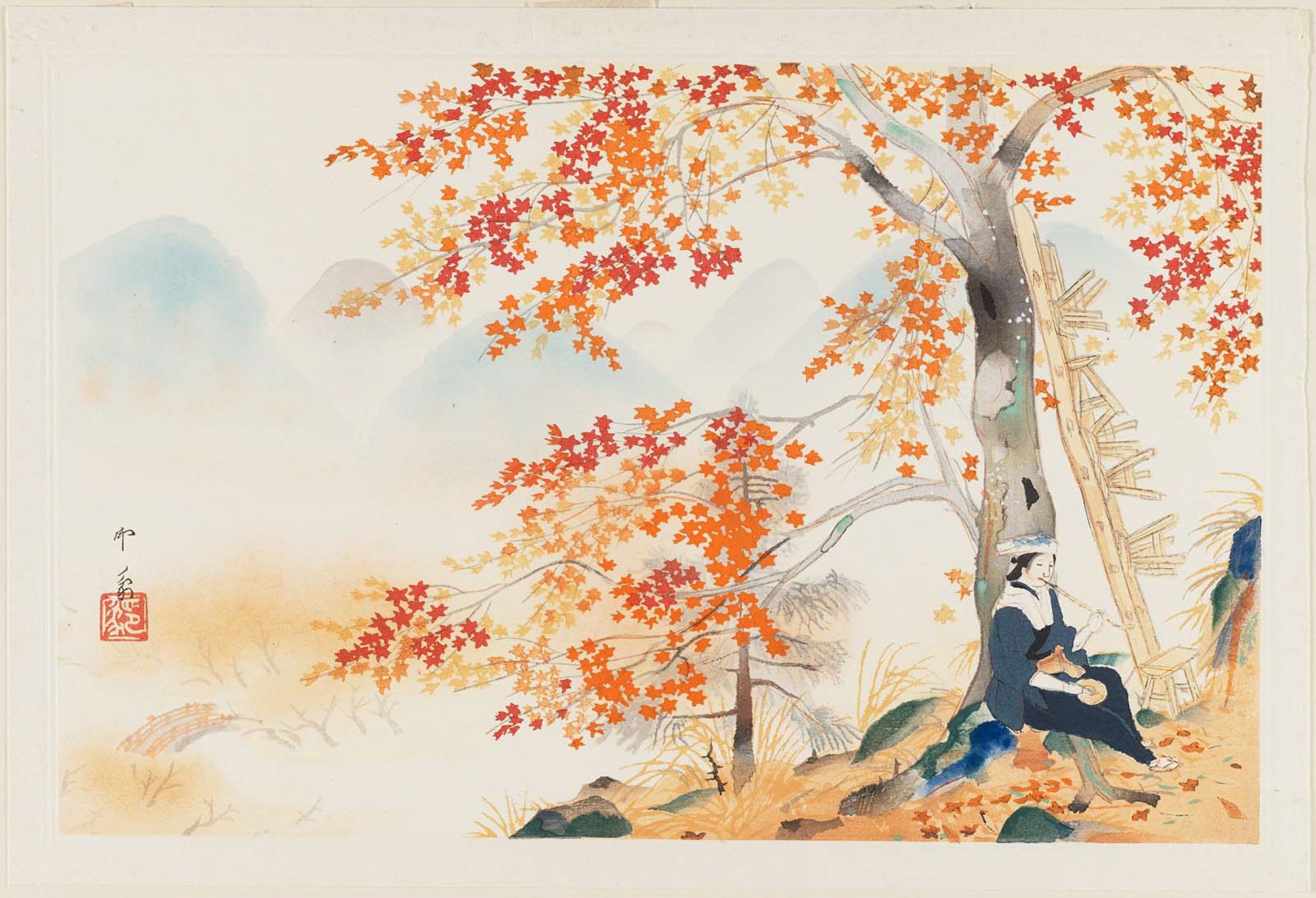
Autumn Maple Leaves at Takao, from the album Eight Views of Kyoto (Kyôto hakkei)
Woodblock print

The Beach at Kaiganji in Sanuki Province (Sanuki Kaiganji no hama), from the series "Collection of Views of Japan II, Kansai Edition (Nihon fukei shu II Kansai hen)"
1934
Color woodblock print; oban

Tea Kettle, section of a sheet from the series "Mirror of Stone Rubbings of Views of the Provinces" (Kohon meihitsu ishizuri kagami)
n.d.
Woodblock print; ishizuri-e, section of harimaze sheet
Featured in Collections
Curated cross-cuts that include this print.
Frequently Asked Questions
Kiso no Oroku Combs was created by Utagawa Hiroshige (歌川広重) in 1843-47.
Kiso no Oroku Combs depicts landscapes.