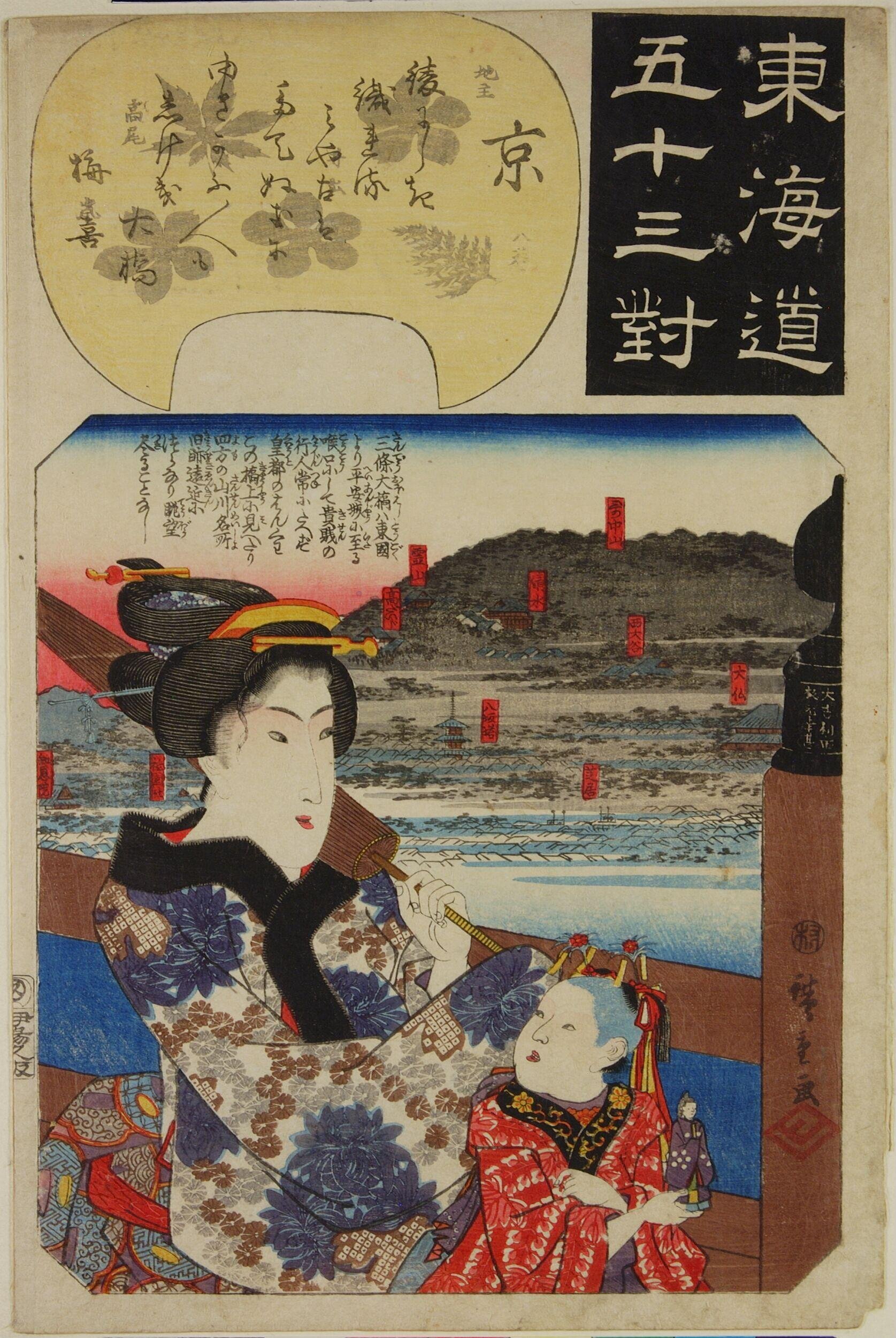
Kyoto (Kyō)
- Medium:
- Source:
- Victoria and Albert Museum
Description
In the foreground, a woman with an elaborate black coiffure and ornate hairpins stands in three-quarter view, wearing a floral kimono (purple and white blossoms with a black-and-white checked underlayer) with a black collar; she holds a brown pipe to her lips with one hand. Beside her a round-faced child in a red kimono with tasseled hair ornaments looks up at her, holding a small figurine. Behind them a panoramic landscape in blue and grey tones shows a river or bay before a low mountain dotted with red cartouches bearing place names, rendered in a pink-to-blue gradient sky; a fan-shaped cartouche at top left holds columns of Japanese text over a pale yellow ground, beside a black title cartouche reading "Tōkaidō Gojūsan Tsui" and "Kyō," identifying this as the Kyoto print from Utagawa Hiroshige's series.
More Prints by Utagawa Hiroshige


More Landscapes Prints

Lake Kugushi in Wakasa Province (Wakasa Kugushiko), from the series Souvenirs of Travel I (Tabi miyage dai isshu)"
Wakasa Kugushiko
1920
Color woodblock print; oban
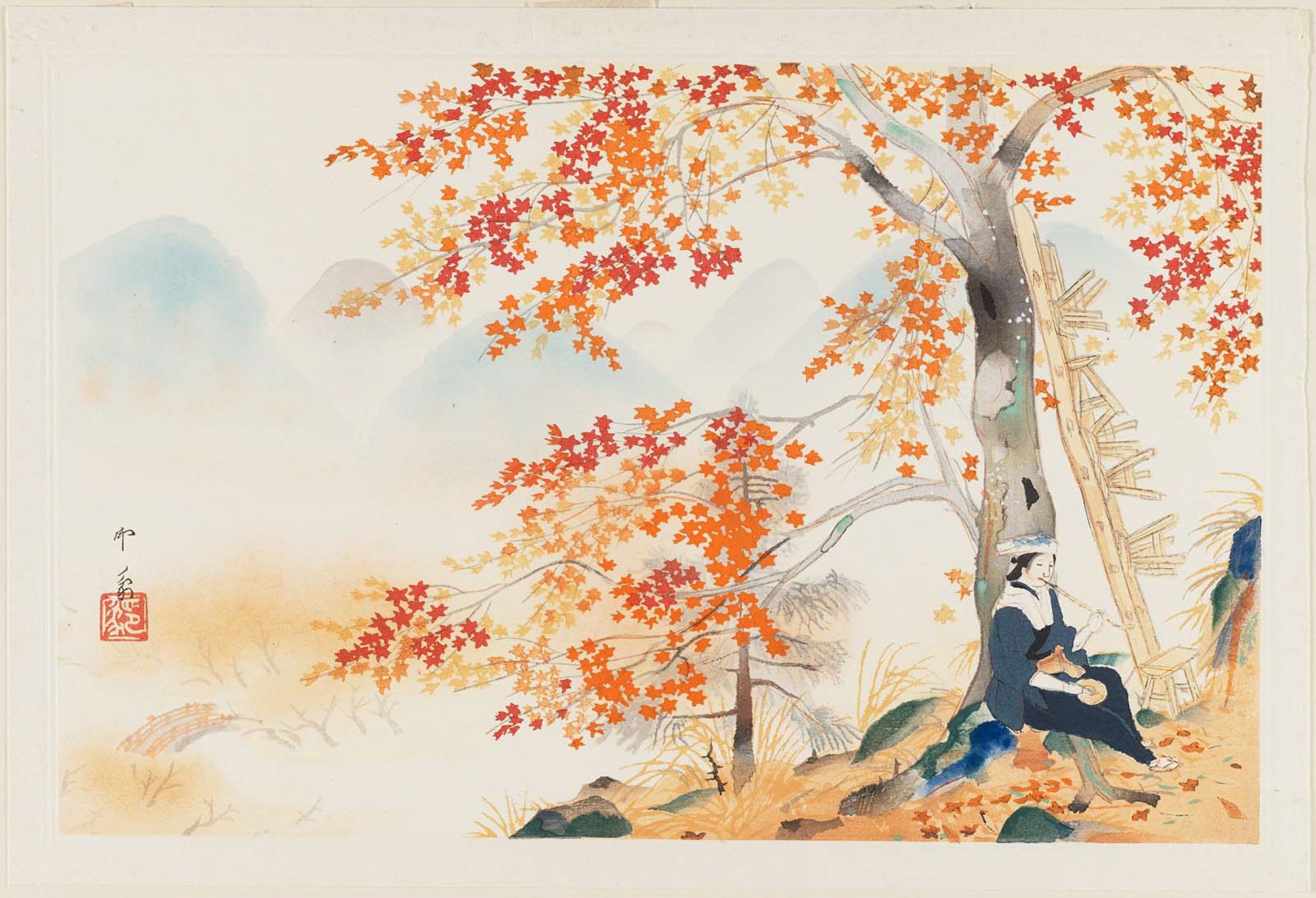
Autumn Maple Leaves at Takao, from the album Eight Views of Kyoto (Kyôto hakkei)
Woodblock print

The Beach at Kaiganji in Sanuki Province (Sanuki Kaiganji no hama), from the series "Collection of Views of Japan II, Kansai Edition (Nihon fukei shu II Kansai hen)"
1934
Color woodblock print; oban

Tea Kettle, section of a sheet from the series "Mirror of Stone Rubbings of Views of the Provinces" (Kohon meihitsu ishizuri kagami)
n.d.
Woodblock print; ishizuri-e, section of harimaze sheet
Featured in Collections
Curated cross-cuts that include this print.
Frequently Asked Questions
Kyoto (Kyō) was created by Utagawa Hiroshige (歌川広重).
Kyoto (Kyō) depicts landscapes.