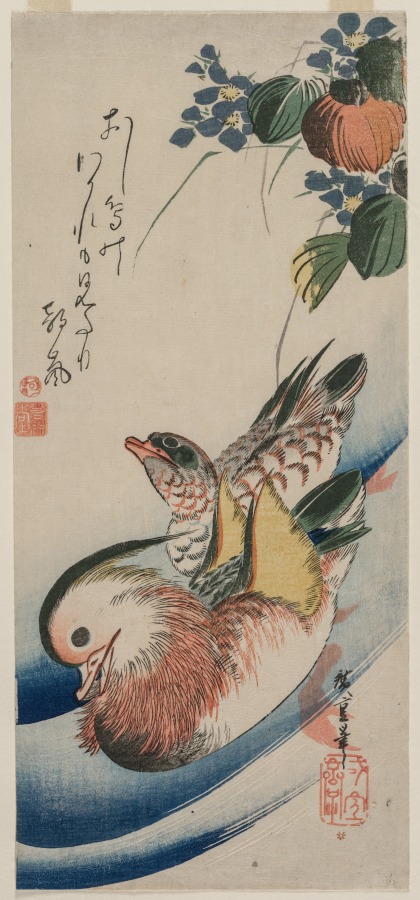
Mandarin Ducks and Flowering Plants
- Date:
- early or mid-1830s
- Medium:
- color woodblock print
- Source:
- Cleveland Museum of Art
Description
Dated about 1830 and held in the Cleveland Museum of Art, Mandarin Ducks and Flowering Plants is an Edo ukiyo-e bird and flower print by Utagawa Hiroshige. The mandarin duck, or oshidori, was a beloved subject in East Asian art, traditionally paired as a symbol of marital fidelity because the brilliantly plumed male and softer brown female were thought to mate for life. Hiroshige presents both birds in close-up at the water's edge, the male's iridescent crest, vermilion bill, and flared sail-like wing feathers contrasted with the muted barring of his partner. Around them, late spring or early summer plants are loosely indicated: arching grasses, a flowering iris or marsh marigold, and rippling ribbons of blue water. The vertical format, often called a chu-tanzaku, was favored for pairs of birds and seasonal sprays, and Hiroshige uses it to direct the eye downward along the slope of the male's body to the water below. Although celebrated above all for his landscape print series of the Tokaido and Edo views, Hiroshige sustained a parallel practice in kacho-e or bird and flower prints. These sheets show his fluency with the conventions of classical Chinese flower painting filtered through Edo workshop printing. The Cleveland impression preserves the gentle bokashi gradations and crisp keyblock lines that mark his finest kacho-e designs of the early 1830s.
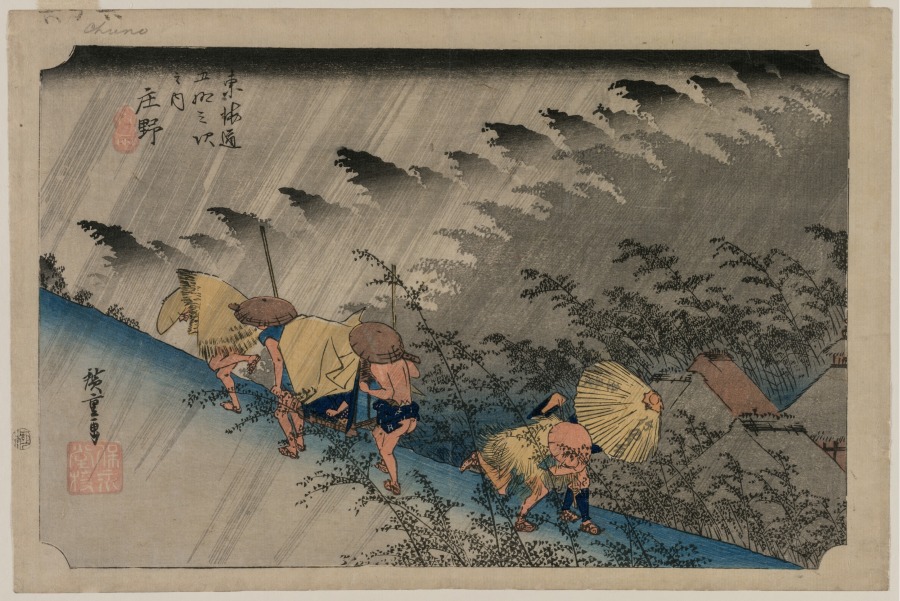
More Prints by Utagawa Hiroshige


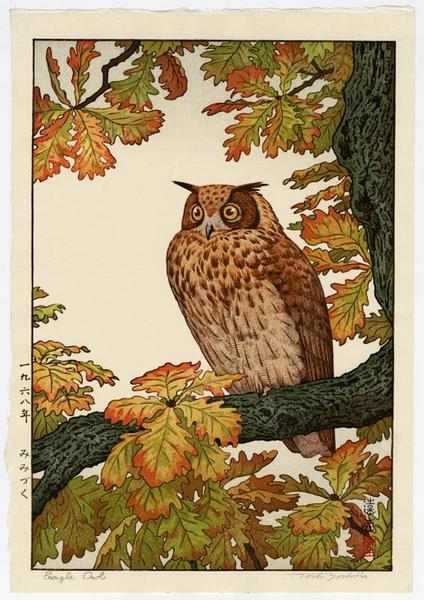
More Birds & Flowers Prints
Featured in Collections
Curated cross-cuts that include this print.
Frequently Asked Questions
Mandarin Ducks and Flowering Plants was created by Utagawa Hiroshige (歌川広重) in early or mid-1830s.
Mandarin Ducks and Flowering Plants depicts birds & flowers and landscapes.