
Nihon Bridge seen in the Snow (Nihonbashi setchu no kei), from the series "Famous Views in the Eastern Capital (Toto meisho)"
- Date:
- 1837/38
- Medium:
- Color woodblock print; chu-tanzaku
- Source:
- Art Institute of Chicago
Description
Nihon Bridge Seen in the Snow is one of Utagawa Hiroshige's many treatments of Edo's most symbolically important crossing, which served as both the official starting point of the Tokaido and the commercial heart of the city. The print belongs to the series Famous Views in the Eastern Capital (Toto meisho) and is dated to 1837. The Art Institute of Chicago holds an impression of the sheet (object 13226). Hiroshige shows the timber arch of Nihonbashi under heavy snow, with the storehouses and shops of the merchant quarter banked along the canal beyond. Pedestrians cross the bridge in a thin line, hunched under cloaks and umbrellas, while boats are visible on the water below. The print exploits the classic Edo ukiyo-e palette for snow scenes: a dominant white of unprinted paper, occasional gray washes for the sky, and small concentrated accents of indigo, vermilion, and warm brown in the buildings and figures. As a landscape print, the design highlights Hiroshige's interest in transforming the same urban landmark across weather and season, treating Nihonbashi as a stage on which the changing surface of the city could be read. The Toto meisho series sits between his earlier kacho-ga and travel prints and the mature city portraits that would follow in the late 1850s, and the Nihonbashi snowscape is among its most concentrated and atmospheric sheets.
More Prints by Utagawa Hiroshige


More Landscapes Prints

Lake Kugushi in Wakasa Province (Wakasa Kugushiko), from the series Souvenirs of Travel I (Tabi miyage dai isshu)"
Wakasa Kugushiko
1920
Color woodblock print; oban
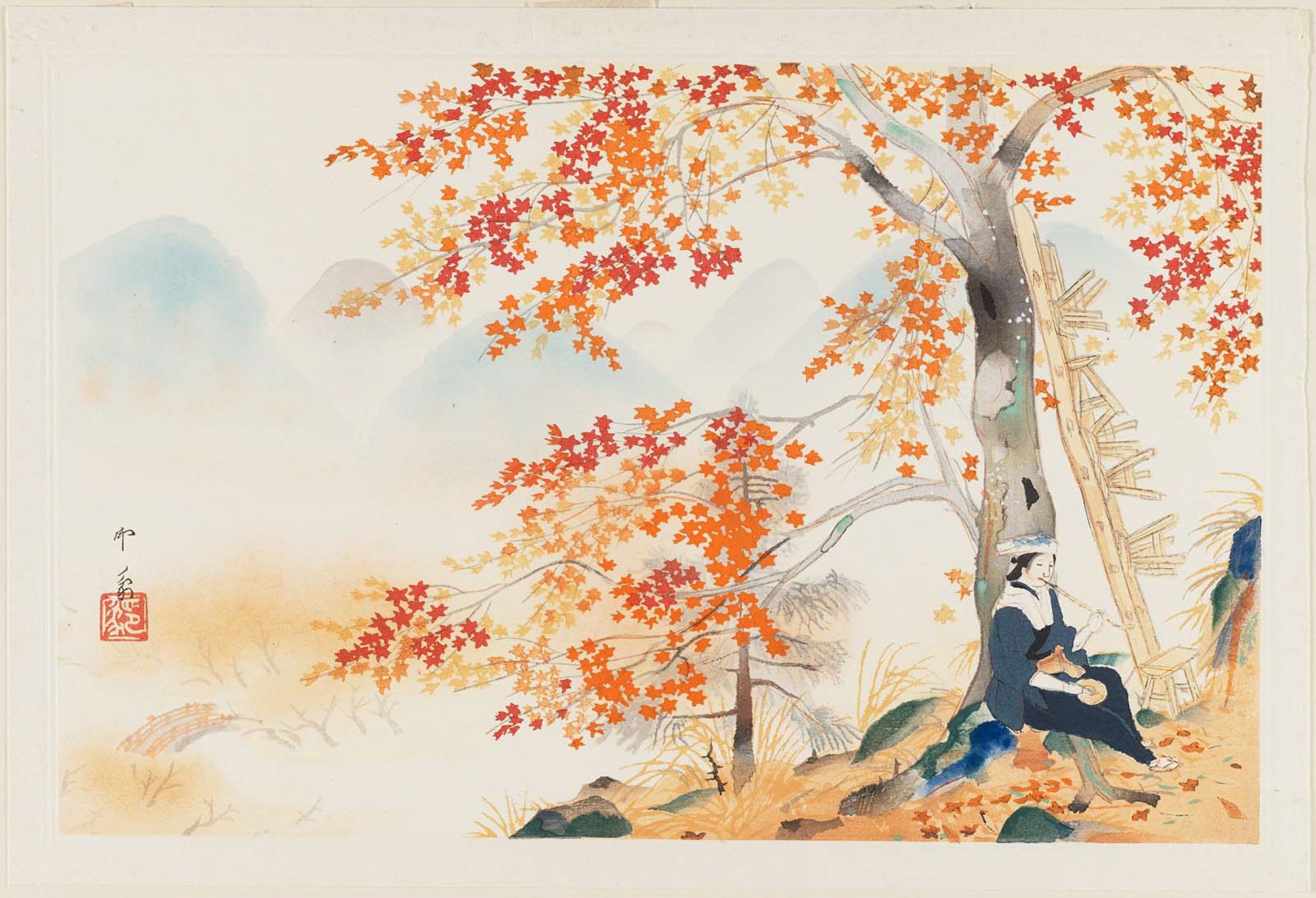
Autumn Maple Leaves at Takao, from the album Eight Views of Kyoto (Kyôto hakkei)
Woodblock print

The Beach at Kaiganji in Sanuki Province (Sanuki Kaiganji no hama), from the series "Collection of Views of Japan II, Kansai Edition (Nihon fukei shu II Kansai hen)"
1934
Color woodblock print; oban

Tea Kettle, section of a sheet from the series "Mirror of Stone Rubbings of Views of the Provinces" (Kohon meihitsu ishizuri kagami)
n.d.
Woodblock print; ishizuri-e, section of harimaze sheet
Featured in Collections
Curated cross-cuts that include this print.
Frequently Asked Questions
Nihon Bridge seen in the Snow (Nihonbashi setchu no kei), from the series "Famous Views in the Eastern Capital (Toto meisho)" was created by Utagawa Hiroshige (歌川広重) in 1837/38.
Nihon Bridge seen in the Snow (Nihonbashi setchu no kei), from the series "Famous Views in the Eastern Capital (Toto meisho)" depicts landscapes, bridges, and winter.