
Suido Bridge and Surugadai (Suidobashi Surugadai), from the series "One Hundred Famous Views of Edo (Meisho Edo hyakkei)"
- Series:
- One Hundred Famous Views of Edo (print 48 of 118)
- Medium:
- Color woodblock print
- Dimensions:
- 36 × 24.3 cm
- Source:
- Art Institute of Chicago
Description
This oban-format nishiki-e from the One Hundred Famous Views of Edo (c. 1857) depicts the Surugadai district of Edo with carp-shaped kite streamers (koinobori) filling the upper register. The koinobori, flown during the Boys' Festival in the fifth lunar month, are rendered in vivid pigments—crimson, black, and white—and dominate the pictorial space through an exaggerated close-up cropping device. Through the gaps between the streamers, the Kanda River, the Suido Bridge, and the tiled rooftops of Edo recede into a blue-grey distance. A single streamer curves across the upper edge of the composition, cropped by the picture boundary. This strategy of placing large-scale foreground objects against a receding landscape is characteristic of Hiroshige's late designs, compressing near and far elements into a single picture field and creating a visual rhythm between the decorative, pattern-like quality of the koinobori and the atmospheric depth of the cityscape below.
More Prints by Utagawa Hiroshige


More Landscapes Prints

Lake Kugushi in Wakasa Province (Wakasa Kugushiko), from the series Souvenirs of Travel I (Tabi miyage dai isshu)"
Wakasa Kugushiko
1920
Color woodblock print; oban
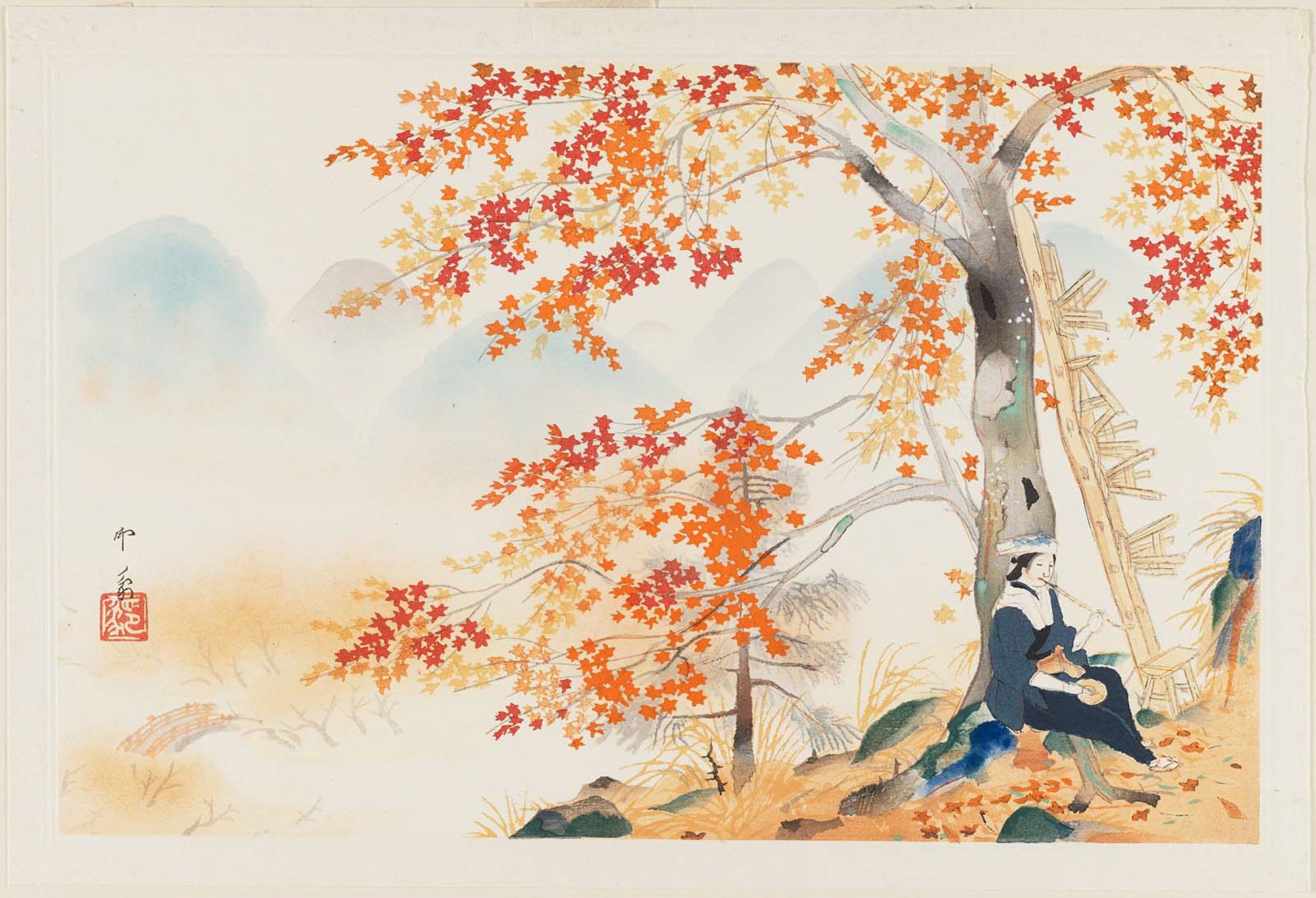
Autumn Maple Leaves at Takao, from the album Eight Views of Kyoto (Kyôto hakkei)
Woodblock print

The Beach at Kaiganji in Sanuki Province (Sanuki Kaiganji no hama), from the series "Collection of Views of Japan II, Kansai Edition (Nihon fukei shu II Kansai hen)"
1934
Color woodblock print; oban

Tea Kettle, section of a sheet from the series "Mirror of Stone Rubbings of Views of the Provinces" (Kohon meihitsu ishizuri kagami)
n.d.
Woodblock print; ishizuri-e, section of harimaze sheet
Featured in Collections
Curated cross-cuts that include this print.
Frequently Asked Questions
Suido Bridge and Surugadai (Suidobashi Surugadai), from the series "One Hundred Famous Views of Edo (Meisho Edo hyakkei)" was created by Utagawa Hiroshige (歌川広重).
Yes — Suido Bridge and Surugadai (Suidobashi Surugadai), from the series "One Hundred Famous Views of Edo (Meisho Edo hyakkei)" is part of the One Hundred Famous Views of Edo series (print 48 of 118) by Utagawa Hiroshige.
Suido Bridge and Surugadai (Suidobashi Surugadai), from the series "One Hundred Famous Views of Edo (Meisho Edo hyakkei)" depicts landscapes, edo & tokyo, and famous places (meisho-e).
Suido Bridge and Surugadai (Suidobashi Surugadai), from the series "One Hundred Famous Views of Edo (Meisho Edo hyakkei)" measures 36 × 24.3 cm.