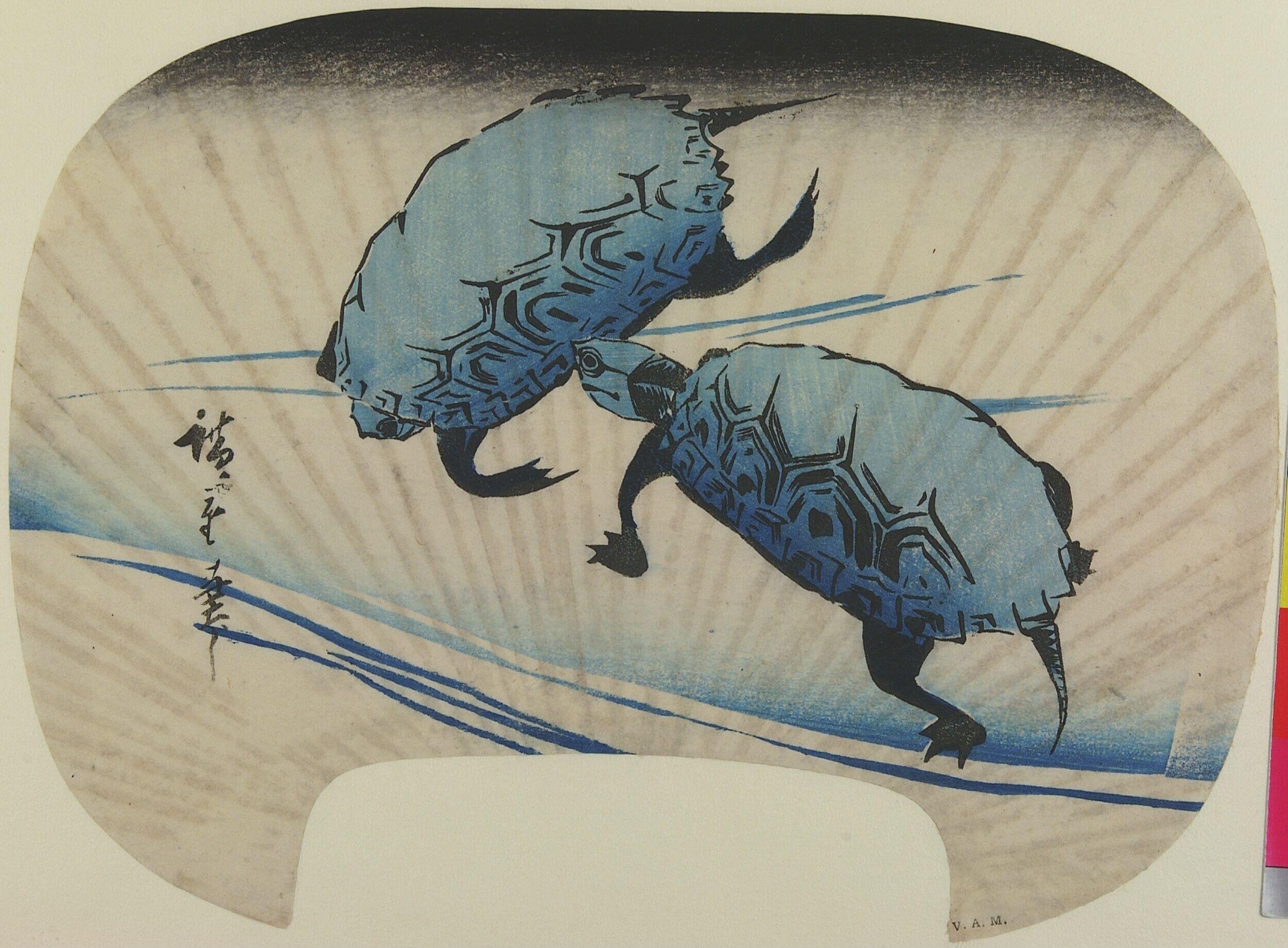
Swimming Turtles
- Date:
- ca. 1840-1842
- Medium:
- Source:
- Victoria and Albert Museum
Description
Swimming Turtles, a small kacho-e or bird-and-flower print of around 1840, demonstrates that Utagawa Hiroshige, although celebrated above all as the master of the landscape print and Edo ukiyo-e townscape, was equally fluent in the close observation of nature. The composition gathers a cluster of soft-shell turtles into a tight diagonal across the sheet, their shells overlapping in browns and ochres against a flat band of blue-green water. Soft tendrils of pondweed and a few floating petals frame the group above and below. Turtles in East Asian visual culture carry layered symbolism: longevity, steadiness, and the cosmological associations of the four directional creatures. By tightening his viewpoint to almost touch the surface of the water, Hiroshige creates the same sensation of intimate proximity to a natural subject that he achieved in his celebrated bird-on-branch prints, while simultaneously testing the limits of negative space within the Edo ukiyo-e tradition. The carving of the reticulated shells and the gentle bokashi gradation of the water bed both reflect the publisher's investment in high-quality blockwork. The print is preserved in the Japanese collection of the Victoria and Albert Museum, where it accompanies a strong representation of Hiroshige's natural-history subjects.
More Prints by Utagawa Hiroshige


More Landscapes Prints

Lake Kugushi in Wakasa Province (Wakasa Kugushiko), from the series Souvenirs of Travel I (Tabi miyage dai isshu)"
Wakasa Kugushiko
1920
Color woodblock print; oban
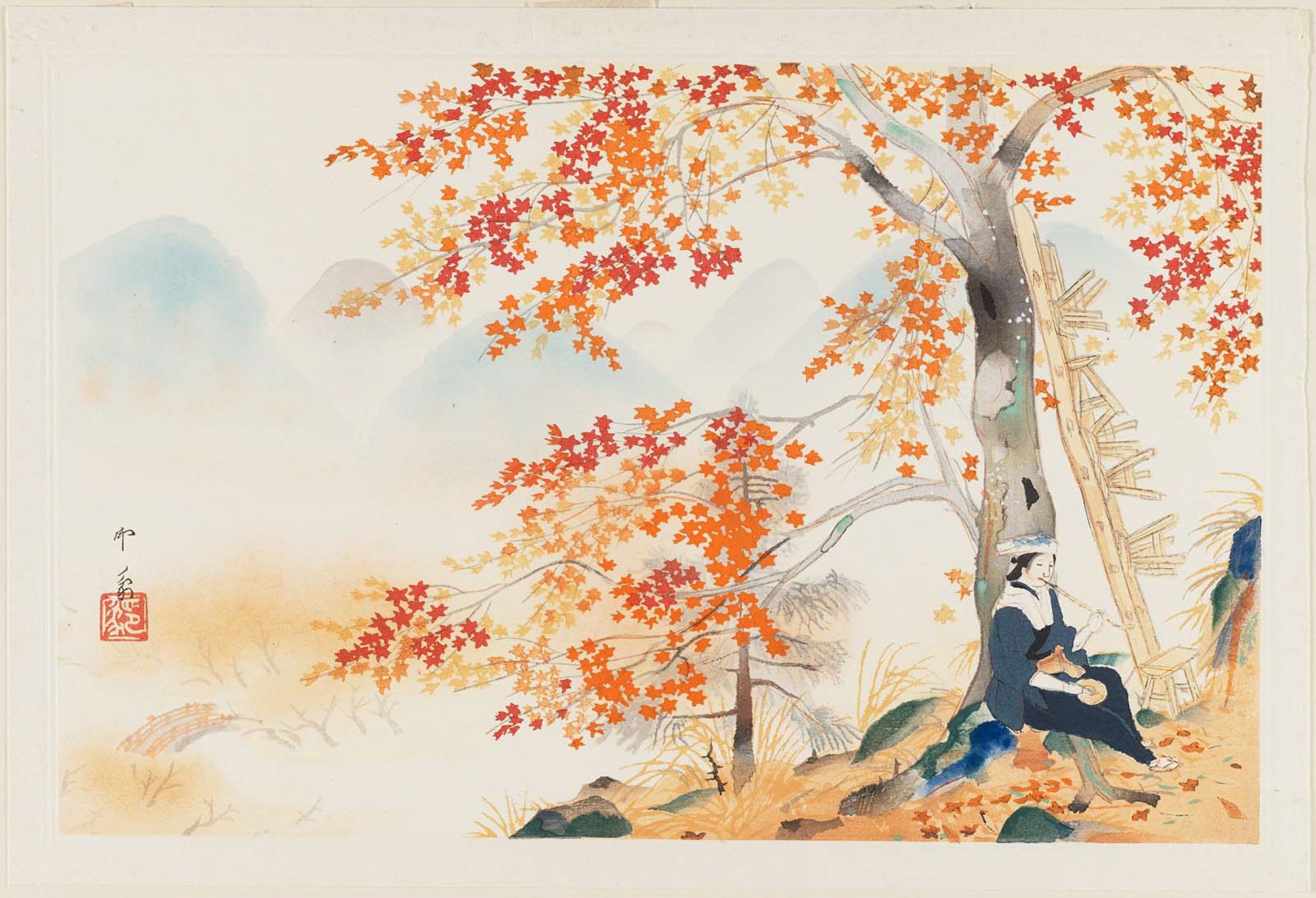
Autumn Maple Leaves at Takao, from the album Eight Views of Kyoto (Kyôto hakkei)
Woodblock print

The Beach at Kaiganji in Sanuki Province (Sanuki Kaiganji no hama), from the series "Collection of Views of Japan II, Kansai Edition (Nihon fukei shu II Kansai hen)"
1934
Color woodblock print; oban

Tea Kettle, section of a sheet from the series "Mirror of Stone Rubbings of Views of the Provinces" (Kohon meihitsu ishizuri kagami)
n.d.
Woodblock print; ishizuri-e, section of harimaze sheet
Featured in Collections
Curated cross-cuts that include this print.
Frequently Asked Questions
Swimming Turtles was created by Utagawa Hiroshige (歌川広重) in ca. 1840-1842.
Swimming Turtles depicts landscapes.