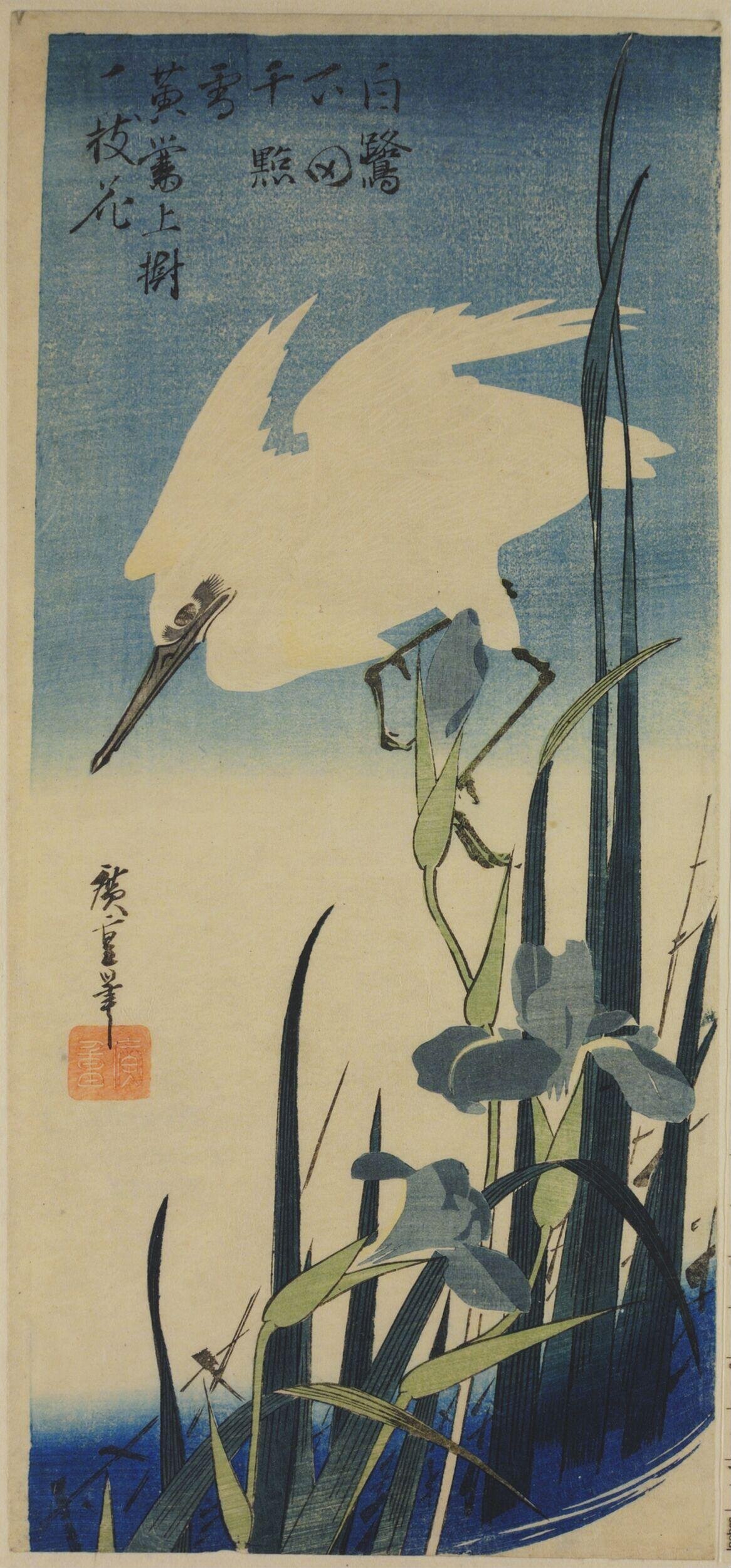
White heron landing behind irises
- Date:
- early 1830s
- Medium:
- Source:
- Victoria and Albert Museum
Description
White Heron Landing Behind Irises, dated 1830 and held by the Victoria and Albert Museum, is a kacho-e, or bird-and-flower print, by Utagawa Hiroshige. Although best known for his Edo ukiyo-e landscape prints, Hiroshige was also a leading designer of bird-and-flower compositions, and this image represents his sensitive engagement with that genre at an early stage in his mature career. The composition juxtaposes a white heron, descending or alighting with wings poised, against a cluster of tall purple irises, their leafy blades reaching upward. The use of the upright tanzaku, or pillar-print format, was particularly common in such designs, allowing for a vertical pictorial conversation between the bird's body and the verticality of the flower stalks. The combination of heron and iris carries a seasonal charge of late spring or early summer and resonates with classical waka and haiku traditions in which water birds and waterside plants commonly appear. Hiroshige's restrained palette of white, indigo, and green, set off by careful gradation in the background, demonstrates how the medium of the woodblock could distill nature into elegantly economical form. Bird-and-flower prints by Hiroshige were widely admired both in Japan and later in Europe, where they influenced artists such as Whistler and Van Gogh. The V&A sheet stands as a fine example of his contribution to the genre and complements his better-known landscape work, reminding viewers that he was a comprehensive observer of the natural world that surrounded the Edo townspeople.
More Prints by Utagawa Hiroshige


More Birds & Flowers Prints
Featured in Collections
Curated cross-cuts that include this print.
Frequently Asked Questions
White heron landing behind irises was created by Utagawa Hiroshige (歌川広重) in early 1830s.
White heron landing behind irises depicts birds & flowers and landscapes.