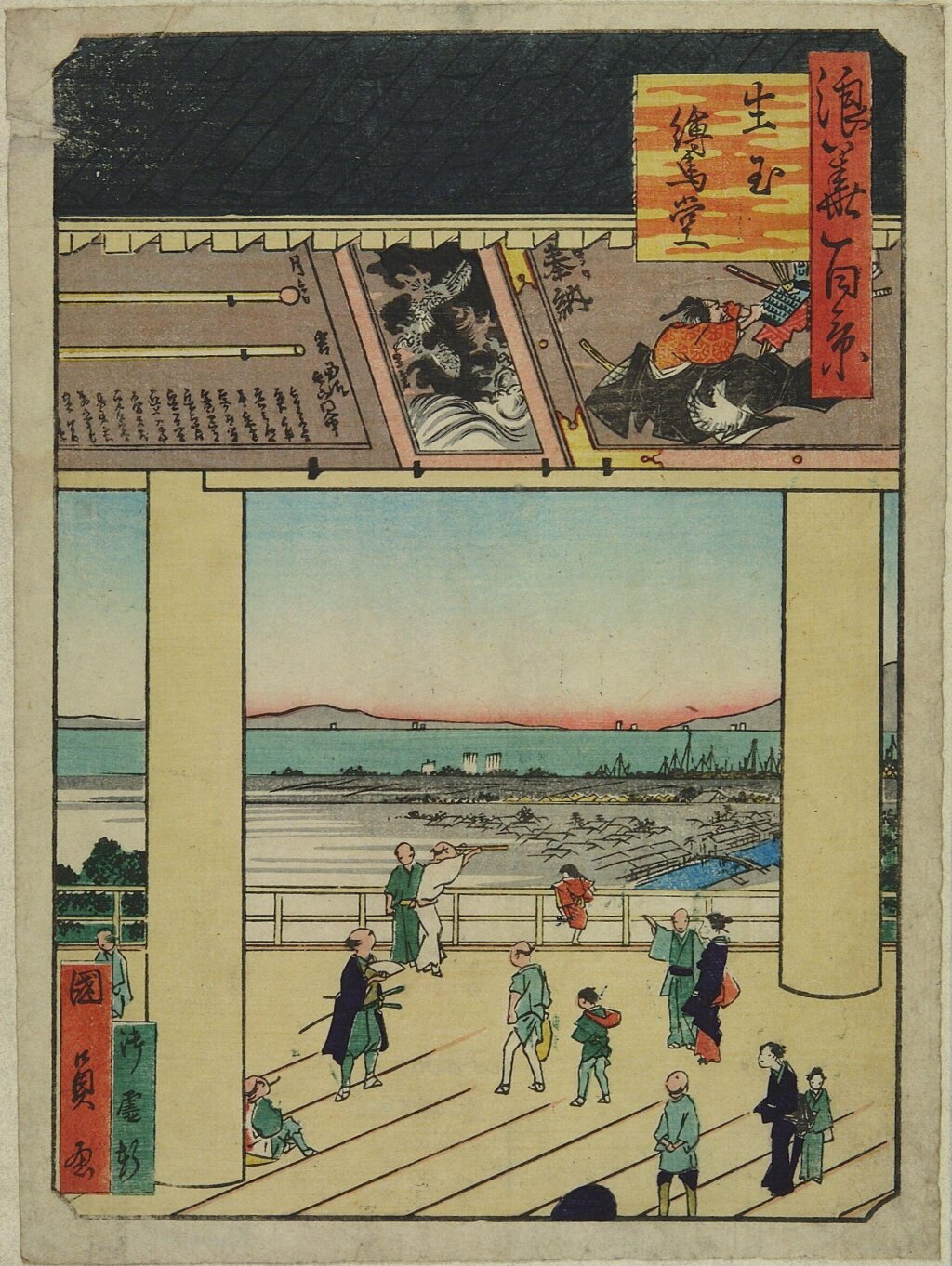
Votive-Picture Hall of the Shrine at Ikutama (Ikutama Ema-dō)
生玉絵馬堂
- Date:
- 1860
- Medium:
- Color woodblock print
- Source:
- Victoria and Albert Museum
Description
This 1860 color woodblock print by Utagawa Kunikazu, held by the Victoria and Albert Museum (accession E.5463-1886), depicts the votive-picture hall (絵馬堂) of the Ikutama Shrine (生玉神社), one of the principal Shinto sites of central Osaka and a popular meisho destination throughout the Edo period. The composition shows the hall's wooden architecture with rows of ema (votive picture-plaques) hanging from its rafters, visitors examining the offerings, and the surrounding shrine precincts rendered in the restrained palette characteristic of kamigata-e topographical prints. The Ikutama Shrine had stood on its present site since the early seventeenth century and functioned as the regional Shinto anchor of the merchant districts of central Osaka, with the votive-picture hall serving as both a public art gallery and a record of communal prayers offered for safe travel, successful childbirth, and commercial fortune. The print belongs to the Naniwa hyakkei (One Hundred Views of Naniwa) series of 1860-1861, the great Osaka topographical project designed collaboratively by Kunikazu with Hasegawa Sadanobu II and Nansuitei Yoshiyuki and modeled on Hiroshige's Edo meisho tradition. The print measures the standard chū-tanzaku format used throughout the Naniwa hyakkei and is executed in ink and color on paper, with careful gradient printing in the sky and selective use of vermilion accents that exemplify Osaka kamigata-e production values. The V&A acquired the print in 1886 as part of the Wakai sale, alongside four other Naniwa hyakkei prints by Kunikazu, and the museum's holdings remain the principal Western reference for Osaka kamigata-e topographical work of the late Edo period.
More Prints by Utagawa Kunikazu

More Landscapes Prints

Lake Kugushi in Wakasa Province (Wakasa Kugushiko), from the series Souvenirs of Travel I (Tabi miyage dai isshu)"
Wakasa Kugushiko
1920
Color woodblock print; oban
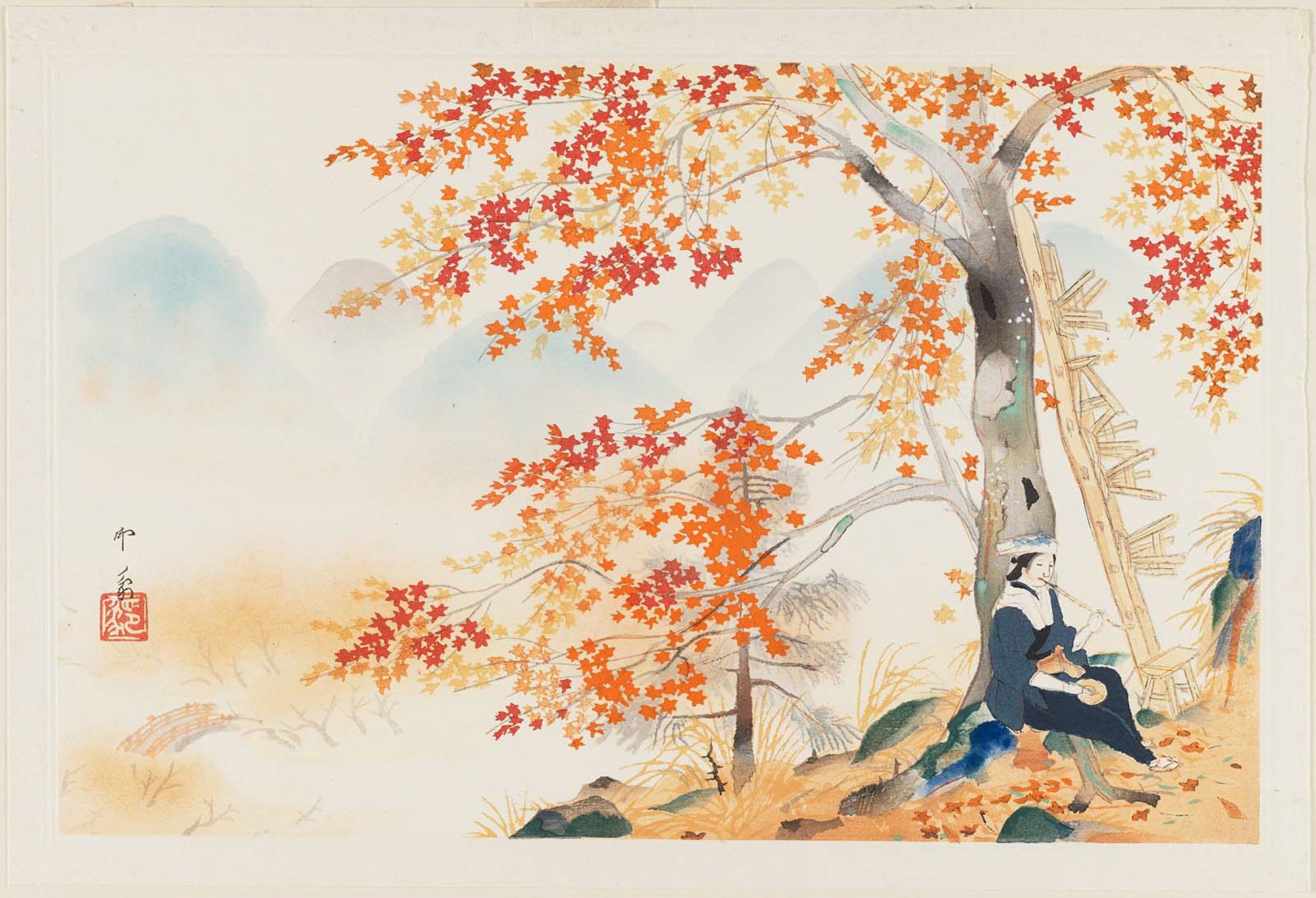
Autumn Maple Leaves at Takao, from the album Eight Views of Kyoto (Kyôto hakkei)
Woodblock print

The Beach at Kaiganji in Sanuki Province (Sanuki Kaiganji no hama), from the series "Collection of Views of Japan II, Kansai Edition (Nihon fukei shu II Kansai hen)"
1934
Color woodblock print; oban

Tea Kettle, section of a sheet from the series "Mirror of Stone Rubbings of Views of the Provinces" (Kohon meihitsu ishizuri kagami)
n.d.
Woodblock print; ishizuri-e, section of harimaze sheet
Featured in Collections
Curated cross-cuts that include this print.
Frequently Asked Questions
Votive-Picture Hall of the Shrine at Ikutama (Ikutama Ema-dō) (生玉絵馬堂) was created by Utagawa Kunikazu (歌川国員) in 1860.
Votive-Picture Hall of the Shrine at Ikutama (Ikutama Ema-dō) depicts landscapes.