
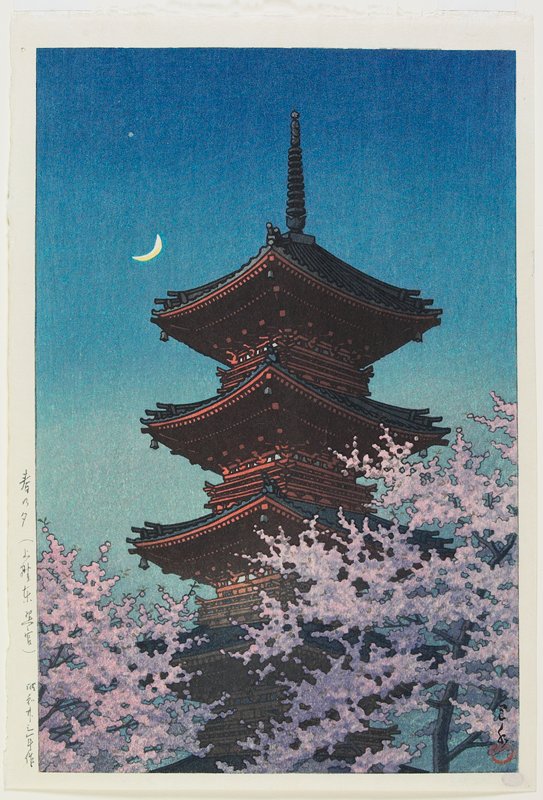
Spring Evening- Post Quake
- Source:
- ukiyo-e.org
Description
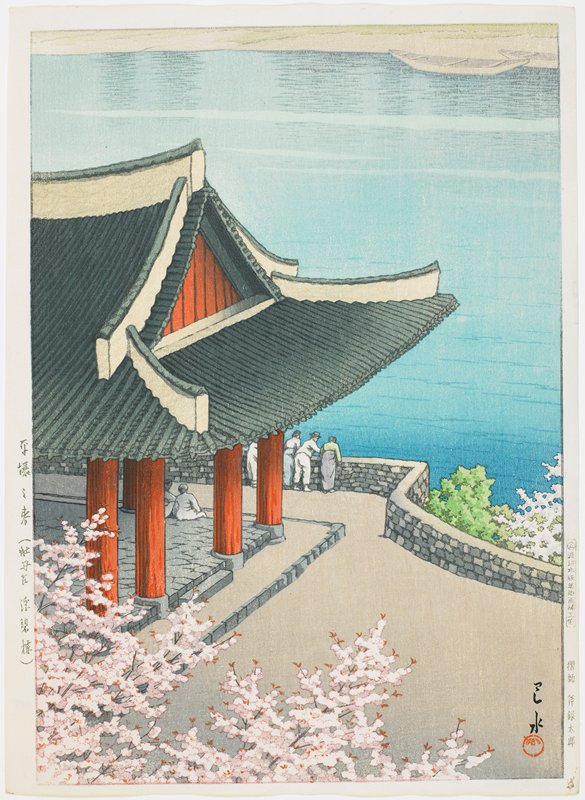
Spring Evening- Post Quake is a Japanese woodblock print attributed in the Hanga catalog to Watanabe Seitei (1851-1918), one of the foundational figures of Meiji kacho-e, the bird-and-flower picture tradition that bridged classical nihonga ink painting and the modern print revival. Seitei studied under Kikuchi Yosai and was the first Japanese artist to travel officially to Europe, exhibiting at the 1878 Paris Exposition, an experience that broadened his command of atmospheric light, soft modeling, and naturalistic observation while leaving his Japanese sense of empty space and seasonal sentiment intact. A spring evening composition in his hand typically gathers low light along a horizon of cherry, willow, or plum, with the seasonal cue carried by a quiet bird, a swallow, or a sparrow at rest rather than by a crowded narrative. The qualifier post-quake places this impression in the cultural shadow of the 1923 Kanto earthquake, when collectors prized intact images of vanished Tokyo landscapes as quiet acts of remembrance, and shin-hanga publishers reissued earlier blocks to meet that demand. Within Seitei's broader project, an evening scene of this kind would lean on bokashi gradation in the sky, restrained register printing, and delicate keyblock outlines for plant stems and feathers, the hallmarks of high-grade Meiji woodblock craftsmanship he helped codify. The source record for this catalog entry comes from ukiyo-e.org, the standard public reference for Japanese print scholarship, where institutional and dealer impressions are aggregated. Because the print is documented only through the aggregator rather than a primary museum holding, dating, publisher, and edition remain open questions, but the title preserves the elegiac mood that runs throughout Seitei's late kacho-e and shin-hanga adjacent output.
More Prints by Takahashi Shotei

More Spring Prints

Featured in Collections
Curated cross-cuts that include this print.
Frequently Asked Questions
Spring Evening- Post Quake was created by Takahashi Shotei (高橋松亭).
Spring Evening- Post Quake depicts spring.