
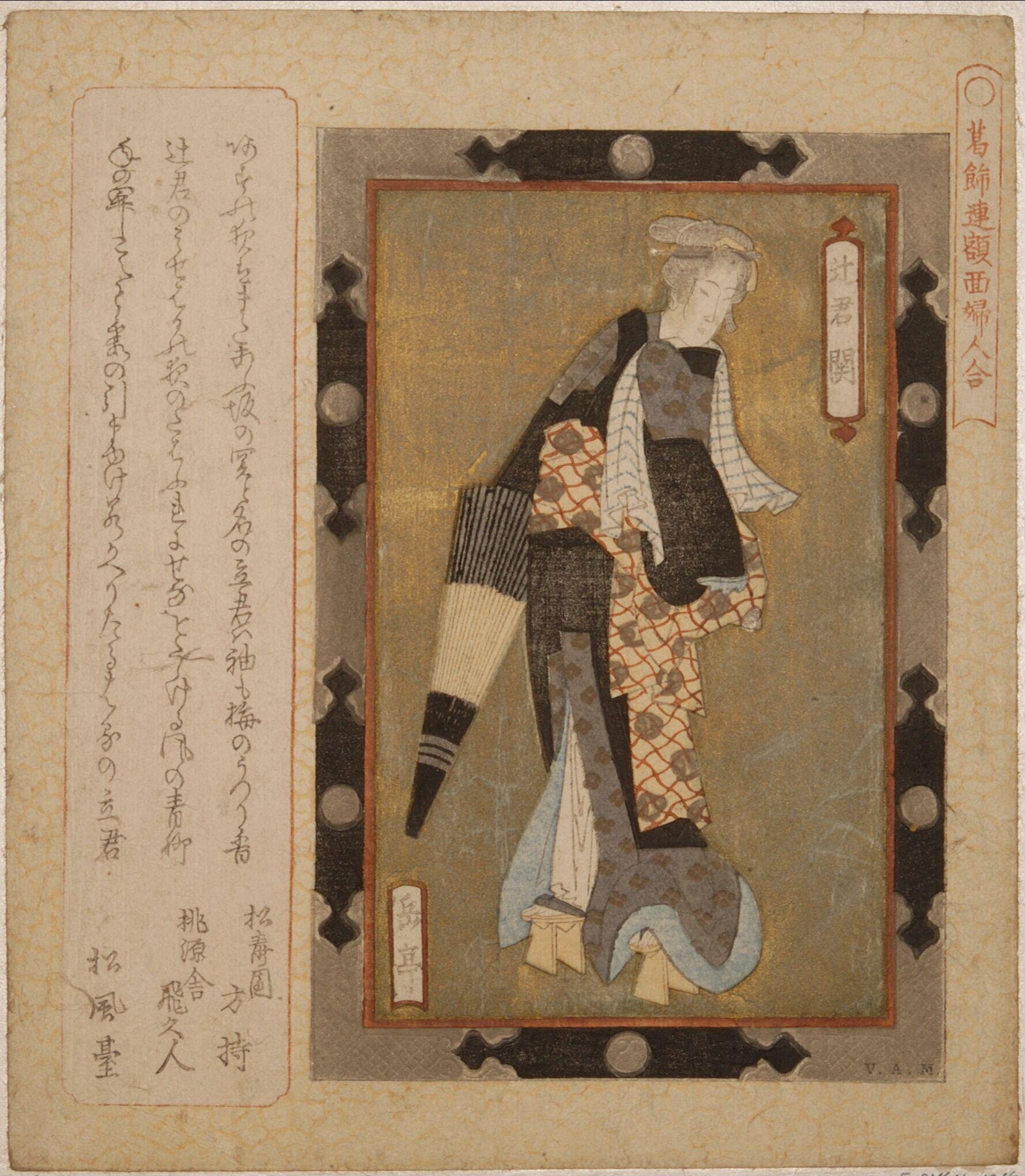
An actor as Mita no Tsuko and peonies, from the series "Ten Designs for the Honcho Circle (Honchoren jubantsuzuki)"
- Date:
- c. 1822
- Medium:
- Color woodblock print; shikishiban, surimono
- Source:
- Art Institute of Chicago
Description
From the Honchoren jubantsuzuki, the Ten Designs for the Honcho Circle, this shikishiban surimono depicts an actor in the role of Mita no Tsuko alongside peonies, combining the kabuki actor portrait tradition with the surimono format's characteristic still-life accompaniment. Held by the Art Institute of Chicago and dated to around 1822, the print is unusual within Gakutei's output for its actor subject, since most of his surimono focus on historical, literary, or genre figures rather than contemporary stage personalities. The peonies serve as both a seasonal marker and a decorative emblem, the so-called king of flowers that Edo audiences associated with theatrical glamour and aristocratic refinement. The Honchoren jubantsuzuki was a self-contained set of ten coordinated designs, each producing a discrete visual statement within an overarching series identity, and surviving impressions like the Art Institute's preserve Gakutei's careful integration of figure, flower, and inscription space.
More Prints by Yashima Gakutei


Frequently Asked Questions
An actor as Mita no Tsuko and peonies, from the series "Ten Designs for the Honcho Circle (Honchoren jubantsuzuki)" was created by Yashima Gakutei (八島岳亭) in c. 1822.