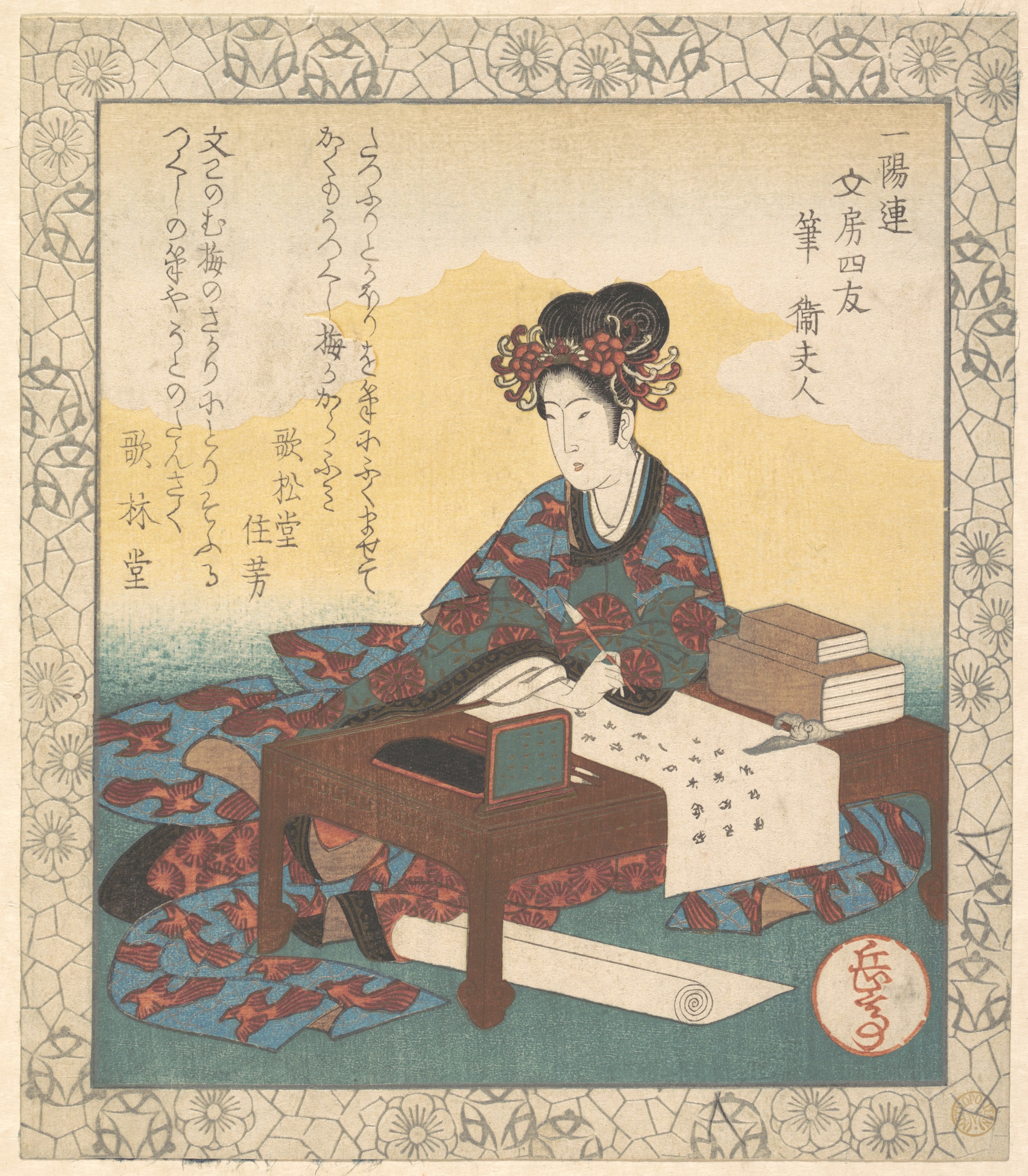
Chinese Lady Seated at a Table, Composing an Ode
- Date:
- 1835
- Medium:
- Woodblock print (surimono); ink and color on paper
- Source:
- Metropolitan Museum of Art
Description
Chinese Lady Seated at a Table, Composing an Ode, in the Metropolitan Museum of Art, is one of Yashima Gakutei's evocations of the literary woman within a Chinese setting. The figure is shown at a writing table, the act of composition rendered through her concentration on brush and paper rather than through any narrative incident. Her costume and the table itself signal a Chinese context, allowing Gakutei to play with continental visual codes while keeping the underlying mood close to the gentle introspection that he brought to his Japanese subjects. As a designer in the Hokusai school, Yashima Gakutei worked under Totoya Hokkei and absorbed the wide-ranging interests of Katsushika Hokusai. Both teachers and student returned repeatedly to Chinese subjects, treating literati women, sages, and immortals with the same attention to detail they devoted to native Japanese themes. A scene of a Chinese lady composing an ode resonated with kyoka audiences for several reasons. It echoed celebrated continental figures such as Ban Zhao, Cai Wenji, or Xue Tao, whose names were familiar to educated Edo readers, and it suggested a continuous tradition of female literary accomplishment that included Japanese poets like Murasaki Shikibu and Ono no Komachi. Within a surimono or surimono-style luxury print, the costume and accessories could be rendered with particular finesse, often heightened by metallic pigments and blind embossing. The Metropolitan Museum of Art's preservation of this Yashima Gakutei design ensures that this graceful cross-cultural meditation on literary women, shaped by the Hokusai school's catholic taste, remains visible to modern viewers interested in the international dimensions of Edo-period print culture.
More Prints by Yashima Gakutei


Frequently Asked Questions
Chinese Lady Seated at a Table, Composing an Ode was created by Yashima Gakutei (八島岳亭) in 1835.