
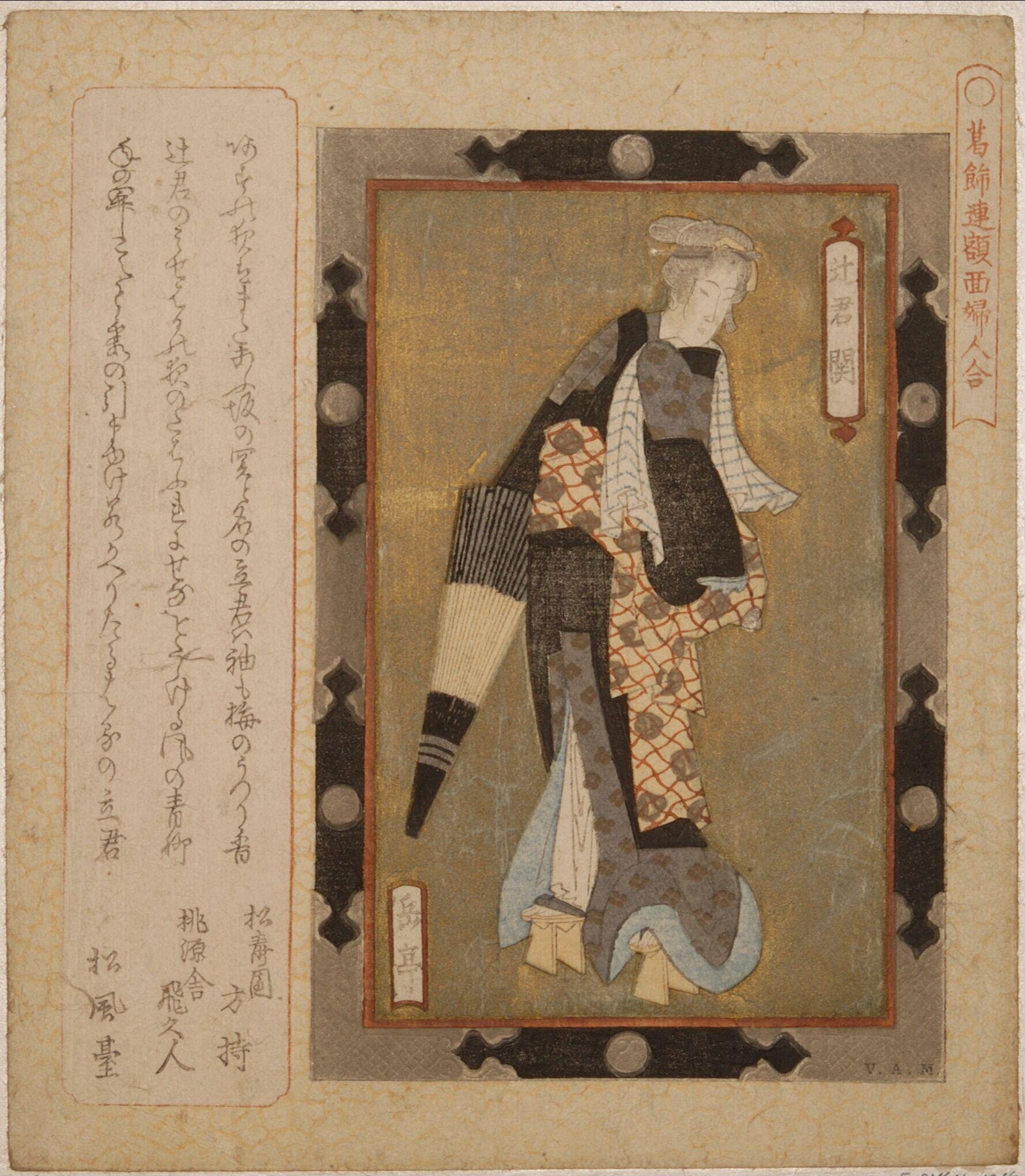
Courtesan and Kamuro Strolling at the Entrance Gate of the Yoshiwara Pleasure Quarters
- Date:
- c. 1820s/30s
- Medium:
- Color woodblock print; shikishiban, surimono
- Source:
- Art Institute of Chicago
Description
Courtesan and Kamuro Strolling at the Entrance Gate of the Yoshiwara Pleasure Quarters, attributed to Yashima Gakutei around 1820 and preserved at the Art Institute of Chicago, brings the iconography of the licensed quarter into the kyoka-e idiom of surimono. The Yoshiwara, the licensed pleasure district outside Edo, had supplied ukiyo-e artists with subject matter for more than a century, and by Gakutei's day the procession of a high-ranking courtesan with her young kamuro attendant was one of the most familiar images in the visual culture of the city. What distinguishes this version is the surimono format: the print would have been commissioned by a poetry circle, printed in a small luxury edition, and paired with kyoka verses that wittily reframed the scene rather than simply describing it. As a member of the Hokusai school, Yashima Gakutei brings Katsushika Hokusai's interest in elegant figure design to the subject, articulating the courtesan's heavy outer robe and tall geta against the kamuro's lighter form. The entrance gate situates the pair at the threshold between the everyday city and the regulated world of the quarter, a boundary that kyoka poets loved to exploit. Deluxe pigments, blind embossing in the textile patterns, and the soft burnish of metallic powders register the work's status as an object meant to be examined intimately, not displayed at a distance. As a surimono by Yashima Gakutei, the sheet shows how privately commissioned prints could absorb the most public subject of Edo culture and turn it into a private literary joke.
More Prints by Yashima Gakutei


Frequently Asked Questions
Courtesan and Kamuro Strolling at the Entrance Gate of the Yoshiwara Pleasure Quarters was created by Yashima Gakutei (八島岳亭) in c. 1820s/30s.