
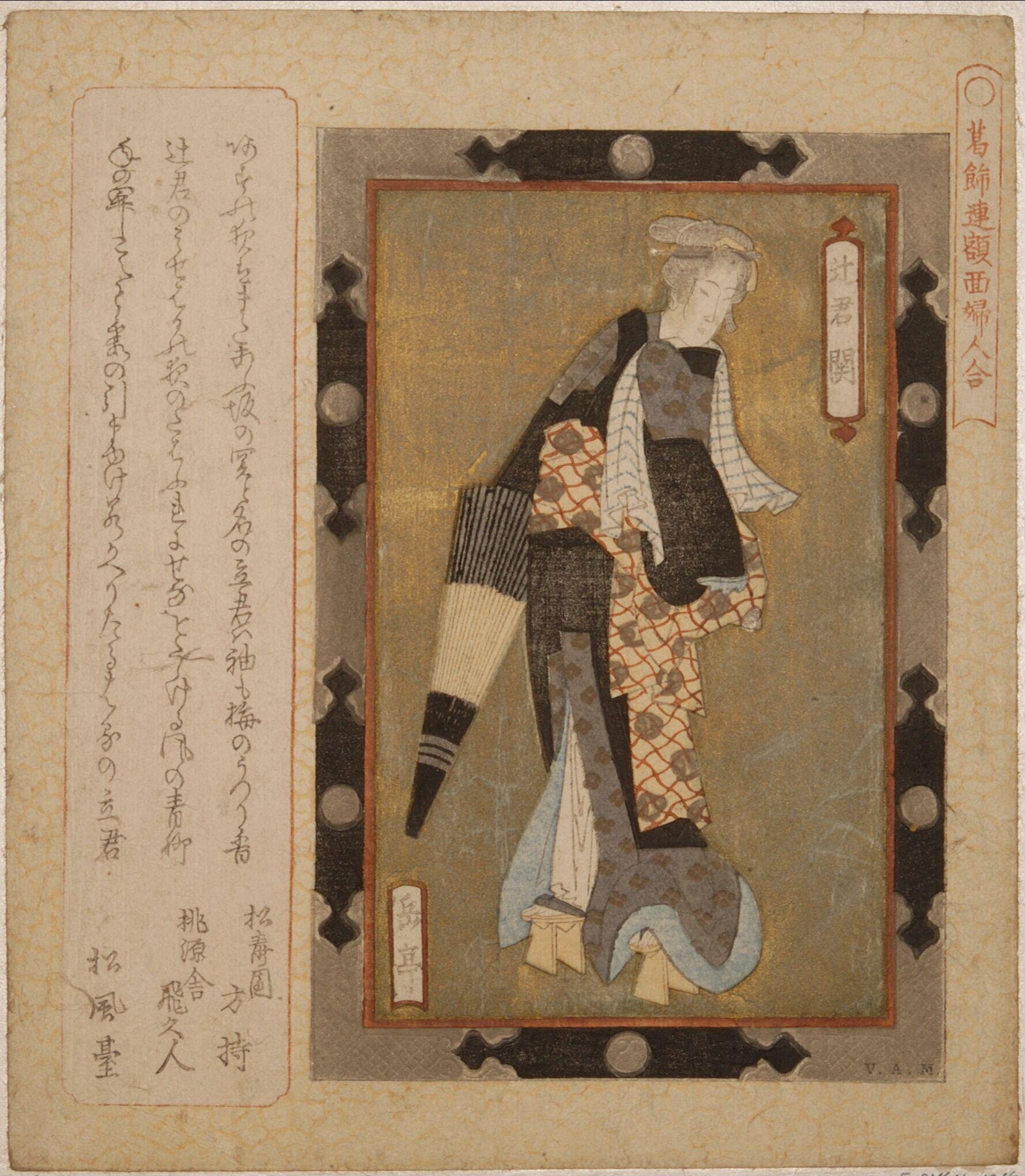
Dongfang Shuo (Tohosaku), from the series "Lives of Taoist Immortals Parodied by Courtesans - A Series of Seven (Keisei mitate ressenden, nanaban no uchi)"
- Date:
- c. 1821/22
- Medium:
- Color woodblock print; shikishiban, surimono
- Source:
- Art Institute of Chicago
Description
Dongfang Shuo (Tohosaku), a 1826 surimono in the same series Lives of Taoist Immortals Parodied by Courtesans - A Series of Seven (Keisei mitate ressenden, nanaban no uchi) by Yashima Gakutei in the Art Institute of Chicago, plays the same mitate game with a different immortal. Dongfang Shuo, in Japanese Tohosaku, was a Han-dynasty court jester and astrologer who, in Taoist legend, stole the peaches of immortality from the Queen Mother of the West and was credited with an almost incomprehensible lifespan. In painting and print he is usually shown clutching the stolen peach, an emblem at once of immortality and of clever larceny. To pair him with a Yoshiwara courtesan is to set the most outrageously long-lived immortal beside the most ephemerally young figure of contemporary Edo - a juxtaposition that the printed kyoka verses would have exploited in any number of comic registers. Yashima Gakutei, working within the Hokusai school under Katsushika Hokusai, shapes the figure with the careful line that surimono on Chinese subjects required, balancing him against generous white space for the poems and the second figure of the courtesan. Deluxe surimono techniques - mineral pigments, karazuri embossing of textiles, and burnished metallic powders for the peach and other prestige details - give the sheet a luxurious tactile presence. As a Yashima Gakutei kyoka-e in the Hokusai school manner, Dongfang Shuo exemplifies the witty mitate culture of late-1820s surimono.
More Prints by Yashima Gakutei


Frequently Asked Questions
Dongfang Shuo (Tohosaku), from the series "Lives of Taoist Immortals Parodied by Courtesans - A Series of Seven (Keisei mitate ressenden, nanaban no uchi)" was created by Yashima Gakutei (八島岳亭) in c. 1821/22.