
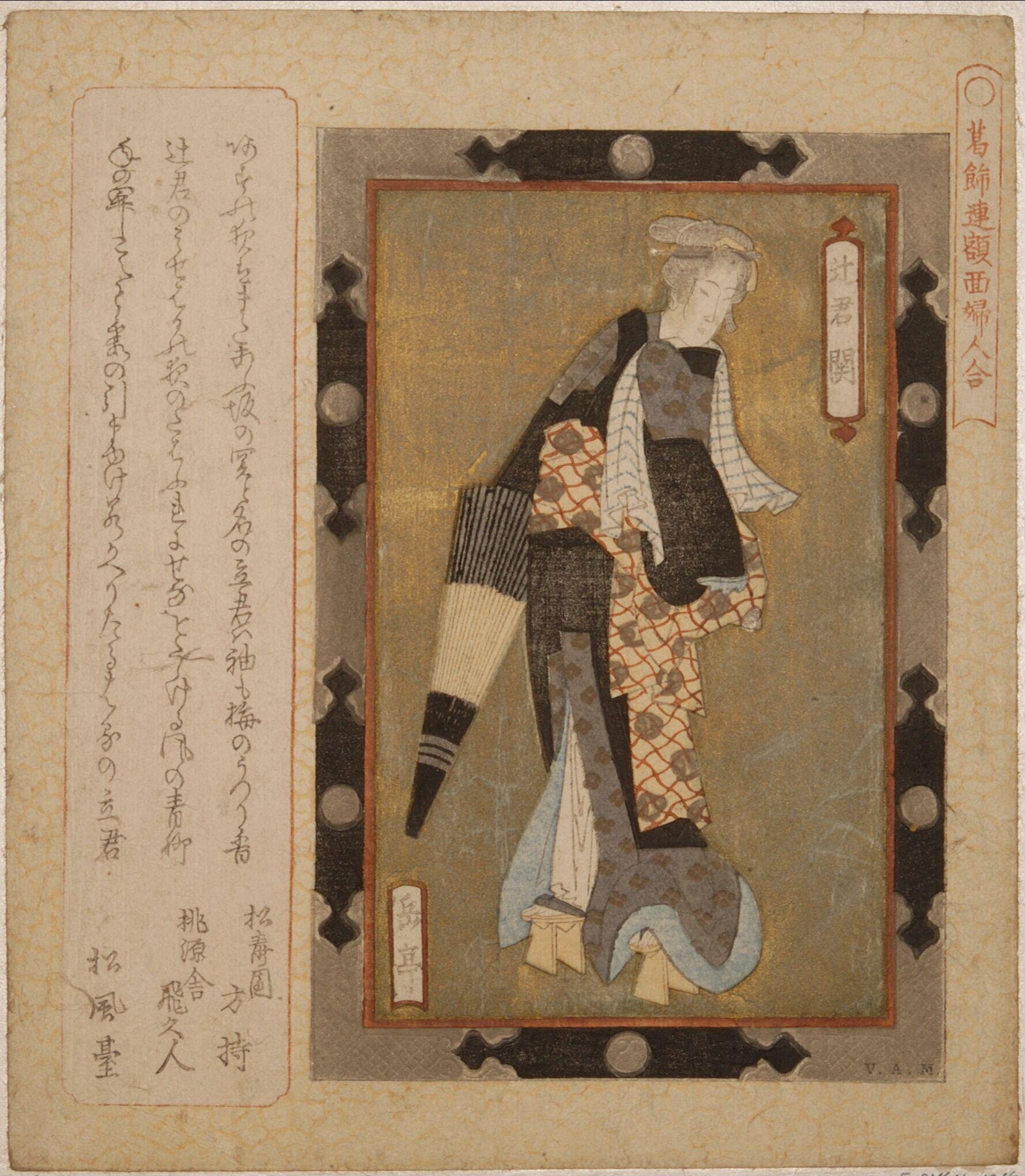
Ebisu (Shobishin), from the series "A Parody of the Seven Gods of Good Fortune (Mitate shichifukujin)"
- Date:
- c. 1828
- Medium:
- Color woodblock print; shikishiban, surimono
- Source:
- Art Institute of Chicago
Description
Ebisu (Shobishin), from A Parody of the Seven Gods of Good Fortune (Mitate shichifukujin), is a 1823 surimono by Yashima Gakutei in the Art Institute of Chicago. Ebisu - the smiling fisherman-god who holds a sea bream and a fishing rod - was the patron of merchants and fishermen and one of the seven shichifukujin that Edo audiences invoked for prosperity. In a mitate or parody print, the deity is filtered through a contemporary lens: the iconography is preserved enough to be recognized but reframed through a witty visual or verbal twist that the accompanying kyoka verses make explicit. Yashima Gakutei, working in the Hokusai school under Katsushika Hokusai, treats Ebisu with the careful design and refined palette that surimono required, balancing the figure against white space for the poems and using the genre's deluxe techniques - mineral pigments, karazuri embossing on robes and accessories, and burnished metallic powders for prestige details - to give the sheet a tactile richness. The print's audience, the kyoka circle that commissioned it, would have read the image and the verses together as a single composition, enjoying the slippage between Ebisu's traditional iconography and the contemporary slant of the mitate. As a Yashima Gakutei kyoka-e in the Hokusai school manner, Ebisu shows how popular religion supplied surimono designers with iconography that could be both venerated and playfully reimagined.
More Prints by Yashima Gakutei


Frequently Asked Questions
Ebisu (Shobishin), from the series "A Parody of the Seven Gods of Good Fortune (Mitate shichifukujin)" was created by Yashima Gakutei (八島岳亭) in c. 1828.