
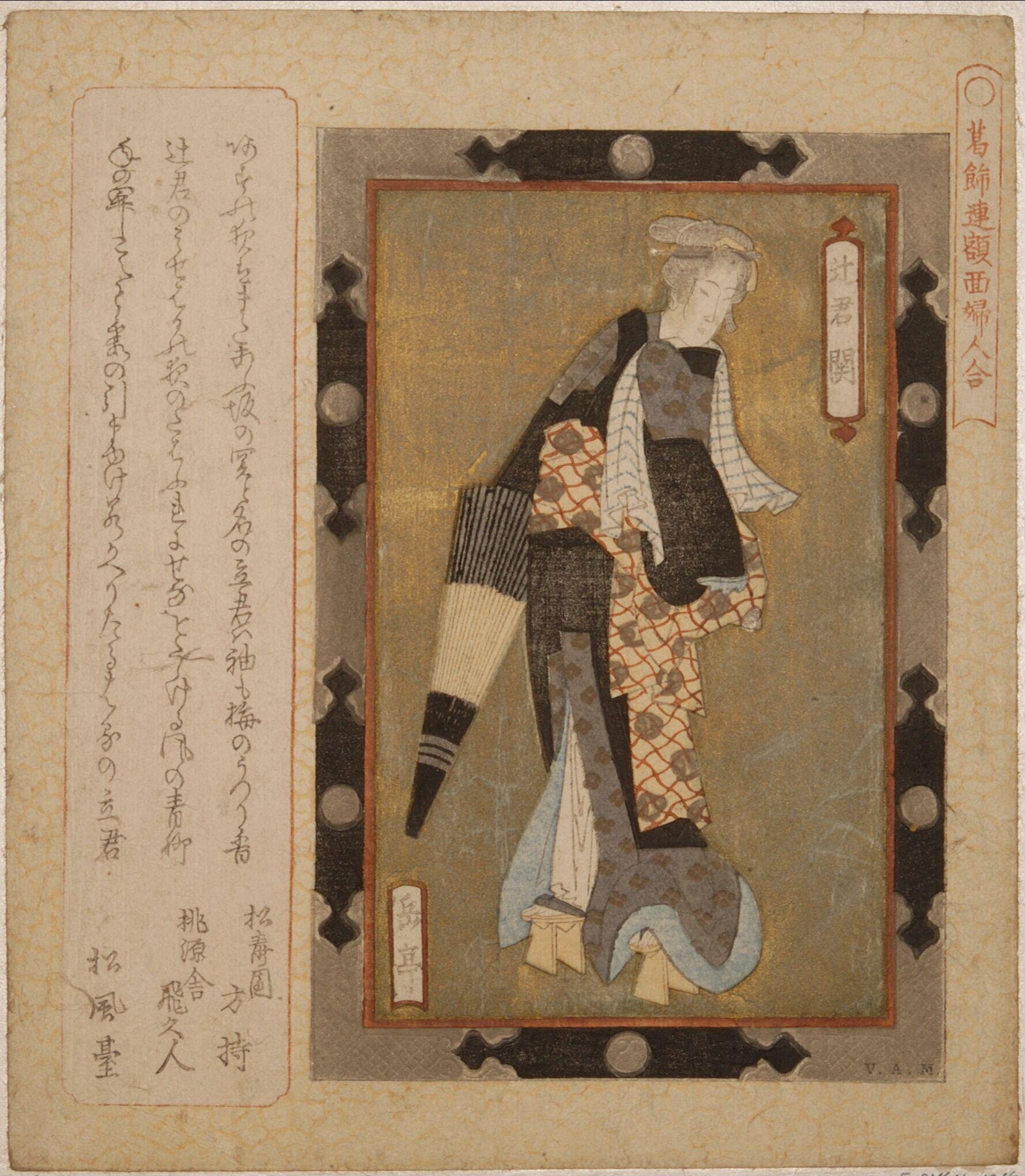
Fan Kuai (Hankai), from the series "Three Broken Gates (Haitatsu sanban)"
- Date:
- 1827
- Medium:
- Color woodblock print; shikishiban, surimono
- Source:
- Art Institute of Chicago
Description
Fan Kuai (Hankai), from the series Three Broken Gates (Haitatsu sanban), is a 1827 surimono by Yashima Gakutei in the Art Institute of Chicago. The series picks three episodes from Chinese history and legend in which a hero burst through a gate or barrier by sheer force; Fan Kuai, in Japanese Hankai, was the loyal general of the founder of the Han dynasty, Liu Bang, and his most famous exploit was crashing through the gates of a rival's encampment to save his lord at the Hongmen banquet. Heroic gate-breaking subjects had long been a favorite of warrior prints, and surimono designers like Yashima Gakutei drew on that iconography for kyoka-e that paired warrior bravado with witty contemporary verses. Working within the Hokusai school under Katsushika Hokusai, Gakutei shapes the muscular figure of Fan Kuai with the dramatic line that musha-e called for, while the surimono format imposes deluxe printing - mineral pigments, karazuri embossing of armor textures, and burnished metallic accents for weapons and prestige details - that distinguished kyoka-e from the commercial warrior print. The kyoka verses printed alongside would have allowed the poetry circle to read Fan Kuai's brute strength against contemporary urban concerns. As a Yashima Gakutei kyoka-e in the Hokusai school manner, Fan Kuai represents the surimono tradition's confident absorption of warrior subject matter into its refined small format.
More Prints by Yashima Gakutei


Frequently Asked Questions
Fan Kuai (Hankai), from the series "Three Broken Gates (Haitatsu sanban)" was created by Yashima Gakutei (八島岳亭) in 1827.