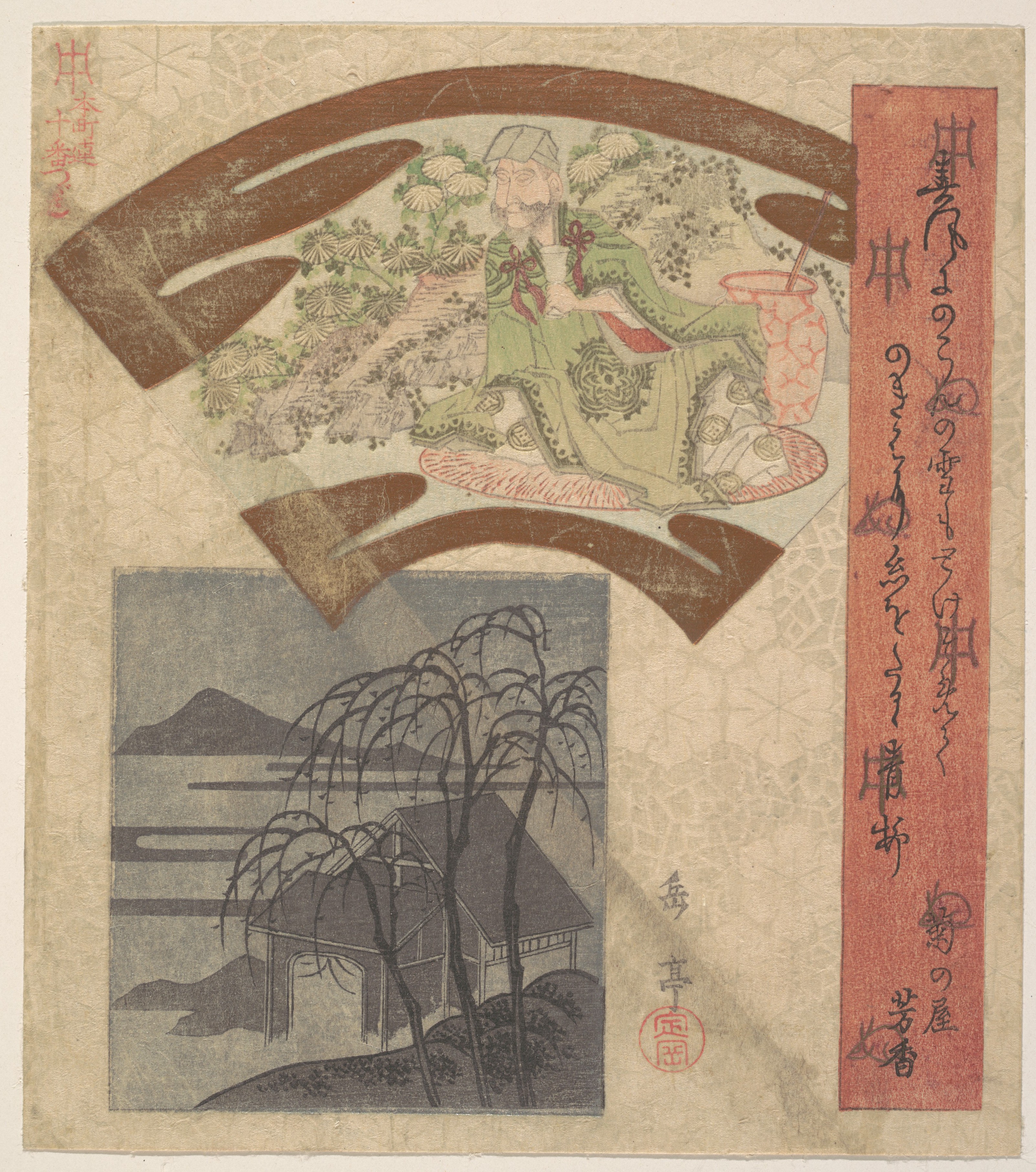
Fan-shaped Design Depicting Chinese Poet or Philosopher
- Medium:
- Woodblock print (surimono); ink and color on paper
- Source:
- Metropolitan Museum of Art
Description
Fan-shaped Design Depicting Chinese Poet or Philosopher, by Yashima Gakutei, is held by the Metropolitan Museum of Art and exemplifies the popularity of fan-format prints (uchiwa-e) within his broader output. Although Gakutei is most celebrated for surimono and the deluxe Tenpozan landscape series, he also designed for the uchiwa-e market, where prints were cut to shape and mounted on fan frames for summer use. As a leading designer within the Hokusai school, trained by Katsushika Hokusai and active alongside Totoya Hokkei, Gakutei brought a learned literary sensibility to his subjects; here, a Chinese poet or philosopher, identified by a robe, scholarly accouterment, or contemplative pose, refers to the tradition of Chinese cultural heroes that fascinated educated Japanese audiences during the late Edo period. The fan format imposed unusual compositional discipline: the curved upper edge and tapering lower bracket forced designers to abandon rectangular logic and arrange figures across an asymmetrical arc. Gakutei's solution typically integrates the figure with calligraphic inscriptions or background washes that complete the design within the irregular space. The Metropolitan's example preserves the printed sheet before assembly, allowing scholars to study the design as Gakutei conceived it. Within the Hokusai school, fan prints provided an additional venue for the kind of literate, allusive subject matter that distinguished members of the workshop from competitors in the actor- and beauty-print market. Gakutei's contribution to uchiwa-e demonstrates the breadth of his career and his ability to move fluidly between surimono, single-sheet prints, picture albums, and fan designs.
More Prints by Yashima Gakutei


Frequently Asked Questions
Fan-shaped Design Depicting Chinese Poet or Philosopher was created by Yashima Gakutei (八島岳亭).