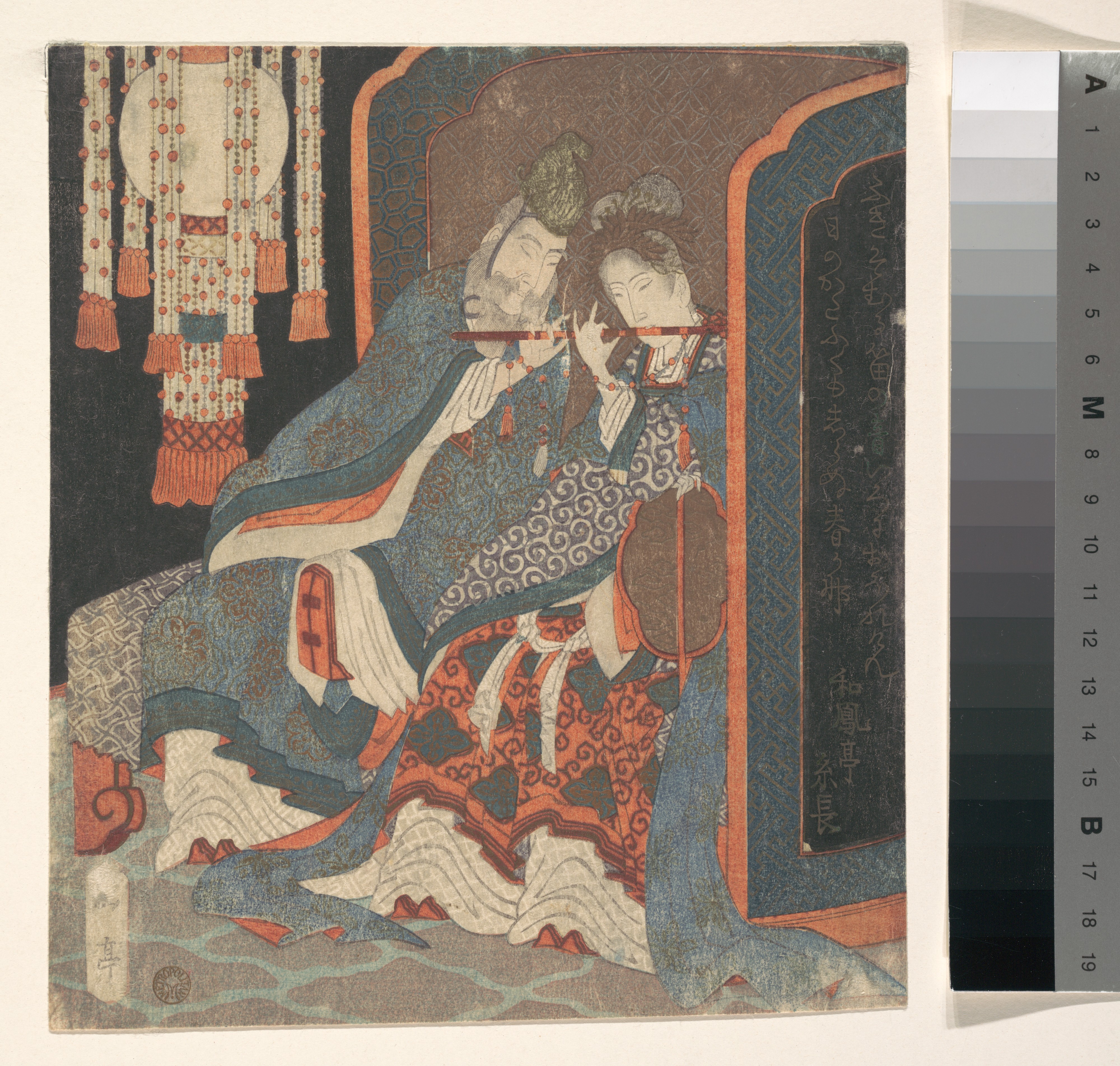
Genso and Yokihi
- Date:
- ca. 1820
- Medium:
- Woodblock print (surimono); ink and color on paper
- Source:
- Metropolitan Museum of Art
Description
Genso and Yokihi, in the Metropolitan Museum of Art's holdings, is Yashima Gakutei's treatment of one of the most famous love stories in East Asian literature. Genso is the Japanese name for the Tang dynasty emperor Xuanzong, and Yokihi for his beloved consort Yang Guifei. Their tragic affair, immortalized in Bai Juyi's Song of Everlasting Sorrow, was a touchstone of poetic and pictorial allusion in Japan for centuries. Edo-period artists returned to the couple regularly because their tale combined imperial splendor, romantic devotion, and political catastrophe, all themes that resonated with audiences educated in Chinese letters. Gakutei's image places the lovers within a setting that signals their imperial status while preserving the intimate scale that surimono required. As a member of the Hokusai school working under the influence of Totoya Hokkei and Katsushika Hokusai, he was practiced in compressing layered narrative content into a small format. The figures are arranged with attention to gesture, the costumes are rendered with characteristic precision, and the accompanying setting evokes a Chinese court without forsaking the print's pictorial economy. Within kyoka poetry circles, Genso and Yokihi made a particularly powerful subject. Their story enacted the highest tensions of love and duty, and verses written in response to such an image could draw on a deep well of Japanese and Chinese poetic precedent. Surimono designed for this purpose were typically enriched with metallic pigments and blind embossing, making the materials themselves a kind of homage to the imperial luxury depicted. The Metropolitan Museum of Art's record secures Yashima Gakutei's contribution to this enduring iconographic tradition.
More Prints by Yashima Gakutei


Frequently Asked Questions
Genso and Yokihi was created by Yashima Gakutei (八島岳亭) in ca. 1820.