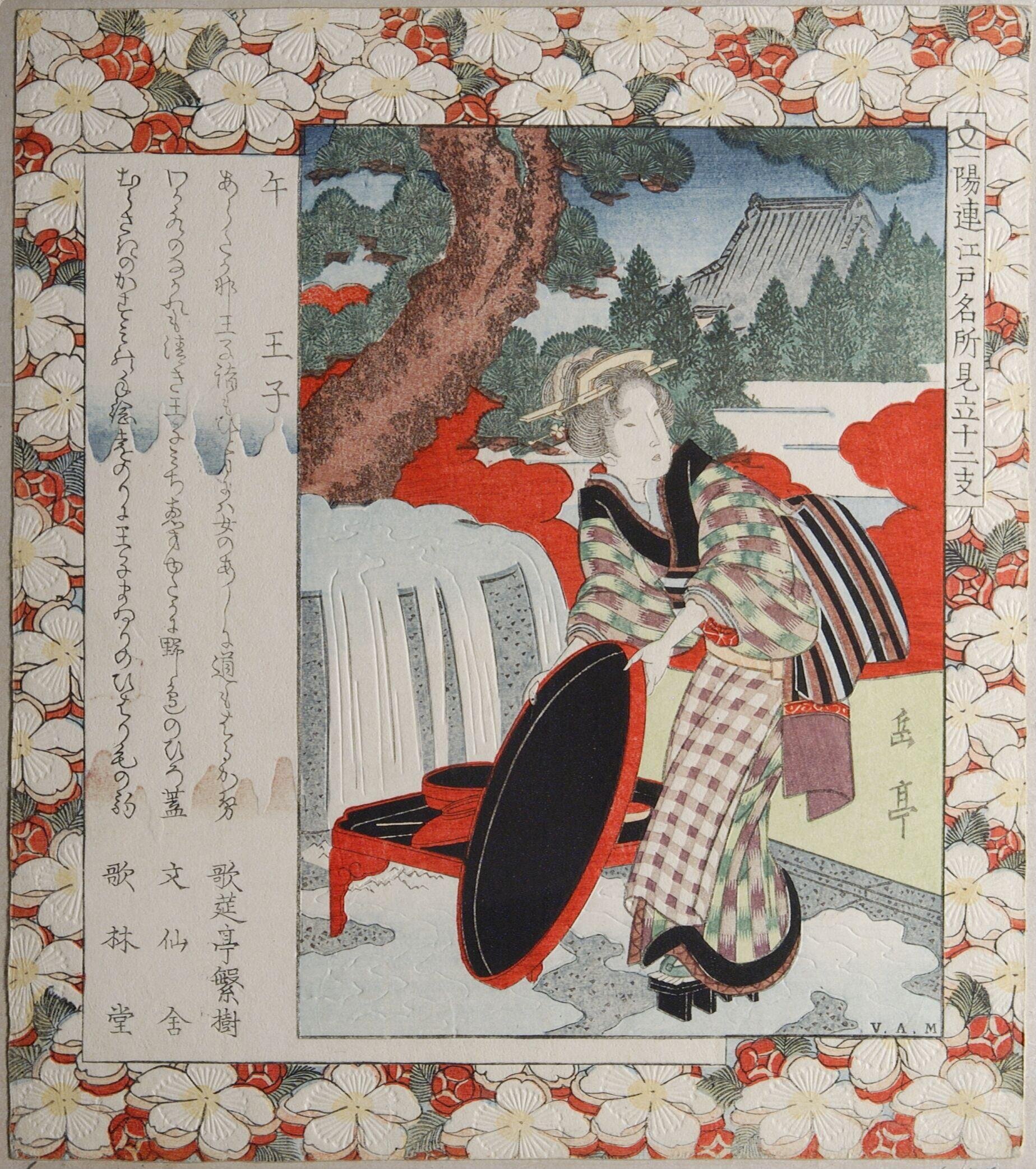
Horse (Uma)
- Date:
- ca. 1826
- Medium:
- Source:
- Victoria and Albert Museum
Description
Yashima Gakutei designed Horse (Uma) in 1826 as part of his complete zodiac surimono cycle, contributing this print as the seventh of the twelve calendrical animals. The Victoria and Albert Museum preserves the design within its extensive Gakutei holdings.
The horse stands or trots with the alert poise that East Asian artists reserved for noble equine subjects. Gakutei renders the animal's coat with finely modulated overprinting that suggests both muscular structure and the gleam of well-tended hair, while the mane and tail flow in rhythmic curves that contrast with the firmness of the body's contour. Saddlery or harness, when included, is rendered with the patterned brocades and metallic accents that distinguish surimono from commercial woodblock prints.
Gakutei studied design in the Hokusai school under Totoya Hokkei, and Katsushika Hokusai's frequent depictions of horses in his prints, sketches, and Manga albums offered a clear model. Hokusai's followers learned to balance observation with stylization, treating the horse as both a believable animal and a vehicle for cultural and seasonal meaning. The horse occupies a key role in Japanese ritual and folklore, from Shinto sacred horses to the steeds of warriors and zodiac association.
Zodiac sets like this one were commissioned for the New Year of the corresponding animal, particularly by kyōka poetry clubs. The Victoria and Albert Museum's example, alongside its other zodiac prints from 1826, allows scholars to reconstruct the full cycle and study Yashima Gakutei's organizing approach to the series. The Uma print exemplifies how Hokusai school design discipline, surimono craftsmanship, and East Asian calendrical iconography converge in a print that is at once observational, decorative, and richly symbolic.
More Prints by Yashima Gakutei


Frequently Asked Questions
Horse (Uma) was created by Yashima Gakutei (八島岳亭) in ca. 1826.