
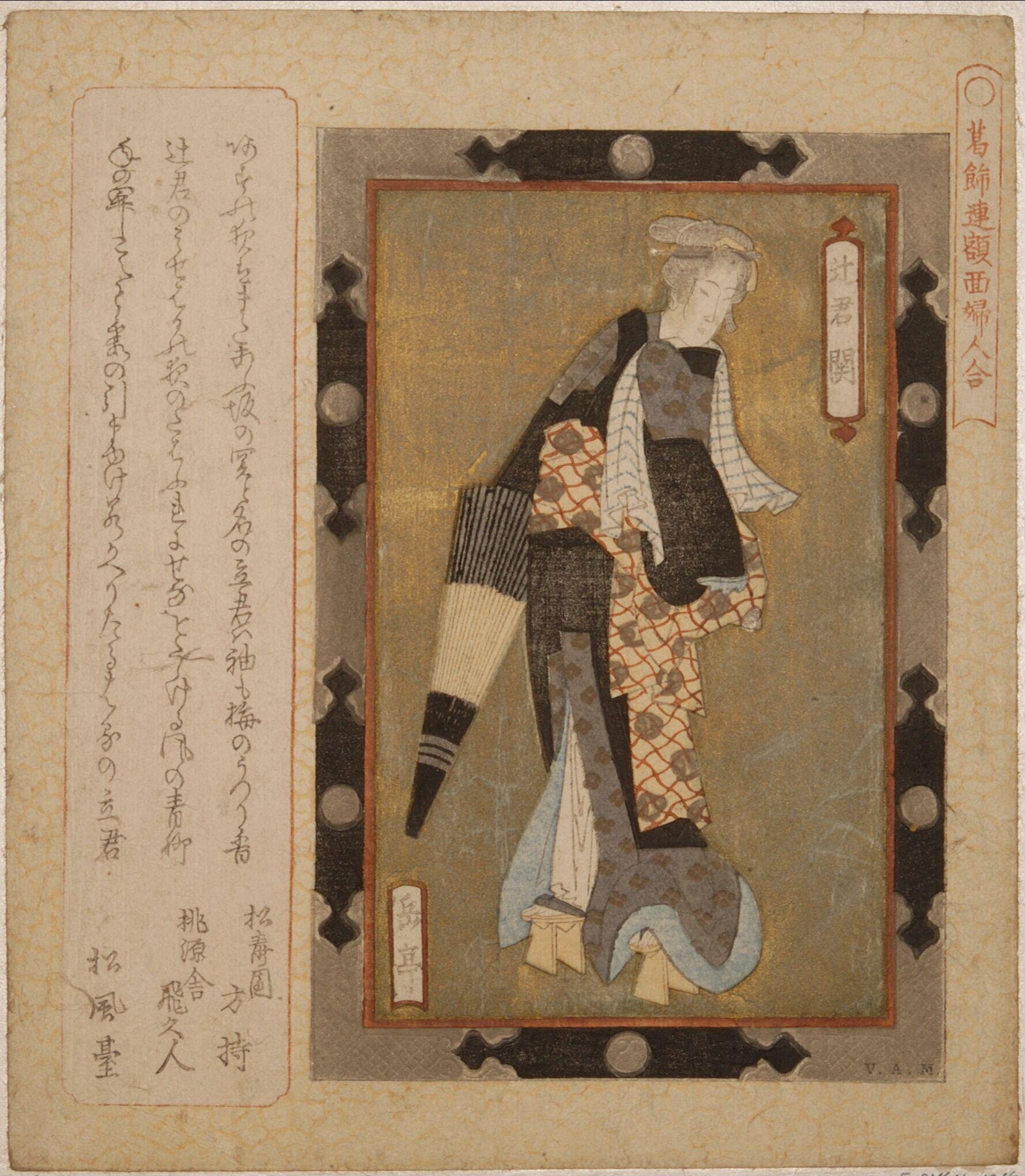
Japanese poetry, from the series "Three Classical Arts for the Sugawara Circle (Sugawara sanseki)"
- Date:
- early 1820s
- Medium:
- Color woodblock print; shikishiban, surimono
- Source:
- Art Institute of Chicago
Description
Japanese Poetry belongs to Yashima Gakutei's privately commissioned surimono series Three Classical Arts for the Sugawara Circle (Sugawara sanseki), made around 1820 and now held by the Art Institute of Chicago. The set takes its name from the Sugawara poetry circle and its three subjects from a classical triad of literary arts, with this sheet representing the indigenous tradition of Japanese poetry: waka and, by extension, the linked-verse forms and the kyoka that circle members themselves practiced. As a surimono, the print was issued outside the commercial publishing system, paid for by club members and produced in a small deluxe edition to be exchanged as a gift or kept as a memento of a poetry gathering. Gakutei was one of the leading specialists of the genre in his time, a pupil within the Hokusai school under Katsushika Hokusai, and his treatment of the subject draws on the school's combination of figural elegance and refined design. The image is deliberately spare, leaving generous space for the kyoka poems printed alongside it; embossed textures, burnished metallic pigments, and carefully tuned mineral colors register the sheet's status as a luxury object. To members of the Sugawara circle, the print announced both the topic of the day and the cultural lineage they claimed for their own verses. As a kyoka-e by Yashima Gakutei in the Hokusai school manner, Japanese Poetry is a small, learned object that condenses a long literary inheritance into a single luminous sheet.
More Prints by Yashima Gakutei


Frequently Asked Questions
Japanese poetry, from the series "Three Classical Arts for the Sugawara Circle (Sugawara sanseki)" was created by Yashima Gakutei (八島岳亭) in early 1820s.