
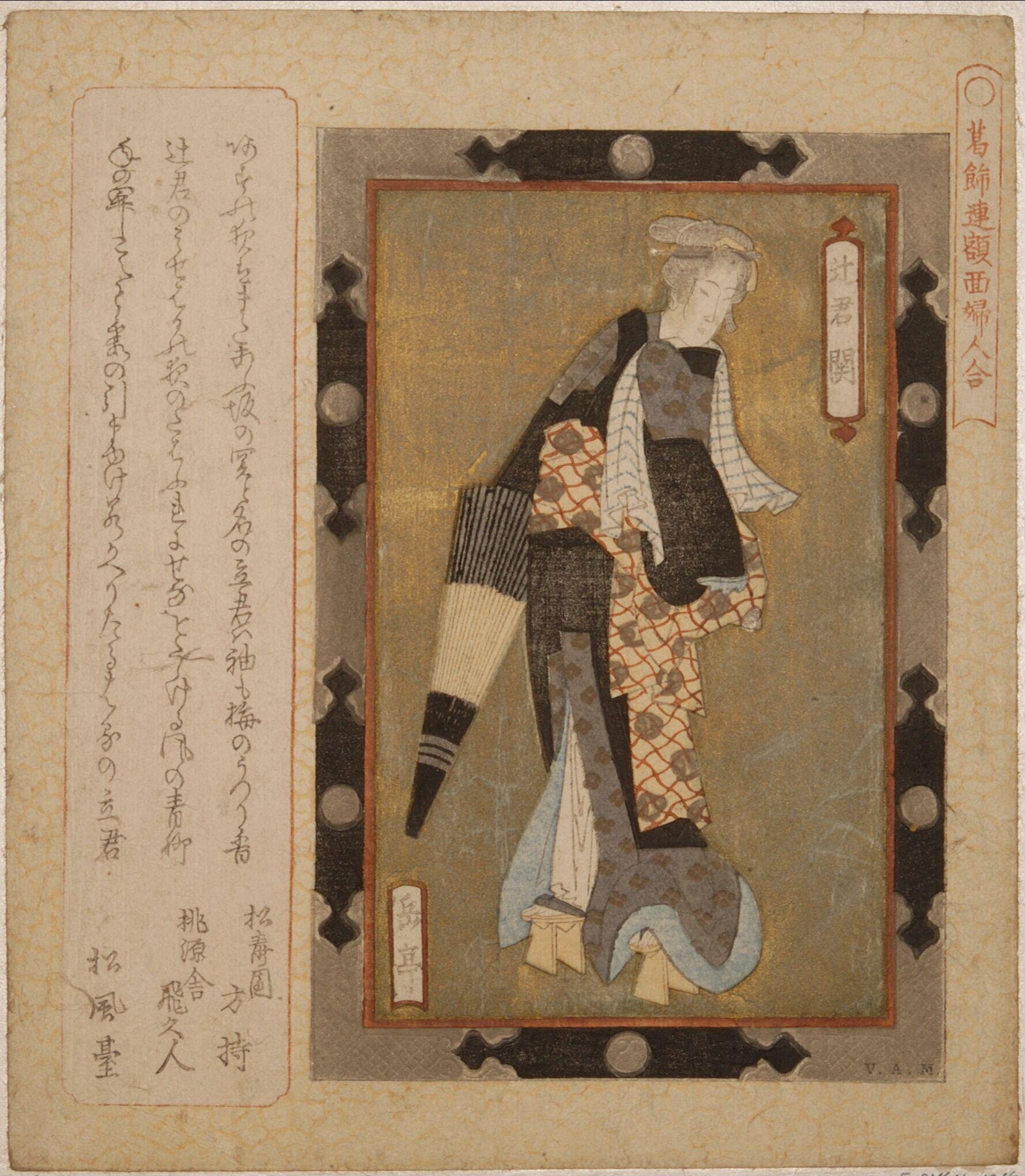
Jurojin, from the series "A Parody of the Seven Gods of Good Fortune (Mitate shichifukujin)"
- Date:
- c. 1828
- Medium:
- Color woodblock print; shikishiban, surimono
- Source:
- Art Institute of Chicago
Description
Jurojin, from A Parody of the Seven Gods of Good Fortune (Mitate shichifukujin), is a 1823 surimono by Yashima Gakutei in the Art Institute of Chicago. The seven gods of good fortune, the shichifukujin, were a popular grouping of deities of Indian, Chinese, and Japanese origin who together stood for the auspicious blessings the Edo public sought at New Year and other festive occasions. Jurojin, the long-headed god of longevity often accompanied by a deer or a crane, was one of the most beloved figures in the group. In a mitate or parody print like this one, the figure is reframed through a contemporary or comic register: Jurojin might be replaced by an Edo beauty, or rendered in a self-consciously playful style, with kyoka verses that exploit the slippage between the divine model and its modern echo. Working within the Hokusai school under Katsushika Hokusai, Yashima Gakutei shapes the design with the genre's characteristic balance of figural grace and refined geometry. The sheet uses the deluxe surimono techniques - karazuri embossing, burnished metallic pigments, and carefully calibrated mineral colors - that distinguished kyoka-e from commercial ukiyo-e. As a Yashima Gakutei kyoka-e in the Hokusai school manner, Jurojin shows how the surimono tradition could fold popular religion into the witty literary register that the poetry circles prized.
More Prints by Yashima Gakutei


Frequently Asked Questions
Jurojin, from the series "A Parody of the Seven Gods of Good Fortune (Mitate shichifukujin)" was created by Yashima Gakutei (八島岳亭) in c. 1828.