
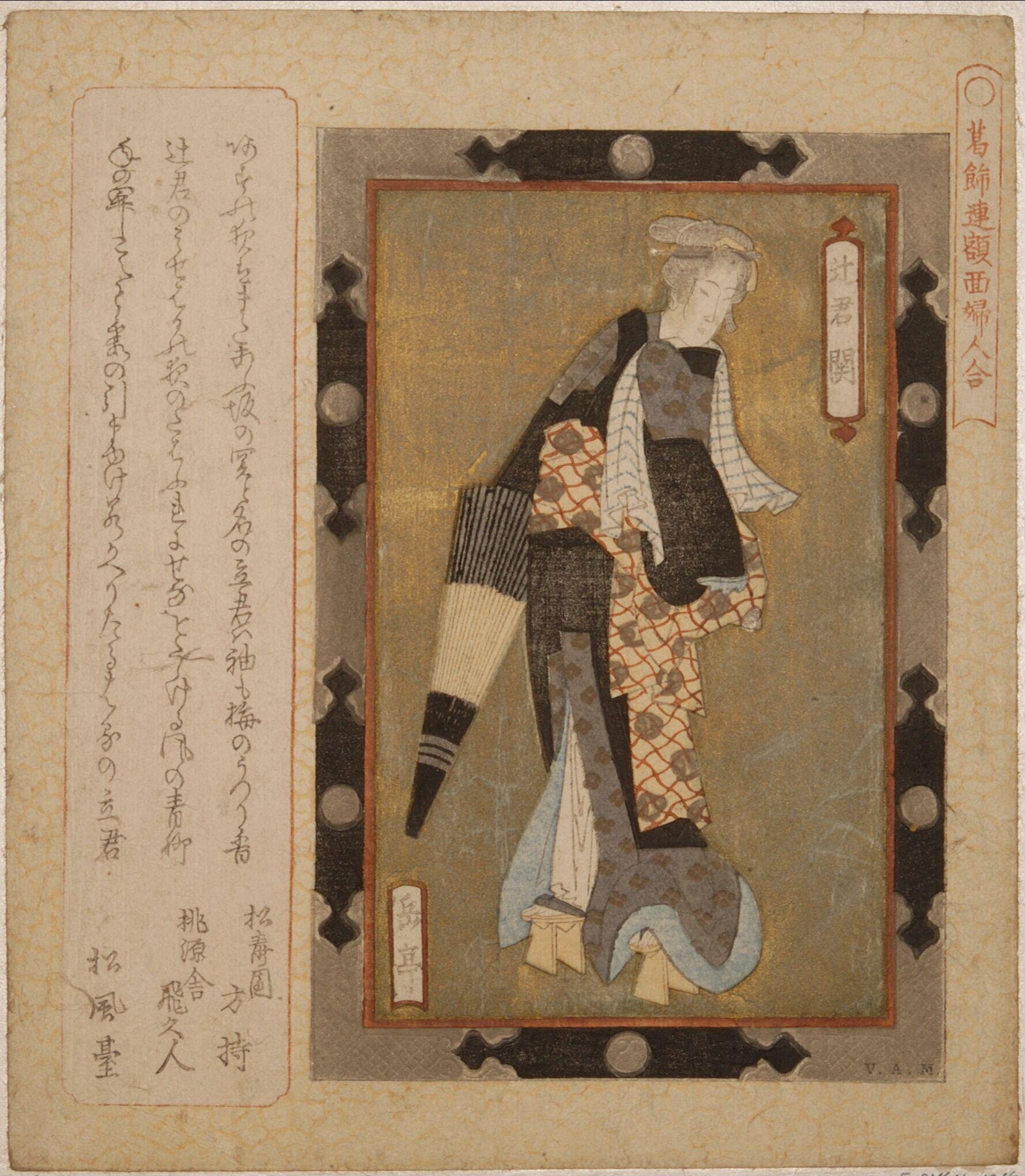
Kyoto: Courtesan of the Shimabara, from an untitled series of the three capitals
- Date:
- c. 1820s/30s
- Medium:
- Color woodblock print; shikishiban, surimono
- Source:
- Art Institute of Chicago
Description
Kyoto: Courtesan of the Shimabara comes from an untitled surimono series by Yashima Gakutei on the theme of Japan's three capitals, dated to around 1820 and now in the Art Institute of Chicago. Edo-period print culture regularly grouped the country into its three great urban centers - Kyoto, Osaka, and Edo - and series like this one let poetry circles compare them through their licensed pleasure quarters, their famous places, or their characteristic types. In this sheet Kyoto is embodied by a courtesan of the Shimabara, the licensed quarter that retained an air of older imperial refinement quite distinct from the more raucous Yoshiwara in Edo. Gakutei, working within the Hokusai school under Katsushika Hokusai, shapes the figure with the elongated elegance characteristic of late surimono bijin design, dressing her in patterned robes that the print's blind embossing and burnished metallic pigments would have made tactile in the hand. The kyoka verses that would have surrounded the image in its original sheet form would have played on Kyoto's reputation for refined diction and classical reference, juxtaposing it with the Edo voice of the poetry circle's members. As a privately commissioned surimono by Yashima Gakutei, the print exemplifies how kyoka-e used regional comparison to flatter the audience for which it was made while building each sheet around a single resonant figure.
More Prints by Yashima Gakutei


Frequently Asked Questions
Kyoto: Courtesan of the Shimabara, from an untitled series of the three capitals was created by Yashima Gakutei (八島岳亭) in c. 1820s/30s.