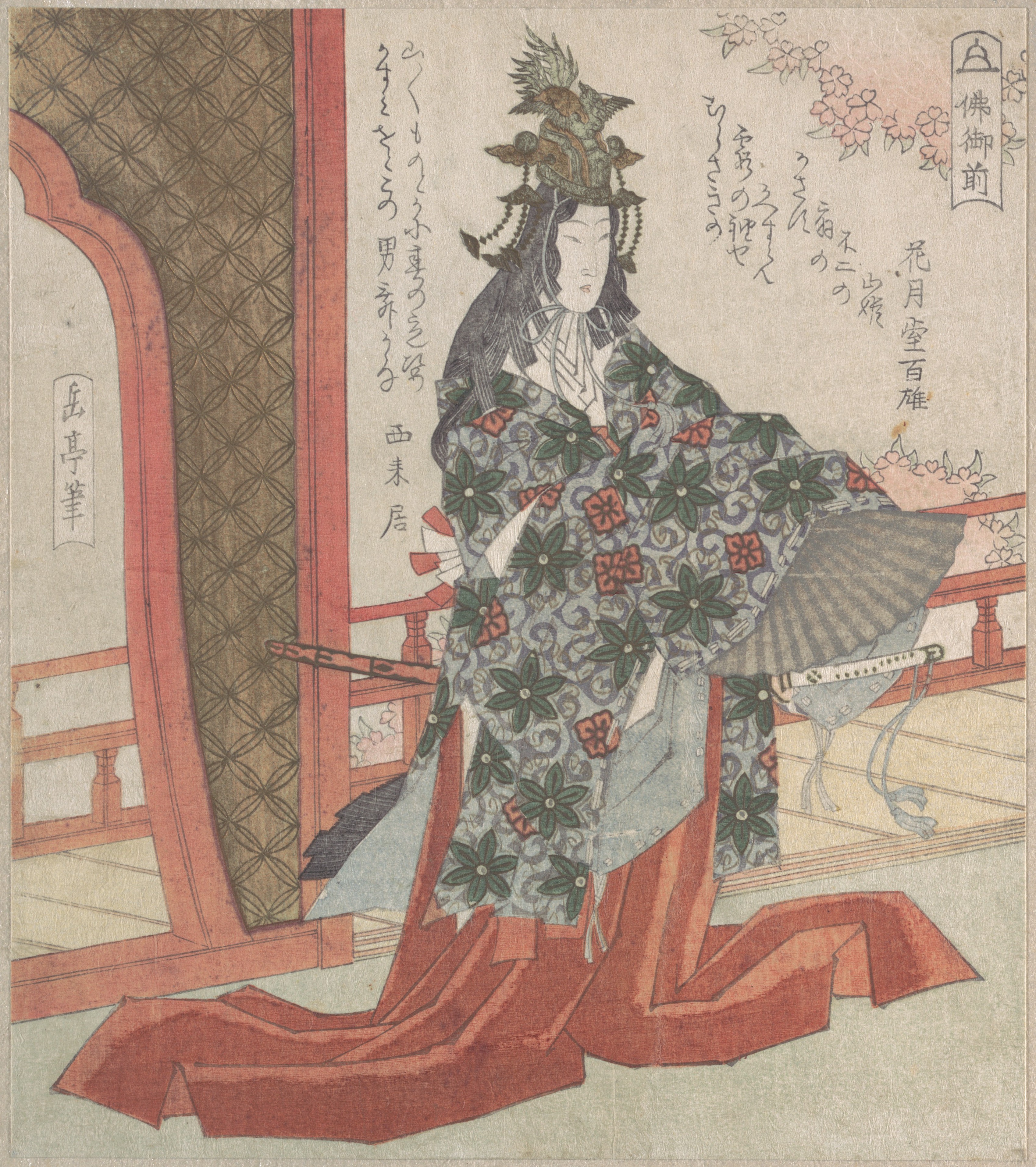
Lady Hotoke Dancing
- Date:
- 19th century
- Medium:
- Part of an album of woodblock prints (surimono); ink and color on paper
- Source:
- Metropolitan Museum of Art
Description
Lady Hotoke Dancing, by Yashima Gakutei, is held by the Metropolitan Museum of Art and depicts the legendary figure Hotoke Gozen, the shirabyoshi dancer immortalized in the Heike monogatari and the noh play Hotoke no Hara. According to the Heike, Hotoke was a celebrated dancer who briefly displaced Gio in the affections of Taira no Kiyomori, only to renounce the secular world and become a Buddhist nun alongside Gio and her family. The story became one of the great parables of impermanence, fame, and the path to enlightenment, and supplied print and theatrical designers with a recurrent female subject. Yashima Gakutei, trained in the Hokusai school under Katsushika Hokusai and active among the Edo and Osaka kyoka surimono workshops, brought to this literary heroine the Hokusai school's discipline of figural composition and the surimono format's technical luxury. The shirabyoshi costume of a man's hat, a sword at the hip, and a long-trained robe gave designers a distinctive sartorial vocabulary that distinguished Hotoke from other female subjects. Surimono printing techniques, including metallic pigments on accouterments, embossed accents in the textiles, and bokashi gradations of background, would have lent the design the tactile richness characteristic of the format. The accompanying kyoka verses, integral to surimono, would have linked the visual subject to a literary occasion, perhaps a meditation on impermanence or fame. The Metropolitan Museum's holdings of Gakutei's classical heroines provide an essential resource for studying how the Hokusai school engaged the Heike tradition within the privately distributed deluxe print idiom.
More Prints by Yashima Gakutei


Frequently Asked Questions
Lady Hotoke Dancing was created by Yashima Gakutei (八島岳亭) in 19th century.