
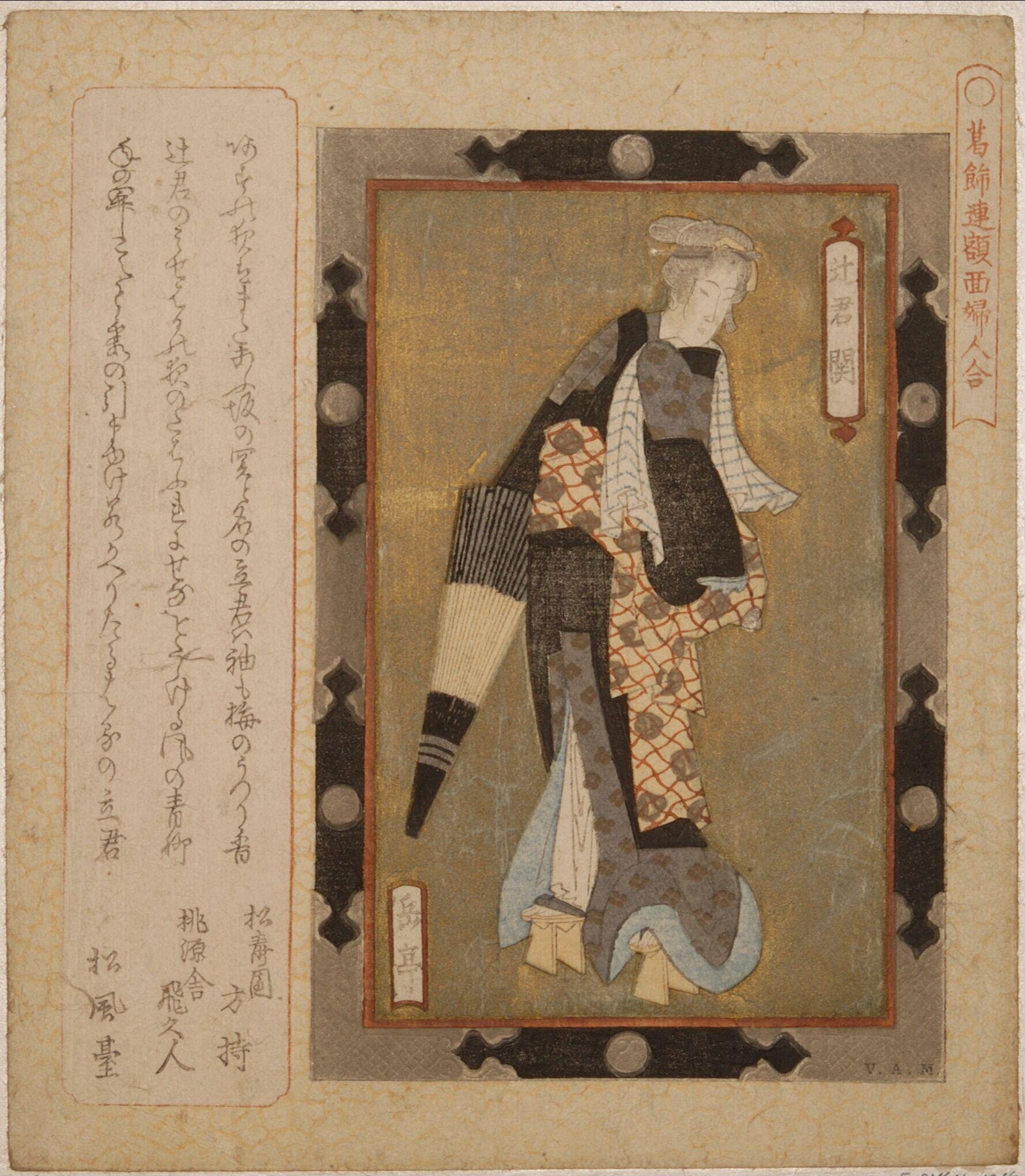
Lady with Fan Standing on Verandah
- Date:
- 19th century
- Medium:
- Woodblock print (surimono); ink and color on paper
- Source:
- Metropolitan Museum of Art
Description
Lady with Fan Standing on Verandah, by Yashima Gakutei, is held by the Metropolitan Museum of Art and exemplifies the intimate domestic scenes that Yashima Gakutei produced within the surimono idiom. As a designer trained in the Hokusai school under Katsushika Hokusai and active in the Edo and Osaka kyoka networks, Gakutei adapted the Hokusai school's interest in everyday life to the privately commissioned deluxe print format that defined his career. The lady, depicted on a verandah opening to a garden or a slope of roof tile, holds a folding or rigid fan, a perennial attribute that linked the image to summer, courtship, and refined leisure. The verandah setting, common in late Edo painting and printmaking, allowed designers to negotiate the boundary between interior and exterior, between architectural geometry and natural prospect. Surimono printing techniques, including bokashi gradations across the kimono and sky, embossed accents on the textiles, and metallic pigments where appropriate, would have lent the image the tactile richness that distinguished surimono from commercial bijin-ga. The accompanying kyoka verses, typical of the genre, would have linked the visual scene to a seasonal moment or a poetic conceit relevant to the commissioning club. The Hokusai school's discipline of figural composition organizes the woman's posture, the fall of her kimono, and the play of pattern across the textiles. The Metropolitan Museum's holdings of Gakutei's figural surimono provide essential comparanda for studying his bijin idiom within the broader culture of nineteenth-century deluxe printmaking.
More Prints by Yashima Gakutei


Frequently Asked Questions
Lady with Fan Standing on Verandah was created by Yashima Gakutei (八島岳亭) in 19th century.