
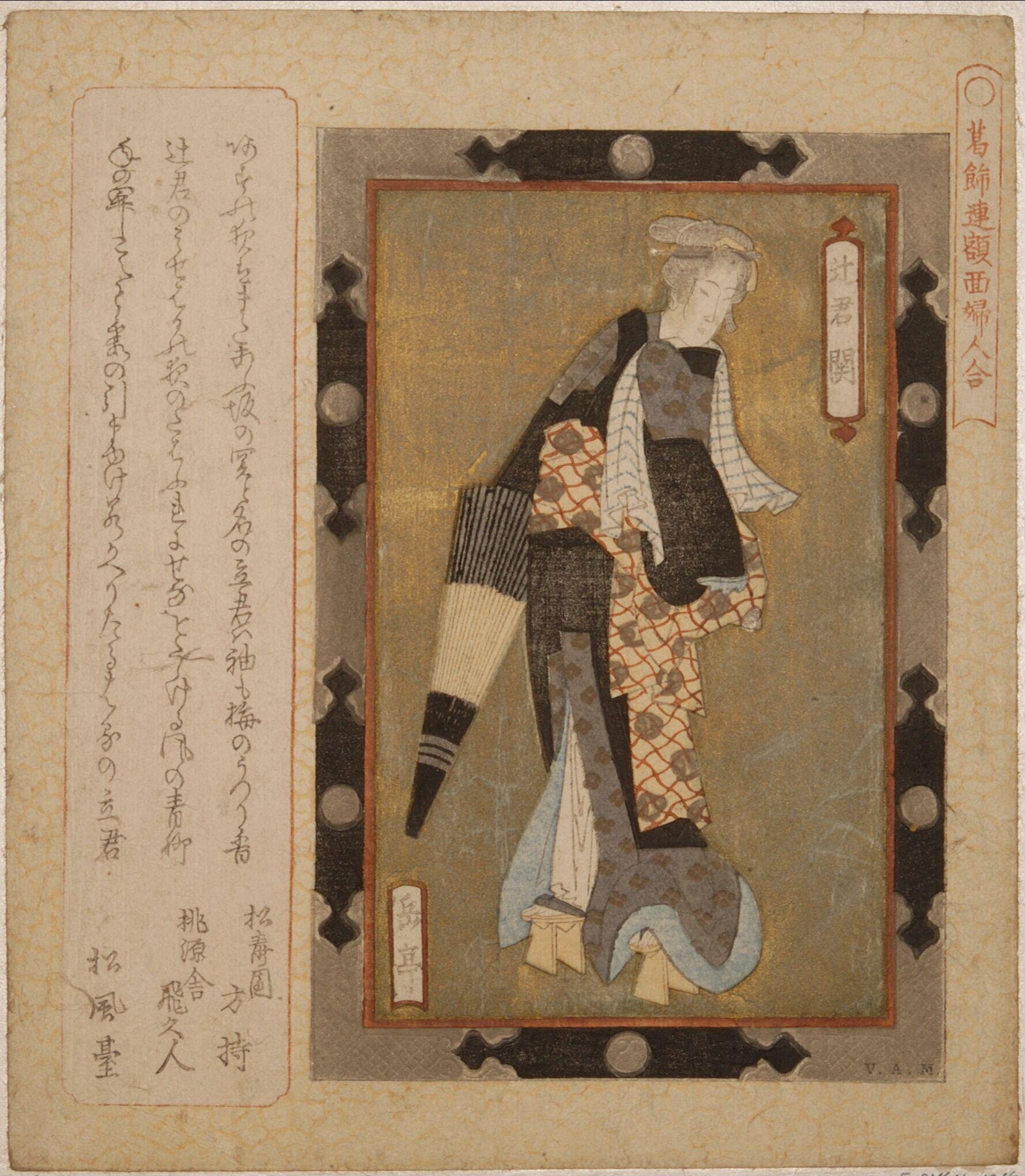
Liu Haichan (Gamma), from the series "Lives of Taoist Immortals Parodied by Courtesans - A Series of Seven (Keisei mitate ressenden, nanaban no uchi)"
- Date:
- c. 1821/22
- Medium:
- Color woodblock print; shikishiban, surimono
- Source:
- Art Institute of Chicago
Description
Liu Haichan (Gamma), from Yashima Gakutei's series Lives of Taoist Immortals Parodied by Courtesans - A Series of Seven (Keisei mitate ressenden, nanaban no uchi), is a 1826 surimono in the Art Institute of Chicago. The series is built on a classic surimono conceit: each of seven Taoist immortals from the Liexianzhuan tradition is paired with - or parodied by - a contemporary Yoshiwara courtesan. Liu Haichan, in Japanese Gamma, is the immortal associated with a three-legged toad which he is said to have lured from a well with a string of coins; he became a popular subject in East Asian painting as an emblem of wealth and supernatural mischief. By matching him with a courtesan, the series tightens the joke that ran through much of Edo mitate culture: the parallel between the immortals' detachment from worldly cares and the licensed quarter's own fantastical economy. Yashima Gakutei, working in the Hokusai school under Katsushika Hokusai, treats the figure with the supple line and refined palette that surimono required, while the kyoka verses printed alongside drew the comic comparison out. The print uses the deluxe surimono techniques characteristic of the genre - mineral pigments, karazuri embossing, and burnished metallic accents - to give the sheet the tactile presence that distinguished kyoka-e from commercial woodblock prints. As a Yashima Gakutei kyoka-e in the Hokusai school manner, Liu Haichan is one of the wittiest mitate of his career.
More Prints by Yashima Gakutei


Frequently Asked Questions
Liu Haichan (Gamma), from the series "Lives of Taoist Immortals Parodied by Courtesans - A Series of Seven (Keisei mitate ressenden, nanaban no uchi)" was created by Yashima Gakutei (八島岳亭) in c. 1821/22.