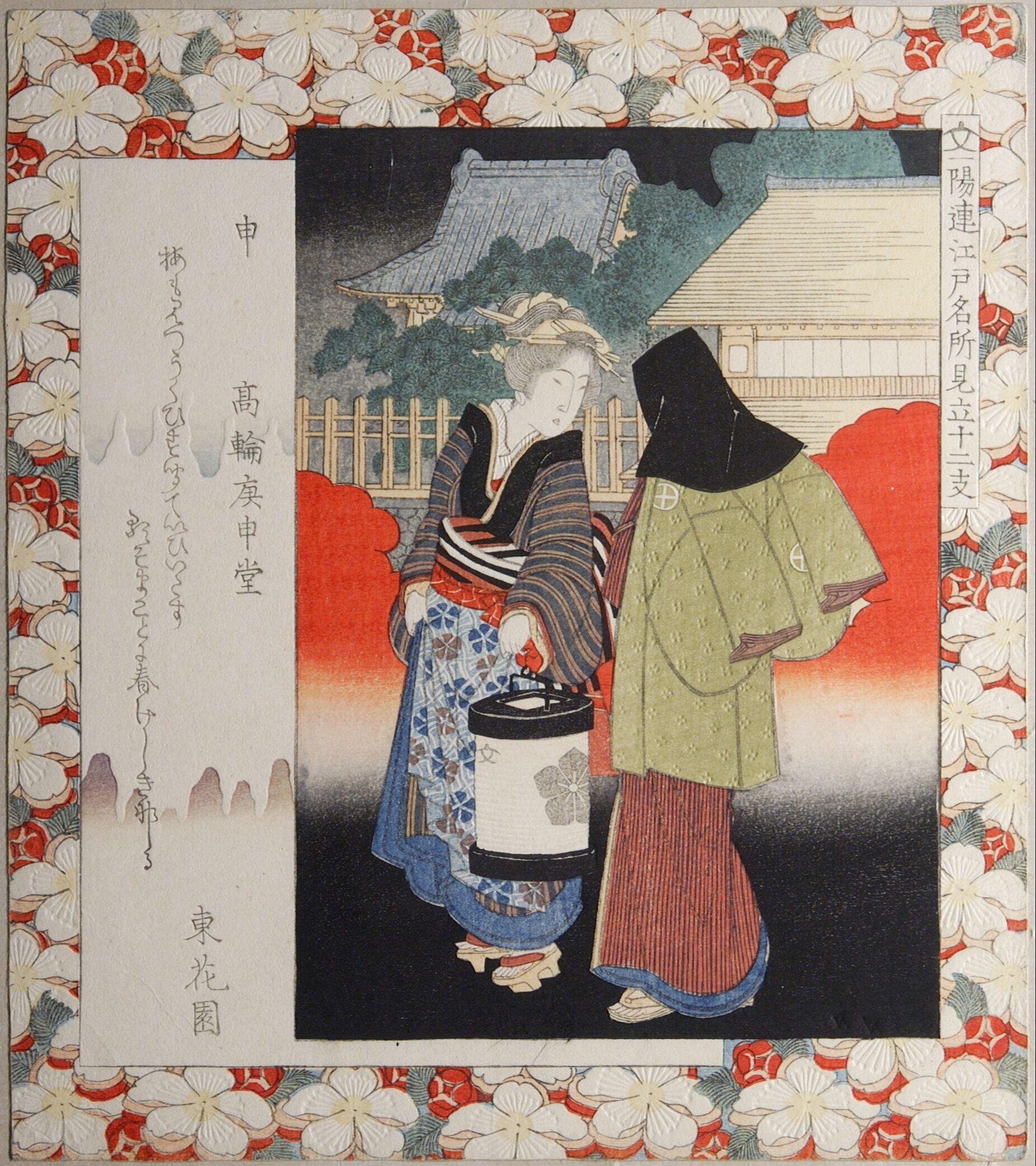
Monkey (Saru)
- Date:
- ca. 1826
- Medium:
- Source:
- Victoria and Albert Museum
Description
Yashima Gakutei designed Monkey (Saru) in 1826 as the ninth animal in his complete zodiac surimono cycle. The Victoria and Albert Museum preserves the print among Gakutei's calendar designs.
The monkey is rendered with the lively expressiveness that East Asian artists customarily reserved for the animal. Gakutei depicts the creature with attentive eyes, dexterous hands, and the slightly stooped posture of a Japanese macaque (nihonzaru). The reddened face and grayish-brown coat are achieved through careful overprinting, and the monkey may hold a peach, branch, or other attribute drawn from folkloric or Daoist tradition. The arrangement balances the animal's natural form with the symbolic resonance that monkeys carry across East Asian visual culture.
Gakutei trained in the Hokusai school under Totoya Hokkei, and Katsushika Hokusai's interest in monkeys, especially performing monkeys (saru-mawashi) and the legendary Sun Wukong, gave Hokusai school designers a rich vocabulary for treating the creature. Hokusai's sketches captured both the animal's anatomy and its anthropomorphic gestures, lessons that Gakutei inherits in this surimono. The Hokusai school's emphasis on firm contour and judicious color works particularly well for so expressive a creature.
Zodiac surimono were commissioned for the New Year of the corresponding animal, often by kyōka poetry clubs. The Saru print invited verses that played on the monkey's cleverness, its agricultural associations, or its mythic role as Sun Wukong, depending on the commissioning circle's predilections. The Victoria and Albert Museum's impression preserves the embossing, careful registration, and refined pigments that make this print a fine example of how Yashima Gakutei united Hokusai school design discipline with the surimono format's technical and intellectual ambitions.
More Prints by Yashima Gakutei


Frequently Asked Questions
Monkey (Saru) was created by Yashima Gakutei (八島岳亭) in ca. 1826.