
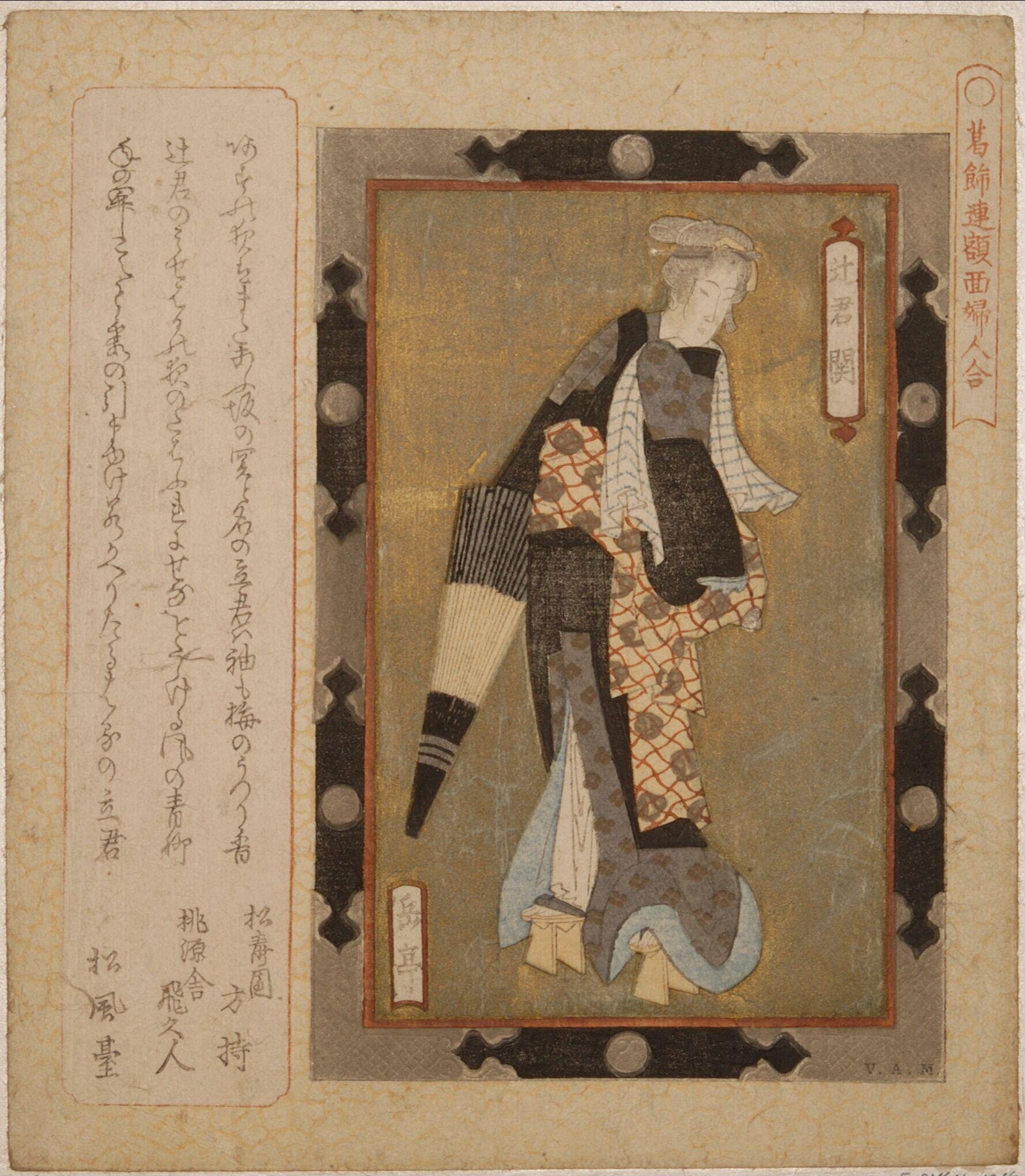
Nibu Hiroyoshi from the Veritable Records of Three Reigns (Nibu Hiroyoshi, Sandai jitsuroku), from the series "Twenty-four Japanese Paragons of Filial Piety for the Honcho Circle (Honchoren Honcho nijushiko)"
- Date:
- c. 1821
- Medium:
- Color woodblock print; shikishiban, surimono
- Source:
- Art Institute of Chicago
Description
This shikishiban surimono from the Honchoren Honcho nijushiko series depicts Nibu Hiroyoshi, an exemplar of filial piety drawn from the Sandai jitsuroku, the Veritable Records of Three Reigns, the early-Heian official history covering the reigns of Emperors Seiwa, Yozei, and Koko. Held by the Art Institute of Chicago and dated to around 1821, the print exemplifies the scholarly ambition of Gakutei's Honchoren commissions, which combed Japanese historical chronicles for native filial exemplars to replace the Chinese figures of the original Confucian Twenty-four Paragons. The Sandai jitsuroku is one of the Six National Histories of Japan, and drawing an exemplar from it lent the surimono series the prestige of official historiography while opening the textual source to kyoka commentary. Gakutei renders Hiroyoshi with restrained linear precision, reserving metallic pigments for costume accents and the surrounding ground, in a manner consistent with the rest of the series.
More Prints by Yashima Gakutei


Frequently Asked Questions
Nibu Hiroyoshi from the Veritable Records of Three Reigns (Nibu Hiroyoshi, Sandai jitsuroku), from the series "Twenty-four Japanese Paragons of Filial Piety for the Honcho Circle (Honchoren Honcho nijushiko)" was created by Yashima Gakutei (八島岳亭) in c. 1821.