
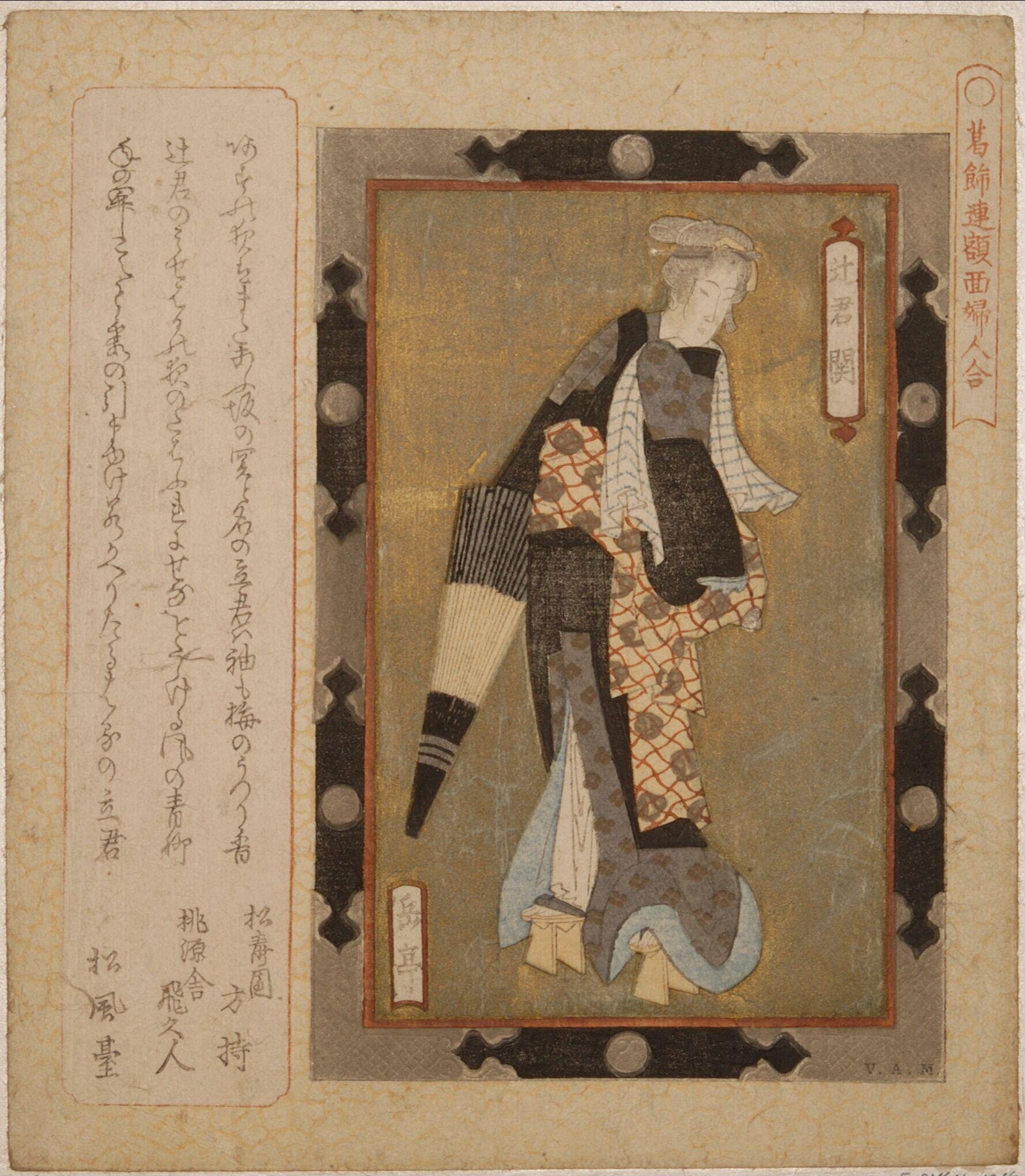
No. 2 (Sono ni), from the triptych "Three Musical Instruments (Sankyoku)"
- Date:
- c. 1825
- Medium:
- Color woodblock print; center sheet of shikishiban triptych (right sheet: 1928.1166), surimono
- Source:
- Art Institute of Chicago
Description
No. 2 (Sono ni) is the central sheet of a triptych surimono series titled Three Musical Instruments (Sankyoku) by Yashima Gakutei, dated to around 1820 and now in the Art Institute of Chicago. The sankyoku of the title refers to the classical ensemble of shamisen, koto, and kokyu or shakuhachi that defined a particular strand of refined Japanese chamber music in the Edo period, and Gakutei's triptych assigned each instrument its own sheet within a unified visual design. As privately commissioned surimono, the prints were paid for by a poetry circle and circulated in a small luxury edition, with kyoka verses printed beside the images so that the picture and poems formed a single composition. Gakutei was one of the most accomplished surimono designers of his generation, trained in the Hokusai school under Katsushika Hokusai, and his treatment of musical subjects characteristically balances figural grace against the geometry of the instrument itself. The middle sheet of a triptych carried a particular compositional burden, anchoring the whole set, and Gakutei's design likely registers that responsibility through symmetry and a calmer palette. Deluxe printing techniques - karazuri embossing of the kimono patterns and instrument cases, mineral pigments, burnished metallic powders - give the sheet a tactile richness in the hand. As a Yashima Gakutei kyoka-e in the Hokusai school manner, the print belongs to the most ambitious type of surimono of its decade.
More Prints by Yashima Gakutei


Frequently Asked Questions
No. 2 (Sono ni), from the triptych "Three Musical Instruments (Sankyoku)" was created by Yashima Gakutei (八島岳亭) in c. 1825.