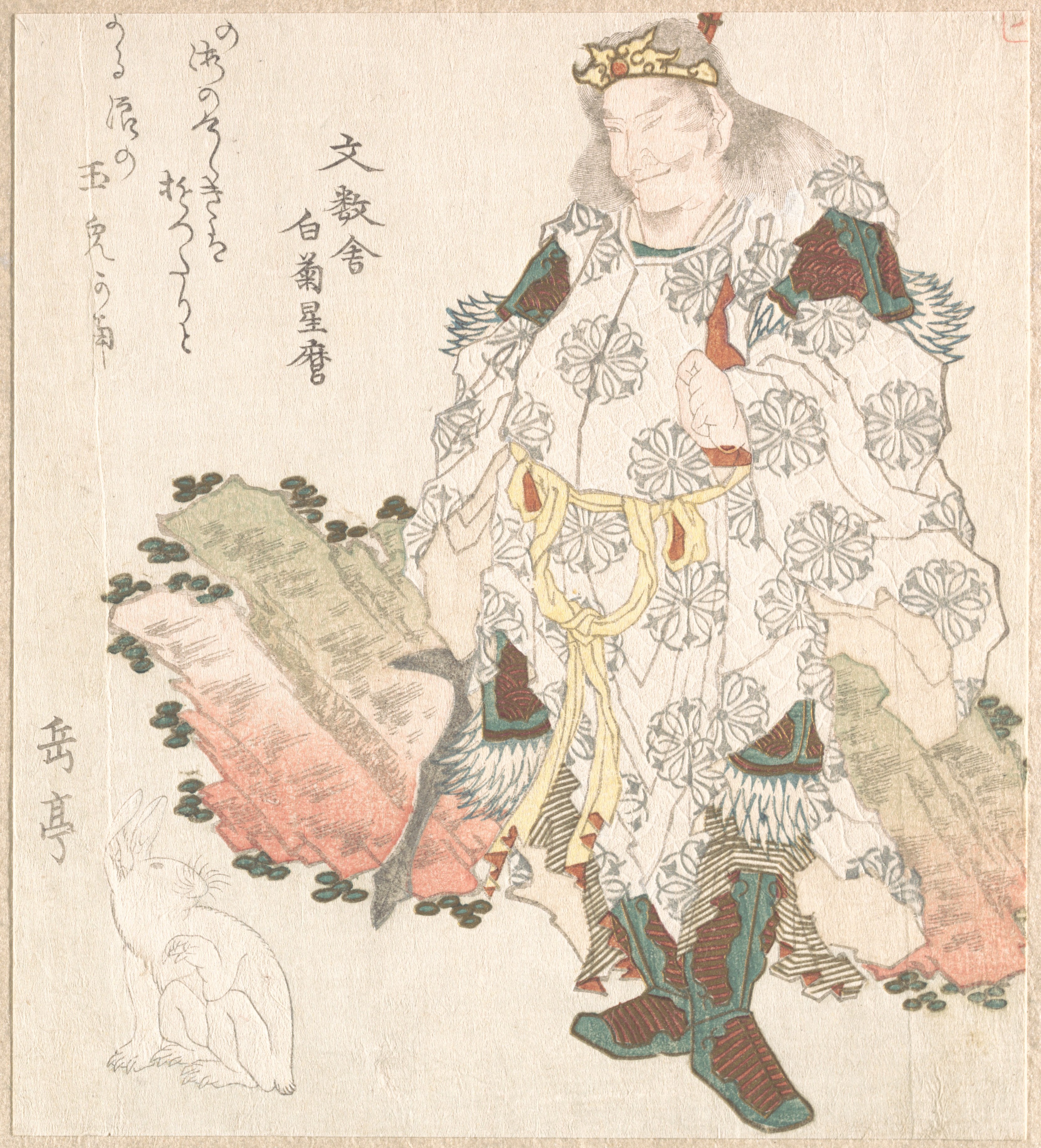
Prince Okuni (?) and a Hare
- Date:
- probably 1819
- Medium:
- Woodblock print (surimono); ink and color on paper
- Source:
- Metropolitan Museum of Art
Description
Prince Okuni (?) and a Hare, in the Metropolitan Museum of Art, is a Yashima Gakutei design tentatively associated with the legend of Okuninushi, one of the major deities of the Izumo region in Japanese mythology. The most famous episode involving Okuninushi tells of his compassion toward the White Hare of Inaba, whom he saves from cruelty by sea creatures and his unkind elder brothers, teaching the suffering hare how to heal itself. Gakutei's print pairs a noble youth with a hare, evoking that act of kindness and the broader theme of mercy toward animals that recurs in Japanese religious and literary tradition. As a designer trained in the Hokusai school, Yashima Gakutei worked closely with Totoya Hokkei and learned from Katsushika Hokusai. His engagement with mythological and literary subjects was wide-ranging, encompassing Chinese sages, Heian poets, and Japanese deities. The Met's catalog entry signals some uncertainty about the precise identification of the figure, which is itself a useful reminder of how surimono frequently relied on subtle, allusive references that contemporary kyoka audiences could parse but that may require careful interpretation today. Hares were familiar figures in Japanese visual culture, associated with the moon, with fertility, and with various folktales. Their compact form and expressive ears suited surimono compositions, where animals often served as foils to human figures. Premium materials and printing techniques used in surimono made designs like this both visually rich and physically refined. The Metropolitan Museum of Art's preservation of the print maintains Yashima Gakutei's engagement with native legend at the heart of the Hokusai school's diverse output.
More Prints by Yashima Gakutei


Frequently Asked Questions
Prince Okuni (?) and a Hare was created by Yashima Gakutei (八島岳亭) in probably 1819.